Showing posts with label methods. Show all posts

Friday, May 1, 2015

That Comfort in the Kitchen

Last Saturday I was in my kitchen, preparing lunch: beet wraps from this cookbook. (A version of the recipe using European measurement standards may be found here; translating it should not be difficult for American cooks and is worthwhile, if you don't want to buy the book. Which is a good and useful book, if, oh, just a little pretentious. Now, back to our story.) I've made the recipe a number of times before. It is not a small amount of trouble, because it has so many elements that must each be prepared individually - cook the quinoa, toast the walnuts, zest the orange, blitz the beets with the goat cheese (measuring all the while), grate the apple, slice the avocado. The resulting flavor combination is so unique, though, that I enjoy making it when I can manage to get all the ingredients together.

The prior week, I'd made a strange chilled borscht from this book, and I bought and boiled too many beets for the recipe. So I had some leftover cooked beets. I also had a whole package of unused herbed goat cheese from yet another recipe; I'd bought the right amount of bell peppers to roast, but twice as much goat cheese as I needed. This is how my kitchen often operates: I get the amounts wrong when I'm shopping, or I find when I'm on the point of making the dish that I should halve the recipe or we'll be eating weird borscht for weeks. This M.O. means that the following week I need to search my cookbooks or the internet for recipes that will use up last week's excesses. Never a dull evening.

I cannot read the caption on this and I badly want to

So I had leftover beets and leftover goat cheese, but they were in different proportions than the recipe called for. I also had herbed goat cheese instead of plain. Also also, I didn't have any walnuts, nor any raisins, so I was using pecans and just going without raisins. My common practice for cooking quinoa is to use half vegetable broth (or chicken broth, whatever's on hand) and half water to cook it in, because it makes the quinoa more flavorful. When the recommended cooking time is over, I turn off the heat, drape a doubled dishtowel over the pot, and put a lid on top. I let it sit for 10 to 15 minutes or until I need to serve. This is a trick I learned from a rice pilaf recipe years ago, and it keeps the quinoa from being either soggy or undercooked. The beet wrap recipe calls for cooking the quinoa in plain water with no after-steaming.

I was considering all these changes with amusement as I was grating the apple (half an apple, I've found, is plenty), and a lightbulb went on over my head so brightly that Matt noticed, from the living room, where he was occupied with something else. I stood perfectly still and let the light penetrate every brain cell it could, and then I noticed Matt noticing me.

"You okay, there?" he said.

"Yeah," I said. "I just figured something out."

"I can see that," he said.

Wednesday, April 22, 2015

Precision v. Grace, Classical v. Jazz (or The Great Oz Has Spoken)

Last week I sort of unintentionally reread some feedback a professor gave me about a year ago.
While this piece feels done, it’s felt done from the beginning, and done in a way that, as impressive as the writing is, feels like there’s a cap on, holding everything together deliberately and tightly. I know this is what most writers aspire to, at least for a while. And then there’s the next stage, which involves letting go of all that tight control to dig deeper, to burrow, to be surprised. I think I already said this, and if not, shame on me. But really, if you can write this well, Katharine, imagine how well you might write if you were really writing. And by that I mean working the language intransitively, not acting upon but acting – not writing about (the self), but writing (the self). You clearly have all the craft skills you need to stop thinking so clearly in meaning. 
This feedback confused me. Even after I achieved some distance and met with the professor, the way forward did not come clearer. (I still didn't understand it particularly well in rereading last week.) But I set it up in the back of my mind, kind of like a canvas backdrop, while I went on and wrote to the best of my ability.

I blogged last fall about how much despair ensued when another professor unknowingly echoed what the first one had said. The backdrop rippled a little, starting to appear more realistic and less like scenery, but I still didn't know what to do with it.

This blog post does not tidily conclude with me figuring it out.

Friday, September 21, 2012

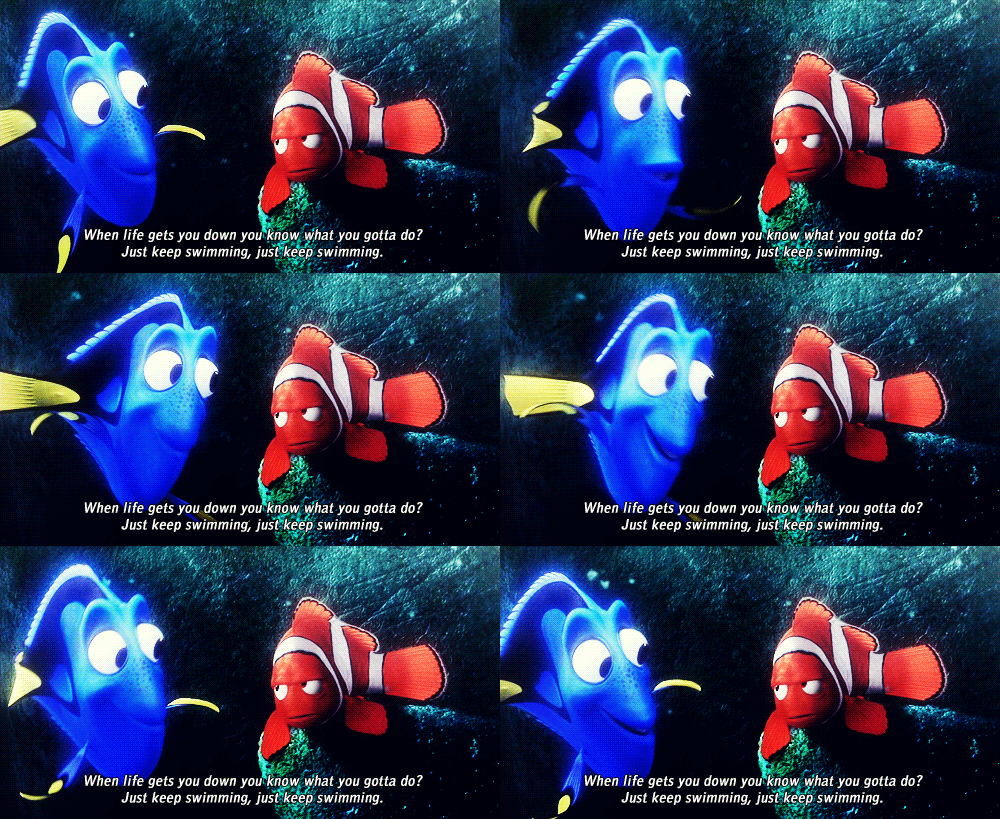
Just Keep Swimming

Many months ago, Matt drew my attention to a video of John Cleese giving a talk on creativity. Because I am not a very good wife, I didn't watch it until a few weeks ago. My excuse was that it was long - more than half an hour - and I'll grant you that's an okay excuse, but I should have watched it anyway. Because it's terrific.


Here is a transcript, if you prefer.

I'm going to guess that everyone who watches/reads this will walk away with a different feeling of what the best idea in it is. So I won't claim that what I got out of it is the most important thing in the video. But golly, it's been helpful in the recent past. In case you have no time to watch the whole thing and draw your own conclusions, here's what I'm talking about:
You know I mean, if we have a problem and we need to solve it, until we do, we feel (inside us) a kind of internal agitation, a tension, or an uncertainty that makes us just plain uncomfortable. And we want to get rid of that discomfort. So, in order to do so, we take a decision. Not because we're sure it's the best decision, but because taking it will make us feel better.

Well, the most creative people have learned to tolerate that discomfort for much longer. And so, just because they put in more pondering time, their solutions are more creative.
For me, these kinds of problems are what my characters are going to be like and what made them that way, what the insides of their apartments look like and what kind of clothes they wear, how I'm going to get from point A to point B in the plot without boring the reader or jumping too awkwardly. Solutions to problems both small and large.

Actually, I can give you an example of a problem where I haven't given up when the simple answer arrived. In my KUFC book, the antagonist group has put together an energy initiative which causes serious harm to my main character and her people. This is in an alternate-history U.S., in the 1940s, and it's a project that is extremely harmful to the earth but on which the antagonist group has put a positive spin, claiming it creates natural, sustainable energy for the general populace. I thought for ages trying to come up with a name for this project. The name had to be slick and memorable, had to indicate both benignity and corporatism, and had to be a word that would eventually make my main character shudder at its very thought. And the only word I could come up with, after thinking and thinking, was Greenpeace. Which is a word that, as most of us know, already exists and has its own connotations and that I can't possibly use.

I argued to myself that I could use it, that it would be a sly wink to the real 21st-century reader, would be yet another clue (as if the reader needs one at the juncture of the book where the project appears) that this was an alternate timeline. I almost convinced myself - but no. It's not the right word. I have to find another one. I'm still sitting solutionless under this problem, BUT, thanks to John Cleese, I'm not afraid of the discomfort of not having that solution yet. I'm using Greenpeace in my notes for the time being, until I come up with the right word, but I'm determined that there'll be another solution coming along sometime in the future. Because this is a shoddy solution and it won't do.

There's a way in which this instinct toward pushing on through discomfort to find the Right solution - not just the convenient one - ties in to perfectionism, which makes me, a recovering perfectionist, very uncomfortable. It's the same little voice, saying keep going because that's not a good enough solution, that dogged me and paralyzed me with not good enough not good enough not good enough for so many years. I don't want to venture into dividing perfectionism into good and bad, because I really couldn't say without bias, but I think driving on with intention toward the best solution is a different thing than failing to start because you can't achieve the ideal solution.

In the past week, I've started to believe keep going is really the only thing that works. It's certainly how I got through the hardest times in my life, and it's simple and catchy enough to sit in my brain without meanness and motivate me. It's how I wrote 2,000 words last night that I trust. Hard to argue with results like that.

Monday, September 17, 2012

Which Reminds Me of a Story

Over Tuesday and Wednesday of last week, I wrote a long story, nearly 10,000 words, that fits together some ideas I've been percolating for months or years. Something central and sad that I've noticed about the world and how we behave in it. A story idea I'd had for so long that I'd gotten impatient with myself about having not written it. Smaller observations and ideas, all important to me and nagging from my notes books to be written, that somehow hooked together as I wrote.

I also tore down the wall between fiction and specifics of my own experience, putting my own childhood dresser into my narrator's bedroom and my own opinion of FJ Cruisers into a character's brain. I've always tried to skirt doing this, because I don't want people making assumptions about what's in my head due to what's in my fiction, but it becomes an elaborate problem to be inspired by my own life but to try really hard to disguise it, more tiring than the main issue of writing the story. So I gave up on striking the right balance and just wrote what was there.

I wrote. And wrote. And wrote. I spent about seven hours on the story on Wednesday (after putting in a workday). And I knew there was a good 2,000 words of it that wouldn't stay, that even as I was writing I knew were the wrong words. Probably I'll have to do a lot more difficult work on it. But I think I've really got something here. It's the first time in yonks - if I'm honest, the first time I remember since 2003 - that I've written something setting forth a clear intellectual idea in which I believe. (As opposed to a story idea, that is.)

I fooled with it a bit on Thursday, cutting out a bunch and rewriting a bunch. Trying and failing to sit back in my chair and look at it objectively; hoping before I went to sleep at night that I hadn't been too much influenced by the Wallace stories I've been reading over the last two weeks. I'm going to give it at least a week, preferably two, before I look at it again.

Part of the reason this story feels so different (and it feels like a total sea change) from what I've been writing in the last two or ten years is that, thanks to the Wallace stories, I stopped thinking about standard technique. I watched a video of him reading from A Supposedly Fun Thing I'll Never Do Again and discovered that the "And but so"-and-similar tic that he uses at the beginning of many sentences sort of runs together into a mush of connective words when it comes out of his mouth. I'd read it as the same disguised formalism that earmarks most of his work, but having now heard it, I wonder if all along he's just imagined he's telling us these stories. As a bard in the king's court.

Hence I gave some thought to how I talk to people, and how I write on this blog, and I realized that I like to give illustrative examples before (and while) I explain how I feel or think about something. (I simultaneously realized that it's probably sort of a bore to talk to me.) This illuminates the manuscript for me - makes it easier to get my point across and adds verity to whatever point it may be. I wondered how this would translate in fiction writing, because I don't do it in fiction writing, and part of the answer is that it translates to a lot of what seems like digressions but are very much not, which for me make a piece of fiction richer (and I know for some people make it obnoxious to read). Another part of the answer is that it feels like exactly how I should have been writing short stories all along.

When I wrote this story, I tried to do two things. I wrote with the central intellectual idea firmly in mind with every single word, with the idea never once leaving my head for any single sentence. And I tried to write it the way I'd tell if it I was one of the characters. I.e. event X happened today, but event X only mattered to me and felt Y way to me because of event Z two weeks ago. And of course I made the effort to hide X and Y and Z in showing, not telling, and the showing came in the form of digressional examples. Which is why the story was almost 10,000 words in its first draft, because there are four stories leaved together and numerous digressions to show and show and show.

Instead of worrying about Omit Needless Words, I just wrote, in the voice I felt suited the character, in the style that felt like a loose pair of jeans, with a great deal of lovely crazy English. Instead of chewing my nails about not being good enough to forget the ever-clanking mechanics that turn today's wheezing literary market, I just wrote, thinking (when I thought about it) that eventually, maybe today or maybe five years from now or maybe twenty years from now, I'd write well enough to find an audience. Instead of nervously donning white gloves and treating this story as the next piece of copper I'd have to shine to perfection, I just wrote. And since I haven't reread this thing yet, I could be wrong, but I'm starting to wonder if (with at least a half-full toolbox, which I think I've got) this is how to do it.

Overintellectualizing is not new to me. And I've wondered kind of faintly whether it's what I've been doing since 2006 or so. But I got it in my head that writing was supposed to be meticulous and difficult and miserable if you were doing it right, and that doing it the way it felt right was going to lead to sloppiness and ignominy and cries from the audience that you didn't know what you were doing. I think it's somewhere in between: after you get the toolbox and get your head right, it's supposed to feel good.

Like sex, come to think of it. But I won't get into that today. 

Thursday, September 13, 2012

They Simply Dig

My friend Dave, who is a visual artist and much, much wiser about the creative process than I am, posted a video of Louis CK talking a bit about his creative maturation on my Facebook wall a couple of weeks ago. I think I had previously conflated Louis CK with some vulgar-for-the-sake-of-vulgar comedian I don't like, or maybe I had just seen an act of his that was over the line for me, but anyway I had him in my head as a person whose work I had little interest in. He's started to get a lot more attention among my circles in the last few years, but I never investigated. And I waited a day or so before I watched this video. Don't make the same mistake I did; watch this now. I know it's 10 minutes long, but watch it.


After I saw this, I knew I had to blog about it. Because this is a central worry for me, that at some point I'll have used up all my ideas and be left with nothing. So I keep believing in trunk stories, fiddling with them and polishing them and sending them out, instead of writing new stories.

This is wrong. This is the complete wrong thing to do. The only way to do work is to do reams of it, to write and perform an entirely new comedy special every year, to dig deeper and deeper and deeper until you're sure there's nothing left. That's when you find your best stuff, the stuff that distinguishes you from the eight zillion other comedians out there, and that's when you go forward.

I know exactly how lost and resentful and terrified Louis CK felt when faced with Carlin's process. The old stuff, the fifteen-year-old jokes, it all feels so valuable. I clutch the old stories to me with sheer panic at the idea that they're disposable. They felt like the best I can do, and how can I just throw out the best of me?

But creative work has to be disposable for it to get better, and the best I can do is way, way ahead of me. That's the lesson I'm assembling this year. Even if it's a lesson some of you reading this learned long ago, and you think me very silly and creatively immature for just getting it now, you've got to be patient and understand that it's a total head-spinning epiphany for me. I have to trash everything before I can unearth what I really have to say. There's a reason Louis CK just kept getting bigger and bigger - he was getting better and better, along with doing his own stuff more and more strongly instead of jokes that could be anybody's jokes.

And the thing I've been repeating like a mantra, as if I can make myself believe it if I repeat it enough times, is that you can't use up all your ideas. That human life is so rich and so wide that even if I thought I'd put everything I had into one story, I can put everything I have into another story I write next year and it'll be completely different. And not only that, you can still mine the same thing in innumerable ways. Tiny Beautiful Things, heck, Strayed's entire career, is proof of that. Very little that she's written has not looped back to her mother somehow, and yet it's all worth reading.

Those trunk stories? Sure, they've been polished to a high shine, but they're only copper. The gold is still ahead. That's what you get when you dig deeper.

Tuesday, July 10, 2012

Painting Within a Tended Field

It frustrates me how easily I give myself over to Yes This Is The Answer. When I find a solution for something, even if there's no chance it's sustainable, I tend to be all I AM THE MASTER OF THE UNIVERSE I FOUND THE ANSWER HUZZAH!!, and then I feel very foolish when whatever it is falls apart upon use in the long term.

Lemme splain.

Remember how I talked about hating to outline? All that still holds true. But there's a lot to keep track of in the KUFC book, a sort of A plot/B plot construction (global plot, personal plot) and some other people's plots that have their own arcs even while our heroine is blissfully ignorant of them. Plus the unfamiliar universe, plus a number of odd characters, plus a backstory, plus being certain that I'm self-styling instead of just plunking the prose on a sentence-by-sentence basis. (Sidebar: the Greenland novel was even more complicated than this, and I think if I'd had an outline, it wouldn't have turned out such a damn mess. For revision, if I ever fucking revise that book, I plan to create an outline and edit it, and then edit the book.) So but for this book I thought I'd do what I usually do and make copious notes in a pretty journal to the side of my desk. That wasn't enough, it turned out, because after I'd written my prologue, after writing pages of notes about the universe, and even after a few hundred words of Chapter One, I still didn't know what happened next.

So I wrote Chapter One on a new page of my notebook and scribbled what I already knew about it: I was going to open with action, with my heroine freerunning, doing what she calls her night work. I thought that was all I knew about it, but then I wrote down what I needed to establish about her, and what I thought was likely to happen to her in order to establish this stuff. Suddenly, more ideas were flowing: little details about the universe, character names and traits, something essential and very interesting about her background that reshapes things a bit. None of this amounted to what anyone would call an outline, because it was just notes and the majority of it stretched way beyond the first chapter, but it gave me a grounding for what I was going to write, which meant that I had a more structured and yet somehow more innovative first chapter when I got down to business on it.

Very stupidly, I presumed that this little bit of outlining had created momentum that would sustain me into Chapter Two. Which it did not. I wrote about a third of Two before I had to stop and go back to the notebook, and scribble through what was going to happen next and why. Then I came up with even more ideas: ways that her personal life was tied in to some of the intrigue of the book, characters who were going to appear sooner rather than later, other characters who weren't going to show up until later and the devices that were going to drag them back into her life. Before even writing it, I fixed what would have been a major mistake: drawing the A plot into the heroine's story too soon.

Everything feels much more orderly. I don't feel restrained, as if I'm doing the prose version of this:

Wait! I know! It's a giraffe! 
But more like I'm running around in a field that has been carefully bordered and mown. Tended, sure, but not unnaturally limited. Plus, I can always jump the fence. While writing Chapter One, I shifted gears to create a character who hadn't been part of my plan, and she's going to be useful.

The work I've ended up with is so superior to what I could have written, with so many more little cables wiring itself to the rest of the book, that I feel...just...grateful, and wholly stupid for not doing this with other projects before now.

I know I'm going against the advice of absolutely every writer I've ever heard of (and surely thousands I haven't), but writing every day doesn't seem to work out for me unless I'm a) short-storying or b) barreling headlong toward the end of a project. Everyday writing on a novel makes me feel resentful of and bored by the work instead of fascinated by it. I feel like I've got all the stuff of my life in the evening (dinner, Matt, movies, relaxing) on one side of a seesaw and writing on the other, and it seems unfair that writing is always heavier. Thus far on this book I've been writing every other day (sometimes with an extra off day in between), and the work has seemed much fresher for it. Sometimes I'll sit down with my notebook on the off day, and sometimes I'll do the notebook thing before writing that evening.

(This all sounds a lot more orderly than it is; a routine has still not been established. Yesterday I spent all morning at errands and didn't get to my job until 2:30, which meant that there really was no evening, just a shower and some Skyrim-watching and bed. Today I'm dawdling in the morning and I don't know if I'll get to anything but dinner at night, although I do hope it's a writing night.)

THE POINT IS, to make this into a Solution, the idea that outlineish note-taking in my notebook is the way that I'll write from now unto death, is wildly premature. And yet I'm thinking Yeeees, This Is The Answer. This is how I outline. See? Problem solved. Now I can be a writer.

It's so exasperating to do this, because I'll trumpet and crow about whatever solution I've just come up with, be very self-satisfied, and then find that this method doesn't work at all for the next project or the next stage of life. Back in my early 20s, I thought the way I wrote was to write completely nonstop for a few weeks, eating, sleeping, breathing the work, and then at the end of it I'd have a novella. That notion was born partially of being in my early 20s and having fewer other responsibilities, and partially of the creative machine being a very different thing then than it is now. A few years ago, it was trudge and slog and write through the pain, and I thought that was effective. (That might have been delusion rather than changing circumstances.) Now it's this notebook/every other day thing. And I'm sure in a few years it'll change again.

It's just like my job-hopping. It gets embarrassing telling your family members at Thanksgiving that you have a different job than you had last Christmas. Again. And telling them that no, you still haven't had any more stories published. Yes, you've changed your method of writing for the 18th time, but you're sure this time you're really on the trolley and nothing will ever change again, so when you're asked about it next year, you'll be able to say yep, that's still the way I do it, I'm confident and secure and totally not a wishy-washy idiot.

Um. Got a little sidetracked there. But I stand by it: I do feel like a wishy-washy idiot sharing these methods and then being like no, I had to tear down that building and build another one four inches away from the first one. It cost me hundreds of thousands of dollars in the currency of personal pride, but it'll definitely be worth it. After all, I've written seven thousand whole words now! Totally worth it.

In unrelated news, I thought we had black-chinned hummingbirds, and then I thought they were Anna's hummingbirds, and now I seriously don't know. Half the hummingbirds native to this area seem to have greenish backs and red throats and dark heads, as these do. Whatever; they're full of pep, and I love watching them. When I'm actually on the patio, in my reading chair, I can hear them going ttttthhhhhhhhrrrrrrrRRRR as they zip by.