Showing posts with label working. Show all posts

Sunday, October 11, 2020

Retail Feet

I haven't written anything other than book reviews, emails, and tweets in three months, and the reason is my day job working with horses. I cannot adequately communicate how hard I have pushed my body in these months. I feel as if I've used every single cell, from scalp to marrow, to work and sweat and breathe and then work some more. 

The physical burden of these months has reminded me of the job I hated the most of any I ever had, selling women's clothes at the mall. I used to cry at night because my feet hurt so much. I cried when I cleaned the dressing room mirrors in the morning, feeling so trapped and aimless in the recycled mall air. I was miserable beyond belief, and part of the reason was that my body was not built for the job. I asked my coworkers what they did about their feet hurting, and they just shrugged. I asked if it drove them as crazy as it drove me that the music tape repeated every 2 1/2 hours, that we heard the same songs in the same order every single day for months, and their answer was along the lines of "what tape?" 

Both these answers boggled me. Hot vines of pain wrapped around my feet by the end of an eight-hour shift; I thought I'd rip the speakers out of the ceiling and hammer them to pieces if I heard "The First Cut Is the Deepest" one more goddamn time. (To this day I shudder when I hear one of the songs from that tape.) The other people in my life at the time mostly worked retail too, and my complaints puzzled them. "Complaints" doesn't really cover it; working retail crushed my spirit, melodramatic as it might sound. Everyone else was like, well, yeah, it's retail. It was like pointing out the brimstone and the demons burning you on the ass with pokers and hearing, well, yeah, it's hell. Get over it. 

My best explanation for this is that I'm not built for retail. It takes a specific constitution to withstand retail: physically, you need the feet for it, and mentally, you need a kind of psychological reef on which repetitive behavior can break without breaking you. I don't have retail feet, and I don't have a retail mind. What I find absurd (Kafka-type absurd, almost-funny-but-horrible) about this is that out there in the world, retail is considered a low bar. Anybody can get a job at the mall. But coping with that job is, for some people, a labor that will destroy them, while others can just shrug indifferently. 

Mine is not the hardest job at the barn. The guys who muck and feed work a lot harder than I do. I feel ashamed that I can't do as much as they can. But I don't have retail feet. When I get home I have to rest, aggressively. It's embarrassing that I can't bounce back, have to treat myself with Epsom salts and excessive couch time, but it's how my body is built. I had to accept it back in my excruciating days at the mall, humiliating as it was when everyone around me met the demands of retail without a flinch, and I have to accept it now. 

Because of owner vacations and COVID, my workload was much heavier across August and September than it was for the first seven months of the year - right at the time when the weather is the most demanding. This summer I've done nine-hour days, walking 10 miles and climbing 500 vertical feet and lifting one 20-lb saddle after another onto the backs of moving 1200-lb animals, in 95F heat. And then went back and did it again the next day. Which means that my rest periods have extended to almost all the days I don't work. Which means that I haven't written anything. 

Since my job as a writer is largely about thinking, the almost-year of this job has been overall good for me. It seemed at first like working at the barn half the week, totally out of my head and into my body, and then working at my computer the other half, totally out of my body and into my head, would be a perfect life. 

But I don't have retail feet. 


Although I haven't produced much of anything new (and I miss it, and I want to, and I'm a literal year behind on finishing just a single essay, and I really want to start a new long project, really bad), I've continued to submit old stuff. That has led to a pretty significant publication coming at the end of this month, God willing. 

Also, a hybrid essay I wrote in I think the first class I took with Higgs, or maybe the second, got published in Wig-Wag. It was rejected twenty-three times before Brad Efford accepted it and then blessed me further by wanting to make very few edits. Now that it's in the world, some of the smartest people I know are telling me it's incredible. I want to be humble about this, but the truth is I know it's incredible. I know that every sentence in it is deliberate, that its threaded-together layers of meaning make it hard to parse but worth the trouble, that it was rejected so often because editors didn't get what it was doing or because their publications weren't daring enough for it. I included a slew of obscure, flashing references to critical theory and a comment on Fred Astaire's hands that the reader won't get unless she already knows the story; deal with it. I don't care that the Sun would never publish an essay like this because it's too weird, too disjointed, too up its own ass; it found the right market, and it's finding an audience (a small but excellent one) because I wrote it exactly the way I wanted to and withstood the consequent rejections. 

If you're a creator, I'm not going to urge you to do the same, because it's not any fun to write and [attempt to] publish this way. But "Bright White American Smile"* is writing only I can do, and I feel wonderfully content with that. 

*This is the title I chose for the essay, but Wig-Wag's format means it didn't appear that way. 

Its publication means I need to update my website, like really bad, and assemble a newsletter to go out when the end-of-month publication happens, if it happens. I've been putting these tasks off for MONTHS. Partly, you know, retail feet; I've been really goddamn tired. But also ugh. I have to figure out what book reviews have appeared since I last updated (March?) and link them all, and then try to fix some of the buggy pages since the last Wordpress update, and then redo my Favorites page and also the home page since it's all **Ceremonials Is Just Now Out in the World!** which is no longer true, and blaaaaah. Website work is usually satisfying to me, but I've put it off so long that it's turned into a regular old chore. 

Other stuff going on: I watched Lost across the last few weeks. I really liked the character work and the wide-open imagination, but I was annoyed as fuck at the dropped threads and hand-waving. I'm left thinking about how men act when they're hit by the thunderbolt, how they move the earth for the women they love, in the same way I've given long thought to male regret. Both ideas underlie a lot of art by men (...all of it???), but they aren't often on the surface. 

I hit the six-month wall, and so did Matt, but it's breaking. I've been cross-stitching in a frenzy, and I made this (pen for scale): 


I'll be participating in a virtual reading through Vroman's on October 26. It's a reschedule of the triple-play ghost-girl-books reading that Gayle, Jennifer, and I originally put together for April. I hope you can come, but if you don't even want to, truly, I understand. I think I've been to one virtual reading in six months. 

Tuesday, February 6, 2018

Interference/Interaction

First (click to embiggen):

What I hope is the first of many yoga/writing workshops I will teach with the amazing Alicia Easter. Get in touch if you're in LA and you want to come. I'd love to see you. Facebook event is here.

I'm writing this post to warm up toward writing a review I don't really want to do. The book has been getting praise from all kinds of reliable sources, and the audience for the outlet I pitched fits the book like Legos locking together. But I'm dubious about the book. I'm not sure whether what it says is worth saying. I'm not sure why the narrator is worth rooting for; not that likability is necessary, but there has to be something redeeming or at least positive about a narrating character and I'm not sure that's the case here.

This morning I quit a book I was reading for review after 50 pages. I feel super guilty, because I made a bit of a fuss about getting the book and I had a great idea for a venue that would pay me for a review, but it's an even worse fit for me than the book in the prior paragraph. It's almost Victorian in its explanatory quality, in the plainness of its style, and I kept wanting to pick up a red pen and slash through whole paragraphs.

I didn't think I could afford to be picky at this stage of my work, but walking through mud sucks.

It's okay. The stack of books I have to read/review is still 10+ tall (including commissioned reviews, the existence of which in my wee life is slightly beyond belief to me). I haven't asked for any new ARCs in some weeks because of the backlog, and because I can't keep this up; the stack of non-review books I want to read is now alarming and I really want several weeks to hole up and read for fun instead. I can't keep reviewing at the rate I have been and still continue to enjoy reading. I don't know how this conflict is going to settle out, but that is how my life has been going for the past few weeks: in a pickle and not knowing how to dill.

My new obsession is the small press The Operating System, from which I bought a quartet of chapbooks after reading the wonderful book The Science of Things Familiar by Johnny Damm. The chapbooks are terrific, small and well-made, experimental and heartfelt.

Other parts of my life are interfering with writing, or possibly writing is interfering with other parts of my life and the other parts are retaliating dramatically. 2018 did not begin well, personally. The huge Tarot spread I did on New Year's Day tells me better things are ahead in February, but I'm unsure whether I'm supposed to be taking action or not. This is why trusting stuff like Tarot is so risky: you start to wonder whether the cards are interacting with your proactive efforts, or if you're supposed to sit still and let the world work.

Out in the world:

An essay about work, which I wrote over a year ago and which kept getting rejected. I knew it was oddly shaped and unparallel to itself, but I didn't want to change it; I wanted it to wind, like a story. Gayle didn't want to change it either, which is why I'm so happy that it's on Lady/Liberty/Lit. The title is a reference to The American Way of Death, which has become obscure, I think, even though no books have come along to replace it that I'm aware of.

A Books I Hate interview with Tomas Moniz. He is a very nice man and a fine writer.

Victorian Spam columns three, four, and five.

Monday, January 1, 2018

Resolute, 2017 Edition

Every year, I post last year's New Year's resolutions with a short analysis of how well I think I succeeded at them, and then I post this year's. So, here are last year's (in greater detail here):

1. Stay calm. A draw, I think. My equanimity grows with each passing year, and I perceive this as a less-passionate and totally preferable way to live. But I lost my cool a couple of times this year, and I lost my temper in private. I will say that the emotional aspects of my PMS worsened really badly in 2017 (like, from 2 out of 10 to 8 out of 10), and I wish I could figure out how to mitigate that.

2. Get off Facebook. No, really, I mean it. Fail. I'm going to stop making this resolution. Every time I really step away from Facebook, my emotional health improves measurably, but I miss important events in my friends' lives and my self-promotion falters. The friends and the promotion matter too much to me right now to make that trade.

3. Stay a healthy distance from smug. Success. Visibly walking the middle politically proved impossible this year, so I tried instead to keep my mouth shut to avoid hurting others. This isn't everyone's best solution, but it is mine.

4. Go toward the crazy, weird, awesome, instinctual. Big success. All of my happiest results personally and professionally came from this choice.

I've already meditated on what 2017 was like for me as a writer. 2018 will mark my seventh year keeping this blog. I don't know how that happened. I look back and all those little bits have added up to something.

I think that's the shape of a life, too.

For the last couple of years, I've had a difficult time coming up with resolutions, but man, this year's were easy.

1. Hustle. Keep up the momentum I've built as a writer in 2017. Working a little bit all the time will be better for me, better for making things happen continuously on the long line between words on the page and publication. I've begun rolling down the hill and I don't want to swerve off into one of those runaway truck ramps and come to a halt in a flurry of sand and ignominy. (Even though I've always wanted to, less metaphorically, swerve off into one of those runaway truck ramps in my car, just to see what would happen.)

2. Keep to my own rhythms. After we got back from the UK I took on the habit for a week or so of two sleeps. I went to bed at a laughable hour, like 7:30, and then woke up in the wee hours and read or wrote for a few hours, and then went back to sleep until 7 or 8. It was great. I felt well-rested, the line between sleeping and waking wasn't as intimidating as it usually is, and I got a lot done. But once the jet lag wore off, and I had to get up for work at 6 again, it wasn't feasible anymore.

I sleep a lot on the weekends, especially during the day. I used to find this pathetic, lazy, and generally an excuse to beat myself up. But now I realize that I function better (I'm more creative, friendly, relaxed, focused) when I nap at some point during the day. I am just one of those people who needs more sleep. Instead of fighting this or insisting that it makes me a sucky person, how nice if I could accept it, and use it to run my life better. There's all kinds of stuff in my life like this, rhythms of my own preference that make me better when I keep to them.

3. Fight fear. I've gotten pretty good at courage in the face of anxiety over the last few years, especially since the first Ojai workshop. I don't find myself victim to fear too often, but I do still feel it in my body on a regular basis, and that is something I can battle against. There's no reason to be afraid of asking for what I want or need, whether it's publication or more ice in my tea.

4. Plan better on a small scale. Planning down to the minute doesn't work for me. Even planning down to the hour is too granular. I get resentful and self-sabotage and nothing whatsoever gets done. But leaving things wide open (so I feel free, instead of feeling trapped) overwhelms me and makes me waste the whole day. It's a fiddly balance to strike and I think, through trial and error, I've finally gotten the process down:
  1. Decide what to do in the morning and what to do in the afternoon [on non-work days]. General goals for four-hour blocks seem right. E.g. "read particular book" in the morning and "write x, y, and z pitches" in the afternoon. 
  2. Keep the goals small, even underwhelming. 
  3. If you feel good/productive, keep going, and accomplish something unexpected (e.g. "do laundry") (because there's always laundry). 
  4. If you fail, do not do not do not yell at self. 
The last step is the most important, because yelling at myself wrecks the entire thing. I get so caught up in how much I suck that I can't keep my plans for the next block of time and I just play solitaire and eat cheese. Which makes me feel like I suck. Which takes me into the next block of time.

I'm recording this not just because I hope it helps you, but also because I need to see this strategy put down in detail in a place I can refer to all year to make myself stick to it.

5. Give myself credit for hard work. These resolutions are much nicer to myself than in past years. It's almost as if I'm learning not to be so hard on myself. Almost as if that had been the primary focus of my therapy since around 2015. Hm.

Anyway, this resolution has to do with not chalking my successes entirely up to luck, or circumstances outside my control. Luck is an integral part of success, as is privilege and talent and other things not determined by one's own will or mettle. But I believe hard work is more than half of success, and possibly a much greater proportion of greater successes. People have said about Marilyn Monroe and Tom Cruise (whatever you think of him) - and probably a number of other exceptionally famous people about whom I haven't specifically read this - that yeah, they had It, something intangible and predestined, but they also worked harder than the reporting person had ever seen anyone work. That always made me feel better about how stardom happens. Hard fucking work.

So yeah. I worked hard in 2017. Luck and privilege and talent had plenty to do with the visible results, but I think hard work had more to do with it. If you know the right people and catch the right wave of the zeitgeist, you can get mediocre books published, but they'll always be mediocre. Good books come from hard work.

6. Let go, let go, let go. A couple of weeks ago, I opened a cabinet at work and found that the computer supplies I had carefully curated (because we sometimes need oddball peripherals, and I keep them in stock so I don't have to send to China for them in a rush), some of which I had been storing in order to bring a batch to the recycling center so as not to dump rare earth metals into the landfill, had all been discarded. Poof. Gone. I almost cried. My boss has been in a slash-n-burn mood lately as we prepare to expand our office, so I understood why this happened, but I was still pretty upset that she had asked someone else - someone who hadn't been in charge of the computer supplies - to clean them out.

Later I remembered that I am winding up my employment here, moving down to two days a week and then to one by spring, and there's no reason I should be so personally upset. Even though I worked hard on this curation, it's not really up to me, nor is it a credit or deficit on my character, what this office does with its supplies. Let go, Kat. This isn't yours anymore.

It's hard. I worked hard on that cabinet, little things here and there, for two years.

7. Take better care of my body and my home. Why don't I brush and floss every night? I don't know. It's not because of the time it takes, and it's not because I don't like flossing. Why don't I go for a half-hour walk after dinner? I don't know. Because I don't remember to. Why don't I put my clothes away at night instead of tossing them over chairs and on the floor? I don't know. Doing these things right takes marginally more time than not doing them at all, and forming good habits will help me live longer and prosper more. So this year I will try to form good habits on little crap like this.

8. Avoid travel. I mean, sort of. Late 2017 had so much travel in it that right now I'd be happy to not travel again until 2019, but I'm sure that'll wear off by spring and I'll return to well-I-suppose instead of no-way-no-how.

Happy New Year, readers and friends. I was happy to know you this year. Stick around and stay strong for 2018.

Tuesday, March 24, 2015

Getting Underwater

This is the truth: I'm not really enjoying the single class I'm taking this semester.

I've tried on several different explanations for size and have settled on two unrelated reasons. 1) The material is not engaging me really at all, in ways that are not the professor's or anyone else's fault. I liked studying Ulysses closely - the sensation was a series of reliefs (relieves?), an experience I might unpack in a later post - but it didn't really light up my brain. Our most recent read, To the Lighthouse, I found impenetrable (probably my own duncery there) and thus I did not enjoy studying it. It was like I'd come to class having read a completely different book than the one the professor discussed. Although I loved the first book we read, The Good Soldier, we really used it as an example for wider literary issues rather than reading deeply into the book itself, which disappointed me.

Merrily we roll along into The Waste Land, which I've read, and I liked the actual poem but found myself bored by what seems to be the point, which is all the allusions and notes and etc. And the latter is, I'm sure, what we're going to focus on in class.

I think we can all agree this is beautiful, but pretty weird

2), just as crucially, I'm itchy to write and I want to be doing that instead. Between work and recovering from work and school and recovering from school and doing so many social things lately and keeping us in groceries and clean laundry, though, I'm having a hard time finding space for it. It's making me disgruntled and that's bleeding over into my experience of school.

I need to do better at elephant-eating. A hundred words a day, or something. But when I think about working that way, I think about my mom, and virtual reality.

When my mom is working, there's this effect of a satellite delay between when you speak to her and when she responds. "Hey, Mom?" [one Mississippi, two Mississippi, three Mississippi, four Mississippi, five Mississippi, six Mississippi] "Yes, honey?" She doesn't even necessarily look at you or stop typing when she responds; it just takes her that amount of time to come out of the fifteenth century and back into the present moment to recognize that someone has spoken and she's bound to reply. She's explained to me - although it didn't really need to be explained, because I've watched it happen - that she has to go through a definite process of disengaging to answer whatever it is that you need from her, and then it takes time to re-engage with the work before she's back where she was. Even an interruption like "Where's the extra soap?" or "Want another cup of coffee?" will lose many precious minutes for her.

She says it's like being underwater, like scuba-diving: all above the surface is dull and far away, and she'll get the bends if she comes up too fast. My own metaphor for this phenomenon is like The Matrix, or some cybermovie from the 1990s where people have to plug into the New-Fangled Information Superhighway with a complex set of gear - something over your eyes, fingers into stable gloves that don't move, ears and nose plugged, something down your throat, etc. Body horror machinery that you need an assistant to get into and out of. Not just a little plug in the back of your neck, and not quite as immersive as that gross red goo with a jillion wires where you live until Morpheus wakes you up: something in between. Disengagement takes time, and re-engagement takes time. It's a process, an effort, an upsetting bother.

Pictured: my mom's metaphor mixed with mine. A.k.a. the cyber-dolphin from Johnny Mnemonic.

When I'm really, totally inside my fiction writing, my immersion is as intense as my mother's. But it takes much more time than a satellite delay to get me inside that zone - over half an hour, easy. The process of plugging in is often so laborious that I buck at the idea of doing it just to write a few hundred words before I have to stop and meet an outside responsibility. Especially for the secret project, which is such a different kind of writing than what I've done before that I need 110% of my concentration to even do it.

I must learn how to overcome this, though, and write a little at a time. I must. That's how my life looks right now, that all I have is dribs and drabs of time, not chunks of it, and I need to be using them.

Sigh.

In book news, I read Middlemarch over the last four weeks. I totally loved it. It was a pleasure. Beneath its old-fashioned exterior is a pen of such strength and wit and insight that it blew my mind.

Middlemarch was also my Big Book for 2015, so that's out of the way. I'm thinking of one of those huge Russian novels for 2016, Anna Karenina or War and Peace or some such book. I've heard all good things about those novels and I even read about a third of Karenina at one time, but I just don't have a lot of interest or motivation regarding them as of yet. Meanwhile, it's shaping up that I'm going to read the other two volumes of Remembrance of Things Past over the next two summers. Three years of Proust! I wish I could have read it all at once, but this is an acceptable compromise.

Wish me luck at getting underwater in April. My self-imposed deadline is starting to look unrealistic. :(

Tuesday, September 30, 2014

Bore-Us Lessing and Other Lore from Last Week

After this weekend, I need to write a postscript to this post about reading. I need to make a correction: sometimes I do read in order to conquer. Because I'm 400 pages into The Golden Notebook and I'm determined to finish it - not because I'm enjoying it, but because it will not defeat me.

It's boring. It's astoundingly boring. It is this boring:


It combines endless self-dissection of a dull and pretty pathetic woman with political philosophy that has all the maturity of Objectivism with bold pronouncements about how women in general feel about orgasms and menstruation that bear little resemblance to how I (a woman, last time I checked) feel about orgasms and menstruation with UNFATHOMABLE BORINGNESS.

The edition I'm reading is 666 pages long (not a typo). For the first 150 pages I kept going because I was waiting for it to get somewhere, and for another 100 pages I kept going because I couldn't believe it really wasn't going anywhere, and then for another 50 I kept going because I marveled at how the book was almost halfway done and it was still as boring as counting rocks, and for the last 50 pages I've been fueled by vengeance. I insist upon finishing it now. It shall not triumph.

On Sunday I picked up This is the Story of a Happy Marriage, which is a book of shortish essays, just to read a few as a break. I laughed, and nearly cried, hysterical with relief at Patchett's fluid, pleasant prose, her wit, her utter lack of clunkiness and her ears not made of tin.

How did The Golden Notebook ever win such a respectable place in 20th century literature? The more pages I stack up behind my bookmark, the more I find that Lessing really doesn't write well. The structure of the book is postmodern and interesting, but the content sucks. Her word repetition is not a style (like Saunders or Wallace) but just poor editing; her prose is flat and lifeless; her head-hopping and interminable psychological speculation betray an inability to convey character information in subtler ways, not an Auster-like multilevel approach to human behavior.


Well. Now that I've complained at length about an experience I could theoretically stop having at any time, here's what else is up.

Last week felt like a big writing week. I wrote about 5,000 words, which is not actually much when I hold it up next to productive weeks of times past, but it felt like an awful lot. On Thursday morning I set out to do this week's writing exercise for my workshop class, because I had volunteered to share the exercise with the whole class on Monday and I wanted a decent amount of time to get it out. I wrote 1,000 words, but in writing I abandoned caution about how close to my own life I hewed, and I realized in revising that I could not possibly read this 1,000 words aloud to 15 people who do not know me.

So I started over. I had a handful of ideas that stuck to the exercise's parameters, and for two hours none of them worked. I wrote and crossed out, wrote and crossed out. I did finally eke out 1,000 words by thieving part of a friend's stressful job situation to write about. (She was fine with it.) It turned out funny and largely okay; I don't think I'll be submitting it anywhere, but it was competent and it did not embarrass me to read it to the class, which is all an exercise really has to do.

The class liked it. They thought it was funny and they said I read it well. Now I have only to wait and fill my stomach with adrenaline for two weeks more.


See, I signed up for the first workshop slot in mid-October - that is, my story will be one of the first two longer pieces we'll be workshopping in class. (I usually volunteer to go first in a workshop class not because I want to, but to cut down on awkward silence. In my experience no one ever wants to go first.) The story is to be 2,000-2,500 words, and I've had an idea kicking around for several months that I thought would be good for around that length. I intended to write it last week so I'd have two weeks to let it ferment before revising and bringing it in to class.

I set to work on it on Friday and managed 500 words before I ran out of gas. After a long break, I worked for several hours on Friday night, and it was hard, harder than writing has been for many months. I finished a draft (too long, of course), in enough time that I can give it two weeks before I revise, so technically the session was a success. But it was a terrible time. My desperation to walk away and do something else, anything else, was at DEFCON 2. Still, I sat and did it. Because that's the only way it gets done.

I think it's okay, this story. I planned it partly as an opportunity to revisit first-person plural, which I used for this brief story and which I just love. It's limiting and generous in such unique ways, and it's so rewarding to find the right situation for it. I got really interested in the characters as I was writing, and I think that means I'm on the right track.

Is there a situation that can't be covered by a gif from Easy A?
Because if there is, I don't want to know about it. 

In non-writing news, I got a new job, which I start today. I've been working at home for almost three years and I'm frightened about going into an office again. I loved being a copy editor, but the work has dried up as dramatically as California has, and a girl's gotta live. Wish me luck.

Friday, November 8, 2013

Celebrity Deathmatch: Narration vs. Dialogue

First things first: I recorded another piece of fiction. This one's less than ten minutes! It's a tiny piece of the time book, and sort of a microcosmic version of the book's central fantasy element, but the real reason I like it is the voice. This guy is such a dick. I had lots of fun reading him into the microphone.


In other news, I did some more actual writing this week: I finally started on the airplane story. The concept underlying this story is probably ten years old, and I mucked it up horribly the last time I tried a draft. It's been knocking around in my head ever since then, but kind of non-urgently. Since I thought up a way into the idea a few months ago, it's been pressing on me with far more insistence, but I've tried to ignore it, because the potential act of writing it intimidates me badly. I'm not sure I'm skilled enough to set the story forth in the way I want to. I believe the idea/story could be really good, even great, but I'm afraid I'll muck it up again and then have to set it aside a second time.

[Total sidebar: Stephen King expressed this exact anxiety about one of the stories in Skeleton Crew, "Survivor Type," which was about a doctor stranded on a desert island who becomes autocannibalistic to survive. As I recall, King said that the idea seemed too grotesquely delightful to set down at first, so he didn't write it for a long while, afraid of messing it up. Frankly, Steve? I think you did. While the idea is indeed pretty delightful, the story is drug-soaked and ugly, one of my least favorites in that collection.]

Now I worry I've waited too long, and my own anxiety is keeping the thing from being any good. I wrote a few hundred words, and introduced the first two characters; while it seems okay at this [ridiculously early] stage, the fact that there'll be a lot of narration and exposition in this story weighs heavily on me. (For various in-story reasons, writing more of it in dialogue - creating scenes rather than explanations - is not possible.) Until recently, I didn't worry very intently about the balance between narration and dialogue, figuring both were fine and mostly trying to find a good half-and-half between them whenever I wrote. But then 1) the teacher in my UCLA writing class pointed out that the opening to my workshopped story, which I thought was quite strong, is really all exposition; and 2) I skimmed through the Greenland book and saw how I tend to lapse into Victorian narration in order to storytell when I get too lazy comfortable.

As a reader I prefer narration to dialogue, but over the course of this year, several smart writers at the fronts of rooms full of students have told me that most readers are the opposite way. One of my teachers even said that dialogue is considered a break, while chunky paragraphs are taxing. I found this surprising to the point of astonishment, as for me it's always been completely the other way around. Dialogue is laborious for me to read and beautiful narration just flies by.

Anyone want to share their thoughts on this? Which reads more easily to you?

So this story. I don't know. Matt says I should just write it and see what happens, and of course he's right. I just don't want to expend a lot of energy on it and find that the idea's plain old unworkable after all, or that I'm not good enough to do it justice. Or that I am, but I have to rewrite it once I'm through. I never, ever want to do that. But I'm learning that rewriting is the way to write - gradually, kicking and screaming, I am learning it.

Monday, September 30, 2013

Unadorned, But Updated

Over the weekend, I worked on a secret project and I fixed my website. The former was a total geek-out for me, and I can't in good conscience discuss what it was. The best I can do: it involved copy editing and an artist I admire a lot, and is probably not remotely as supercool to anyone else as it is to me. My website, of course, took much less time than I thought it would, and once it was fixed, it was fixed. So, voila. Check it out. I'll have to change it again pretty soon here, because the issue of Theaker's QF with my crazy robot story in it is evidently going to come out within a couple of weeks. But that change will be quick and easy and I will accomplish it fearlessly. 

Back in 2008, my website had all kinds of other shit on it. It had loads of writing samples; it had a detailed table that set forth my submissions and rejections, which I updated so that my [nonexistent] readers could track my progress; it had pages of writer's backstory about the projects I was working on or had completed. None of this seems like a good idea anymore. The samples - okay, but the links on the site to my published fiction show stuff that's finished and editor-approved, which is even better than stuff no one has said yes to. If I had books for sale, samples would be a good idea, but I don't. The progress table - something tells me that magazine editors won't think too highly of me publishing that information. The backstory - well, I'm permanently interested in writer's backstory, particularly my own (preen), but I doubt that anyone else is, particularly since I am the opposite of prominent. 

So I don't really know what to put on the site other than what I have: two little pages, the index and the one that sets out all the published work of mine that you can find on the internet. I am not a fan of rambling bios; when asked by publications, I stick with "Katharine Coldiron's work has appeared in x, y, and z. She lives in California and blogs at <a>The Fictator</a>." Clean and neat. Although I always want to know more about the writers I like, long bios virtually never give me the information I want and are almost always dull or self-aggrandizing or both. 

Anyone have any thoughts about how to juice up the site? Anything you'd like to see there? The only ideas I have involve lists, like lists of movies or books I enjoy, lists of places I've lived, lists of people I've dated, etc. Even with more biographical detail than just a blank list, that stuff is not interesting and I know it. 

--

My UCLA class starts Wednesday. I am excited and extremely anxious that I'll fuck it up somehow. We've been assigned stories to read, which is a pleasant surprise, as prior workshopping classes I've taken would have benefited from outside work. I finished my instructor's book, Middle Men, over the weekend, and really enjoyed it. I'd read two of the stories before in litmags but liked them just as much a second time. Los Angeles is one of the stars of the book, so I rolled around in that like a horse in the grass. 

My classes at CSUN are simultaneously more effort than I expected and exactly how I thought they'd be. In my lit class, we've moved on from short stories to poetry, and thence, for me, into the black void of know-nothing. In my syntax class, I'm passionately engaged on a conceptual level and fumbling around like an idiot on the level of concrete answers to homework problems. 

My life has gotten a little overstuffed in recent weeks, and I'm trying to keep up. I expect to write an essay this week about this picture 


and I really want to get started on a complex short story I've mentioned in half the posts I've put up recently. I doubt I'd accomplish any more if I was juggling three balls instead of four (with school), but when I'm looking at the clock and looking at my to-do list, it doesn't feel that way. 

And tomorrow begins my 384th month on this planet. After spending all damn weekend at my computer, I feel every minute of that in my neck muscles. 

Monday, July 8, 2013

Debriefing

SO.

Just in case you didn't read the last post or forgot or something, I was at the Esalen Institute last week at a writer's workshop with Cheryl Strayed and Pam Houston. Big Sur is foggier and chillier than you'd think.

All week I composed pieces of this blog post in my head, trying to figure out what I was going to say and what I was going to keep to myself about this experience. It would have been a lot easier to write this if I'd still been at my old anonymous blog; I went through an interesting emotional arc from Sunday to Friday, and I'd love to have the chance to decompress about that in thousands of rambling words. I also have a lot to say about experiencing Esalen, not all of which I'm eager to set down under my real name.

So rather than trying to write the most exhaustive or illustrative post about the experience, I'm going to use a technique I learned from Cheryl, and make a list.

1. I am so much more enthusiastic about rewriting now than I was at the end of last week. About the prospect of writing a scene four different ways, even if it takes precious time. I think the way they made us do a pile of exercises and then only mentioned some of them again, leaving the others to be washed out to sea (or expanded upon in one's own time), helped enormously with the feeling that effort expended on writing is disposable, should be disposable, in order for good work to appear at the end of the road.

2. Pam showed us how literary dialogue is supposed to go: at cross-purposes, two separate conversations going on at once rather than direct communication. This was a total revelation. Everyone I talked to about it said the same.

3. The whole time, I was on a knife-edge between pleasure that a place like this exists and astringent cynicism. Very hard to take seriously at the same time as it was a relief to open my mind to hippie woo-woo stuff and enjoy.

4. My writing exercises improved noticeably (to my eye) over the week.

5. I kept coming up with questions that I knew it would be stupid to ask, because they'd send us down a tangential rabbit-hole that would have been great for a lazy afternoon seminar but not good at all in this limited environment. Things like "can MacGuffins exist in lit-fic, or are they just for genre writers?" and "how do you keep from writing the boring story?" and "why is it good to show instead of tell and bad to tell instead of show? Who set up that standard?" Some of these I brought up with other writers over lunch or dinner and we had interesting talks.

6. I made amazing, wonderful new friends, and am terrified that they didn't like me as much as I liked them.

7. I didn't miss Facebook and whatnot at all while I was there, but once back, I fell into the same pattern as before I left. I hope to remember that feeling, though, and treat the commitment of FB a little more lightly.

8. "Yeah, but Alice Munro is a wizard."

9. Form will set you free! Alton Brown says this about keeping organized while cooking, and he's exactly right. Writing a sonnet sounds like it'll be a lot more complicated and difficult than writing free verse, but at times, the limitations can help you to imagine your way into far more interesting places. I saw this come true under my pen this week (not literally with a sonnet but with something similarly formal). Previously I knew this wisdom in a very different context: classical Hollywood cinema labored under a LOT of restrictions and still turned out remarkable art. Sirk wouldn't be Sirk, in all his hilarious symbolic glory, without the Hays code.

10. I smoked too many cloves and even a few regular cigarettes. Aside from looping conversations that drifted well past bedtime, this was the best thing about the evenings there. I miss smoking so goddamn much.

11. One of our exercises was to write down the question at the core of our work. I had a very hard time with this at first, although eventually I came up with an answer. But more on that in the next post.

It was a remarkable week and I'm very, very glad I went. I wish I could do a big workshop like this every season, four times a year, because it's just the sort of thing that quantum-leaps my writing into a new place and presses me back into the confidence I sorely need to get to work.

PS: Everybody to whom I described the wikibook thought it was a neat idea. Nothing is going to keep me from getting this thing done, even if it takes two years.

Tuesday, February 5, 2013

Try, Try Again

Life goes on. Over the weekend, and during a long spell yesterday, I made initial revisions to the KUFC draft. I know I need to give it one more thorough read to make sure I revised it correctly before I start sending it to friends, and I will. Just not...this second.

I realized recently that my job as a copy editor has helped me enormously with my fiction writing. It was a surprise, because the two jobs shouldn't theoretically have much to do with each other. I copy-edit largely meaningless factual articles, all of which have to be written only to a certain point of excellence and not beyond. The New York Times it ain't. Since November of 2011, I've rearranged countless sentences, deleted infinity+1 unnecessary prepositional phrases, and written a great deal of copy even though I didn't want to and wasn't inspired to. All that rearranging and deleting and rewriting has shown me that no sentence has an imperative form, that English is crazy mutable (something I knew vocabularily, but didn't get on a structural level), and that all you need to do in order to write is put one word after another.

The imperative form thing has been the most useful lesson. In the past I tended to think of narrative writing as much more concrete than I now believe it is. Each sentence, I thought, should be structured in one way and one way only, and generally the best way to build the sentence is the way you came up with first, because that's how it feels right.

[your laughter here]

Let's bring in an example. Here's a sentence from the prologue of KUFC (which now has an actual title, Highbinder):
I don't often do jobs across the bay, in part because it's too easy for ferry stewards and M-line attendants to remember seeing me, instead of being able to pass through Ortassi unnoticed like I usually do. 
I know this is sort of a rambling, unsound sentence, but I'm leaving it the way it is. If I wanted to edit it, I would look at it and consider the information I'm communicating in it: 1) Berra (that's "I") doesn't often do jobs across the bay; 2) when a passenger crosses the bay, it's easy for transportation employees to remember seeing him or her; 3) usually Berra goes through Ortassi (that's a city) without being seen. Conclusions we can draw from this sentence are 1) she does most of her "jobs" in the city, and 2) these jobs are of a nature that it's better when she's not being seen.

So, how can I edit the sentence while leaving the information and conclusions intact?
I don't often do jobs across the bay. One reason for this is that ferry stewards and M-line attendants might remember seeing me. I'm pretty hard to spot when I work in the middle of Ortassi. 
This is the simplest edit. It breaks the sentence into thirds and sets its information out to the audience straight, no mixers. With rare exceptions, I just don't write this way. It grates on me and I don't think it communicates nuance the way that something with more style does. Her ego about her abilities shines out in the first edit in an indefinable way that I don't think it does in this edit. You'll notice where I struck through six words that I wrote initially, but didn't need.

Take three:
Most of my jobs take place in the city, so I'm used to passing through Ortassi unnoticed. Going across the bay means encountering ferry stewards, who don't see many people come and go at night. M-line attendants, too, tend to remember seeing you get off at the last stop. 
This is better, stylistically more like me. The similar sounds in "passing/Ortassi" and "attendants/tend" would mean more revision for me, along with the use of the second person in the last part of the last sentence, but other writers would prefer this sort of rhymeish syntax and the genial feeling the reader gets from "you". There's also "see" in two successive sentences. I wouldn't leave it this way, but this is an example.

Take four:
Crossing the bay for my work is unusual. The ferry doesn't see a lot of night passengers, so I might stick in a steward's memory more easily, a problem for someone in my profession. Most frequently I take jobs in the city, and don't encounter too many people who'd remember me for more than a few moments as I flit by in the dark. 
This one is passable, but too wordy and not emotionally nuanced at all. It sets its information forth in an obvious way, which is an advantage for some writers, but not always for me. There are also several simplistic modifiers, like "too" and "more" and "many", which sometimes means I need to break out the thesaurus to say what I really mean, or (as in this case) I'm writing lazily, rather than taking trouble to find the right flow. This version I would strike completely and rewrite rather than trying to cut and paste the pieces together a different way.

Cutting and pasting and rearranging is what I do in my copy-edit job all day long, and the constant question of "How do I put this a different way?" has helped me to read every single sentence in my fiction with the same question in mind. In the past I might have left a not-quite-right sentence as it was just because I didn't think it could be written in a better way. (That sounds egotistical, but what I mean is that I thought there was no better syntactical arrangement of words in English that would say what I wanted to say, not that no one could ever possibly write a better sentence than me.) My assumption was that if I could write it a better way, I would have written it a better way the first time I wrote it. This is bunk and hogwash, but I can only see it as such after having rearranged so many sentences in the past year that I can't even begin to calculate them.

This is what the sentence originally looked like:

I know the formatting's all fucked up if you're reading this in the blog.
Blogger doesn't have a manual picture sizer, because of reasons, I guess. 

So it hasn't changed much. I forgot while I was drafting that I meant this scene to be in the present tense, and later I changed "someone" to "me" to bring the focus back to the main character. Some might argue that I should revise the sentence so that "do" doesn't appear twice, to remove "being able", and so it's clearer sooner that passing through Ortassi refers to I, not to stewards and attendants. But after considering it, along with the other thousands of sentences in Highbinder, I like it the way it is.

The point of this whole exercise is to explain how copy-editing the work of others has helped me with my own, and the biggest change is that I'm able to discern the point of each sentence upon reading it. If I were a more literary writer, the point would be art; if I were a more straightforward writer, the point would be information. For me the point is to communicate information in a specific way, with a specific mood and feel. Doing so often requires breaking the sentence down to its component information and discovering how to retool its syntax to say exactly what I want, exactly how I want. Interestingly, the flexibility of English grammar means that you can often say the exact same thing, with all the same nuance, in half a dozen different configurations. So sometimes revision entails a lot of this, writing and erasing and trying again in a sense that's little more than carpentry.

So, if anyone asks you whether or not writing is an awful lot of work, having read this post, you'll say...?

Tuesday, January 22, 2013

Meet You All the Way (??)

Yesterday morning, I revised the first 15,000 words or so of KUFC. Since I'm not finished with the full draft yet, this might have been premature of me. But in the course of writing the book, some things about the world have changed, so I wanted to get a jump on the more mechanical revisions. Plus, I finally found a website with an architectural glossary, so I could use words like "lintel" instead of saying "the horizontal beam over the top of the door."

It took me until nearly lunch to edit, and then after lunch I sat in the red chair and wrote. I had an hour or so's worth of false starts, and I took several long breaks, but I didn't quit for good until about 11:30, at which point I had finished both the action-y part of the climax and the confrontation-y part of the climax. So all I have left to do now is denoue. Wrap up all my loose ends. Possibly threaten my character's life one more time. And then the [first draft of the] book will be done.

It was hard as fuck to write yesterday's work. Not just because what was happening was impactful and upsetting for these characters, but because it was thrilling. My heart was pounding and I had adrenalin in my stomach. My mood tends to echo what I write when I'm writing it: if a character gets snide or angry, that's what goes on my face and in my mind. If I'm writing a sex scene...well. And this was an action scene, so I got excited, with my heart in my throat. (Silly, perhaps, but I hope it means the writing's more effective.) Because of this it was hard to sit down and concentrate instead of pacing out all that energy. But I did. And then, when I was finished, I slept like the dead.

Today I have pages and pages to type. I'm certain I'll be over 80,000 words when I finish typing yesterday's work, which means to you and me that the book will be book-length in its final draft. Which is always a relief.

That's all for now. I have carpal tunnel syndrome to contract. This cover of "Rosanna" is greater than the sum of its parts. Enjoy.


Friday, September 21, 2012

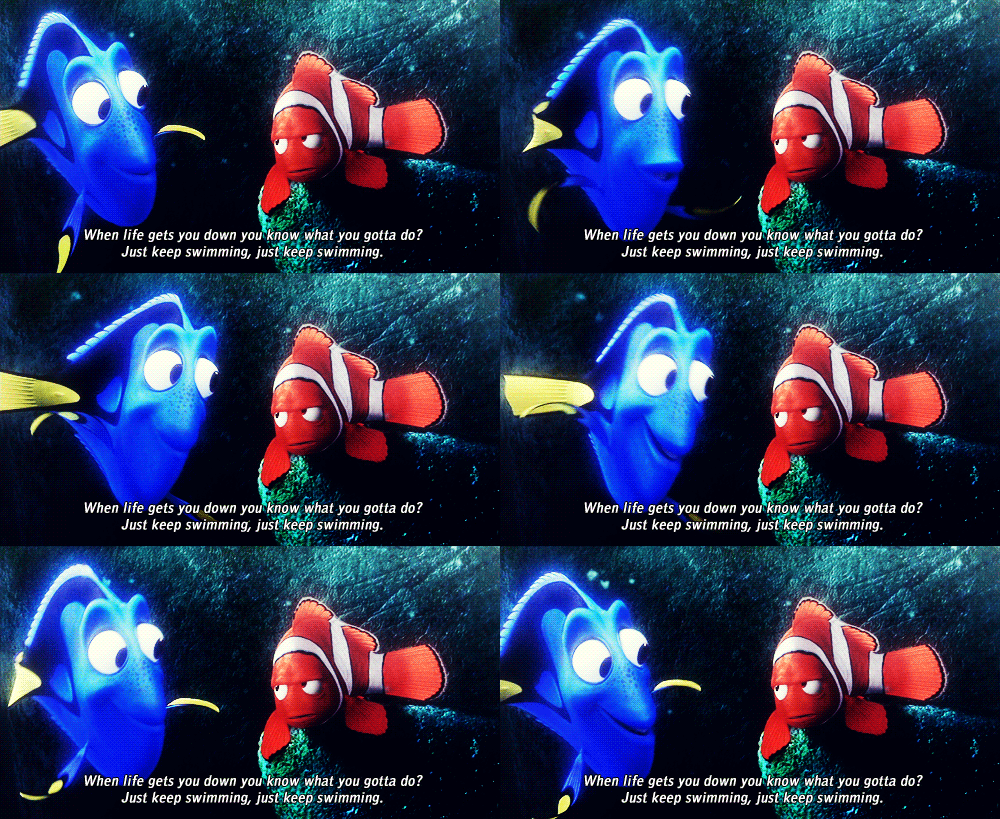
Just Keep Swimming

Many months ago, Matt drew my attention to a video of John Cleese giving a talk on creativity. Because I am not a very good wife, I didn't watch it until a few weeks ago. My excuse was that it was long - more than half an hour - and I'll grant you that's an okay excuse, but I should have watched it anyway. Because it's terrific.


Here is a transcript, if you prefer.

I'm going to guess that everyone who watches/reads this will walk away with a different feeling of what the best idea in it is. So I won't claim that what I got out of it is the most important thing in the video. But golly, it's been helpful in the recent past. In case you have no time to watch the whole thing and draw your own conclusions, here's what I'm talking about:
You know I mean, if we have a problem and we need to solve it, until we do, we feel (inside us) a kind of internal agitation, a tension, or an uncertainty that makes us just plain uncomfortable. And we want to get rid of that discomfort. So, in order to do so, we take a decision. Not because we're sure it's the best decision, but because taking it will make us feel better.

Well, the most creative people have learned to tolerate that discomfort for much longer. And so, just because they put in more pondering time, their solutions are more creative.
For me, these kinds of problems are what my characters are going to be like and what made them that way, what the insides of their apartments look like and what kind of clothes they wear, how I'm going to get from point A to point B in the plot without boring the reader or jumping too awkwardly. Solutions to problems both small and large.

Actually, I can give you an example of a problem where I haven't given up when the simple answer arrived. In my KUFC book, the antagonist group has put together an energy initiative which causes serious harm to my main character and her people. This is in an alternate-history U.S., in the 1940s, and it's a project that is extremely harmful to the earth but on which the antagonist group has put a positive spin, claiming it creates natural, sustainable energy for the general populace. I thought for ages trying to come up with a name for this project. The name had to be slick and memorable, had to indicate both benignity and corporatism, and had to be a word that would eventually make my main character shudder at its very thought. And the only word I could come up with, after thinking and thinking, was Greenpeace. Which is a word that, as most of us know, already exists and has its own connotations and that I can't possibly use.

I argued to myself that I could use it, that it would be a sly wink to the real 21st-century reader, would be yet another clue (as if the reader needs one at the juncture of the book where the project appears) that this was an alternate timeline. I almost convinced myself - but no. It's not the right word. I have to find another one. I'm still sitting solutionless under this problem, BUT, thanks to John Cleese, I'm not afraid of the discomfort of not having that solution yet. I'm using Greenpeace in my notes for the time being, until I come up with the right word, but I'm determined that there'll be another solution coming along sometime in the future. Because this is a shoddy solution and it won't do.

There's a way in which this instinct toward pushing on through discomfort to find the Right solution - not just the convenient one - ties in to perfectionism, which makes me, a recovering perfectionist, very uncomfortable. It's the same little voice, saying keep going because that's not a good enough solution, that dogged me and paralyzed me with not good enough not good enough not good enough for so many years. I don't want to venture into dividing perfectionism into good and bad, because I really couldn't say without bias, but I think driving on with intention toward the best solution is a different thing than failing to start because you can't achieve the ideal solution.

In the past week, I've started to believe keep going is really the only thing that works. It's certainly how I got through the hardest times in my life, and it's simple and catchy enough to sit in my brain without meanness and motivate me. It's how I wrote 2,000 words last night that I trust. Hard to argue with results like that.

Tuesday, July 10, 2012

Painting Within a Tended Field

It frustrates me how easily I give myself over to Yes This Is The Answer. When I find a solution for something, even if there's no chance it's sustainable, I tend to be all I AM THE MASTER OF THE UNIVERSE I FOUND THE ANSWER HUZZAH!!, and then I feel very foolish when whatever it is falls apart upon use in the long term.

Lemme splain.

Remember how I talked about hating to outline? All that still holds true. But there's a lot to keep track of in the KUFC book, a sort of A plot/B plot construction (global plot, personal plot) and some other people's plots that have their own arcs even while our heroine is blissfully ignorant of them. Plus the unfamiliar universe, plus a number of odd characters, plus a backstory, plus being certain that I'm self-styling instead of just plunking the prose on a sentence-by-sentence basis. (Sidebar: the Greenland novel was even more complicated than this, and I think if I'd had an outline, it wouldn't have turned out such a damn mess. For revision, if I ever fucking revise that book, I plan to create an outline and edit it, and then edit the book.) So but for this book I thought I'd do what I usually do and make copious notes in a pretty journal to the side of my desk. That wasn't enough, it turned out, because after I'd written my prologue, after writing pages of notes about the universe, and even after a few hundred words of Chapter One, I still didn't know what happened next.

So I wrote Chapter One on a new page of my notebook and scribbled what I already knew about it: I was going to open with action, with my heroine freerunning, doing what she calls her night work. I thought that was all I knew about it, but then I wrote down what I needed to establish about her, and what I thought was likely to happen to her in order to establish this stuff. Suddenly, more ideas were flowing: little details about the universe, character names and traits, something essential and very interesting about her background that reshapes things a bit. None of this amounted to what anyone would call an outline, because it was just notes and the majority of it stretched way beyond the first chapter, but it gave me a grounding for what I was going to write, which meant that I had a more structured and yet somehow more innovative first chapter when I got down to business on it.

Very stupidly, I presumed that this little bit of outlining had created momentum that would sustain me into Chapter Two. Which it did not. I wrote about a third of Two before I had to stop and go back to the notebook, and scribble through what was going to happen next and why. Then I came up with even more ideas: ways that her personal life was tied in to some of the intrigue of the book, characters who were going to appear sooner rather than later, other characters who weren't going to show up until later and the devices that were going to drag them back into her life. Before even writing it, I fixed what would have been a major mistake: drawing the A plot into the heroine's story too soon.

Everything feels much more orderly. I don't feel restrained, as if I'm doing the prose version of this:

Wait! I know! It's a giraffe! 
But more like I'm running around in a field that has been carefully bordered and mown. Tended, sure, but not unnaturally limited. Plus, I can always jump the fence. While writing Chapter One, I shifted gears to create a character who hadn't been part of my plan, and she's going to be useful.

The work I've ended up with is so superior to what I could have written, with so many more little cables wiring itself to the rest of the book, that I feel...just...grateful, and wholly stupid for not doing this with other projects before now.

I know I'm going against the advice of absolutely every writer I've ever heard of (and surely thousands I haven't), but writing every day doesn't seem to work out for me unless I'm a) short-storying or b) barreling headlong toward the end of a project. Everyday writing on a novel makes me feel resentful of and bored by the work instead of fascinated by it. I feel like I've got all the stuff of my life in the evening (dinner, Matt, movies, relaxing) on one side of a seesaw and writing on the other, and it seems unfair that writing is always heavier. Thus far on this book I've been writing every other day (sometimes with an extra off day in between), and the work has seemed much fresher for it. Sometimes I'll sit down with my notebook on the off day, and sometimes I'll do the notebook thing before writing that evening.

(This all sounds a lot more orderly than it is; a routine has still not been established. Yesterday I spent all morning at errands and didn't get to my job until 2:30, which meant that there really was no evening, just a shower and some Skyrim-watching and bed. Today I'm dawdling in the morning and I don't know if I'll get to anything but dinner at night, although I do hope it's a writing night.)

THE POINT IS, to make this into a Solution, the idea that outlineish note-taking in my notebook is the way that I'll write from now unto death, is wildly premature. And yet I'm thinking Yeeees, This Is The Answer. This is how I outline. See? Problem solved. Now I can be a writer.

It's so exasperating to do this, because I'll trumpet and crow about whatever solution I've just come up with, be very self-satisfied, and then find that this method doesn't work at all for the next project or the next stage of life. Back in my early 20s, I thought the way I wrote was to write completely nonstop for a few weeks, eating, sleeping, breathing the work, and then at the end of it I'd have a novella. That notion was born partially of being in my early 20s and having fewer other responsibilities, and partially of the creative machine being a very different thing then than it is now. A few years ago, it was trudge and slog and write through the pain, and I thought that was effective. (That might have been delusion rather than changing circumstances.) Now it's this notebook/every other day thing. And I'm sure in a few years it'll change again.

It's just like my job-hopping. It gets embarrassing telling your family members at Thanksgiving that you have a different job than you had last Christmas. Again. And telling them that no, you still haven't had any more stories published. Yes, you've changed your method of writing for the 18th time, but you're sure this time you're really on the trolley and nothing will ever change again, so when you're asked about it next year, you'll be able to say yep, that's still the way I do it, I'm confident and secure and totally not a wishy-washy idiot.

Um. Got a little sidetracked there. But I stand by it: I do feel like a wishy-washy idiot sharing these methods and then being like no, I had to tear down that building and build another one four inches away from the first one. It cost me hundreds of thousands of dollars in the currency of personal pride, but it'll definitely be worth it. After all, I've written seven thousand whole words now! Totally worth it.

In unrelated news, I thought we had black-chinned hummingbirds, and then I thought they were Anna's hummingbirds, and now I seriously don't know. Half the hummingbirds native to this area seem to have greenish backs and red throats and dark heads, as these do. Whatever; they're full of pep, and I love watching them. When I'm actually on the patio, in my reading chair, I can hear them going ttttthhhhhhhhrrrrrrrRRRR as they zip by.

Tuesday, June 26, 2012

That Lack of Ink


I have this thing about self-sabotage.

After I was settled in here, and my desk was set up, I set myself a daily goal of how much money I would make so I could get back on track. I decided to meet that goal seven days a week until I felt comfortable (or, preferably, overwhelmed) (ha) with the amount of money in my bank account. I also decided that if I couldn't meet the goal on any given day, I'd make up for it by working more on another day.

My failure was epic. Meeting my daily goal seemed impossible, and in fact I found myself working less capably than I had before the move (i.e. making less money per day), and dreading it and procrastinating against it more. My makeup goals became more and more laughable until, finally, I gave up.

It was a humbling experience. Trying to meet difficult daily goals didn't feel like a challenge; it felt like a wall someone had asked me to climb. All I could do was stare at it and be annoyed that someone had asked me to climb it. I felt lazy and undutiful and sucky.

So at the beginning of last week I set, instead, a goal that I knew I could reach, that seemed easy. All last week, I was easily able to meet and break and then double that goal. I worked effortlessly and cheerfully and, at one point, reached the "impossible" goal I'd set without even breaking a sweat. Mentally, the goal is still the small amount, because then if I'm having a hard or brainless day or if I have other things to do, I can always just work the minimum and walk away.

I also took the whole weekend off this past weekend, which I pretty much never did before the move. I still feel a bit guilty about it, but I'm looking at my tallies and I've worked every day since June 8th, so I don't think a whole weekend was a bad idea at this point. I was tuckered out. So I visited Fred Astaire's resting place and went to Matt's company picnic, and felt better, fresher for Monday.

I'm explaining all this because the same thing happens to me before I begin a writing project. It's the thing that's happening for my KUFC project. I'm getting that itchy feeling under the skin of my brain that means it's time to read over my notes and open a fresh new .doc and put my fingers to the keys. The song embedded above matches my character's state of mind in what's likely going to be a prologue, and I can't get that song out of my mental space. I know what I want to say in that prologue, and I want to write it.

But there's always a good reason not to. More to do for the apartment, more administrative junk involved in moving states (going to the DMV tomorrow morning, WOOOOOOOO), more paid work to catch up on, more correspondence to catch up on, more meals to cook or shopping to do. I went clothes shopping yesterday morning for two hours (frustrating the HELL out of myself in the process), even though I really can't afford it right now (although I genuinely do need clothes), because I knew if I worked as efficiently as I did last week, I'd be done by early afternoon with nothing to do and I'd have no reason not to write.

I'm so intimidated. I'm so worried I won't meet my goals for the project. I'm looking back at my last two books, and although I'm proud of my accomplishments with them, I fear that neither of them came out in a way that will appeal to a broad audience. Which means they're unsellable. I want to have learned from my mistakes and to write a terrific piece of work this time, one that only needs two or three drafts, not ten. I want to keep it light, action-y, kickass, and not get so into emotional and thoughtful shit like I did with the time book or so into character development (ultimately inadequate character development, to boot) like I did with the Greenland book.

Then I get to thinking about the kind of book I really want to write, and no, I want my books to be deep and thoughtful and stylistically particular. Even if it takes me ten more years to find an agent or a publisher or an audience. I admire transparent writers, but I'm not one of them, and I would flounder and sink if I tried to write that way.

Getting all knotted up in this stuff means that nothing is getting written. I thought I had moved somewhat beyond the ugly, inefficient, emotionally crippling perfectionism that defined my teens and the first half of my twenties, but here it is again, rearing up in a different way. Whether in paid work or the important work, if I set big giant goals, I can't even get started. Which was why, much as I wanted to participate in this (that gal is a very cool writer I found randomly), I knew I would just screw the pooch and maybe the book, too, if I tried.

It helps to forgive myself for my weaknesses. When, on Saturday morning, I said to myself "You can take the weekend off, Kat, it's okay", my brain sighed in relief. When every night I go to bed without writing that prologue, and I say sincerely "it's all right, you can try again tomorrow", it helps to keep self-hatred at bay.

But still nothing gets written. No words go on the page. And no amount of contentment is worth that lack of ink.

Wednesday, April 25, 2012

Flat as a Fairy Tale

Torn between two ideas: sci-fi idea derived from Star Wars that I'm not really sure I can write well, and old old literary idea that I love and which I'm pretty sure I'm going to fuck up if I try to write it. So, yesterday, I wrote neither, which I'll grant was a pretty stupid way to avoid the problem. Plus there's outlining the Marilyn book, which GAH-BLAH.

There's also this old story, a fairy tale, that I workshopped with the Barrelhouse group during the fall. They told me that my main character wasn't interesting enough and quibbled annoyingly with my first line. I made my main character an everygirl on purpose, because that's how you do it in fairy tales, right? Snow White is not exactly the most three-dimensional character ever to strut around a Disney landscape. Oh. Pun. Ack.

Point is, this week I've been thinking over whether I want to rewrite this story with this idea in mind. It was this post at Errantry that put me in mind of it. My main character sings (which becomes an important aspect of the story at the end of it), and that is her Only Thing, like the love of honey of the tale Kathleen illustrates. To the workshoppers, this was not enough, and she was really flat and boring. I tried to argue that I'd constructed her like a normal, flat fairy tale heroine, the kind you can project your own characteristics on because she has none of her own (ahem*BELLA*ahem), but they didn't care. The more I think about it, the more I become concerned (not quite convinced) that they're right. I think I'd end up adding a hell of a lot more words if I made the character more interesting, which I guess is okay with me, except that I was happy with a 4,000-word story and don't really want it to be a 7,000er. If it makes the story better, well of course, but it won't necessarily be more saleable if it's better and too long. But that spins me up into asking what the point is, whether I want to write a good story or a saleable story, when the answer is really both. I guess write more, and then try to cut back elsewhere?

I unintentionally created part of a universe in this story that I want to explore elsewhere, so I don't think it would be a bad thing if I were to work a little harder at this first foray into it. It's too short to get much into the universe, so that would be part of expanding the word count, expanding the world. The conflict admittedly appears a little late, but I thought the language made up for it, a bit. I could break it down and start all over, from the top down, with the universe in mind, rather than sneaking into it with just my main character in mind the way I wrote it originally. But that sounds like an awful lot of work, she whined.

Like I said above, I'm still not convinced that flat heroines are entirely wrong for fairy tales written in the present day. (Not set in modern times, just written right now.) Just as I think many readers like predictability to a certain extent, I think many readers like characters they can live through more personally due to having few specific characteristics. Vibrant heroines who are thoroughly foreign to the average reader, but who still possess some universal traits, are one kind of way to draw in readers (cf Scarlett O'Hara), but I think the opposite way is not invalid. Children's books and YA are rife with these sorts of folks, after all.

Y'know, having thought through how not-fun it will be to rewrite this story, I'm suddenly far more interested in working on the SF story. Unexpected bonus. Maybe I'll get down to it today.

Thursday, April 5, 2012

Feedback FTW / Enlightened by Edna

I had another one of those Lost Days yesterday: I got home from class fully intending to work for a little while, and then knock out the last revision of the [non-]horror novel, and then go back to working, meeting my responsibilities for the day with some time to spare. But it didn't work out that way. I didn't do any paid work at all, in fact; I revised for most of the day, into the evening.

Although I have a far better handle on my work schedule now than I did in, say, February, I am still trying to figure out how to make it more intuitive, more like something that I just do without thinking about it, the way I just got up and went to work and then got up and went home when I had a day job. The situation is so loose that I don't feel like holding myself to a specific schedule is necessary - nor do I think it's really the way in which to get the best work out of myself.

In any case, after yesterday's edit, I am through with actively revising for the moment. The book is starting to all blur together and not be new anymore, so I'm going to take notes on the feedback I get from here on and wait a month or two to implement it. I have been getting a LOT more discussion and feedback from readers on this book than I did on the Greenland book, which is either a good sign (because I wrote a more interesting book) or a good sign (because I was clearer with my readers). It's lovely to hear from so many people, especially the unexpected or critical feedback. Keep it coming, folks.

This weekend I have to get down to business on the promo materials I'll take with me to Colorado - synopsis, elevator pitch. I thought I might draft a query letter, too, while I'm at it. Matt gave me a terrific opening for it, so I think it'll be a bit easier than other queries I've written. Since I need to update my website, too, I've got to put together a synopsis and blurb for the Greenland book, which I find a dreadful prospect. I always find that I have either one sentence or three pages to say about that book, because it's so weird and straddles a few different things.

I'm almost finished with a book of Edna O'Brien short stories. The first book of hers I read was The Light of Evening, which is on my Special Shelf. I was utterly bowled over, and very nearly decided to stop writing altogether after I read it. I was overwhelmed by how not as good as her I would always be - how very minuscule and worthless my talent was compared to hers. (The reason I changed my mind is an entirely other post.) Then I read In the Forest, and I was sort of...disappointed. It was a great book, beautiful and vague in sort of the same way, but not a totally Other experience the way Evening had been. I thought, okay, well, she had an off (ish) book. I'll try again another time. So I got this book of short stories, and now that I'm all but two finished with it, I'm feeling the same sort of way: but...but...this was supposed to be otherworldly! It was supposed to knock me flat! And this is just...highly accomplished. It's still fiction I could never write, it just doesn't seem like it came from the pen of God, as Evening did.

I don't know what's up with this, whether maybe it's me, but I partly wish I hadn't started on her oeuvre with Evening, hadn't gotten my expectations so worked up. I'm going to keep trying - I just requested the Country Girls trilogy from the library, the books that got Ireland's panties in a bunch when they were published in the 60s - but I'm going to lower my expectations a bit.

Also, read The Light of Evening. You will never be the same.

Sunday, March 25, 2012

[Not-]Done

Well. The open-door draft of the horror novel is complete, the formatting is done, and 10 copies have been ordered from Lulu. Of course I noticed several errors this morning when doing my one-last-chorus roll through the proof version, but they'll be fixed in the next round, if I need a next round. I am so relieved to be done, and really proud of myself for steaming through it in four days.

Although I don't know what else to call it here for the sake of quick reference, calling it "the horror novel" doesn't feel too accurate anymore. When I was first writing I envisioned it as a sort of genre-toasting romp, with delightful gore and a monster under the stairs and calls coming from inside the house and whatnot, but it just didn't come out that way. (I never even managed to put in "I'll be right back." Sad face.) It has a few horror elements, but it's a lot more about the relationships between the characters, and includes a few tablespoons of philosophy about time. Not terribly gory, either. Matt suggested "supernatural thriller", which is about right. He said he was never scared while reading it, but I reminded him that he knew the whole plot, and so knew what would come out okay and what wouldn't.

It's tight. It's ready for an audience. And since I've taken most of a week off from paid work to do it, I'm really pleased to be finished.

Since the poll below has resulted in a dead split, I decided to go with Version 2, the version I wrote originally. I still see Matt's point, but I wrote the danged thing and I liked it the way it was. Thanks to all who participated.

I think I'm going to hold off mostly on further composing until things settle out with our geographical situation. The next pieces of work in front of me are revisions on the Greenland book, which I can't really do until summer because of a grant I applied for (it would be dishonest to do the work the grant is supposed to fund before finding out if I won the grant); plotting out the Marilyn book, which I'm not very enthused about for various reasons; revising a couple of short stories that ended up not winning anything or being accepted, so I can send them out to more places; and writing a few essays and/or stories I've sketched out in my little stained-glass notebook. And the unhappy task of promotional material for the [non-]horror novel - query letters, synopses, elevator pitches, etc.

The Marilyn book is the big project. It stems from a short story I wrote about five years ago, intended to be the first chapter, and while I'm reasonably proud of the story, the idea is really the 24K gold of it. I think it might have been done before, but not by me, and it's an idea wide enough that it should be okay. The thing about it is, all I have is a faint shape of what's going to happen in the book, and I need to come up with a whole cast of characters and a context in which to put the thread of plot I have in mind. The last two books, the Greenland book and the [non-]horror novel, both had tens of thousands of words plunked down, about the first third of them written in years past, and I only had to go back and finish what I'd started. This one has about 2,000 words, tops. So it's a bit overwhelming to think about getting started. It may not make sense, but it feels like I'm heading into an actual different job than the prior one. Like I was a car mechanic for the last two books, and suddenly I'm being asked to work on jet engines.

Revising the stories is not an encouraging prospect. Much as I dislike revising in generally, I really hate revising stories - it feels oddly like a waste of time, and it's so intricate and fiddly. Like watch repair, or bomb defusing. Writing the essays isn't appealing either. I've become intimidated by how much astonishingly good creative nonfiction there is out there, and I feel like my essays make small and inessential points.

Whine, whine. The upshot is, I'm going to leave off new writing except for a few little projects here and there until probably mid-summer, and just bend my head to the money-work for the time being. I might try to plot out the Marilyn novel, but probably not, not until I have to. I sincerely hope that something will happen at the writers' conference in April to kick things into gear for me, but I'm not relying on it. I will have to take the promo stuff for the [non-]horror novel there, though, so I'll be working on that for the next few weeks in between money-work. It is very very hard to write summaries and pitches for your own work, I'm here to tell you. I mean, I wrote 90,000 words because just a paragraph about this topic and characters simply wouldn't do, and now I have to go back to a paragraph? And write it in engaging but non-salesman-y language? Shyeah. Harder than writing the book, dammit.

I am going to take today off of all work except the class I'm teaching. Get back to the grindstone on Monday. Yesterday was a long day; I revised straight from about 12:45 p.m. to about 11:15 p.m. Towards the end I kept yelling down to Matt that "Formatting is FUN!" Because it is not. Not.

Tuesday, February 21, 2012

Concerning Hobbit Drafts

First: this. What a desperately needed shot of frustrated genius (and pathos). Happy birthday, DFW, and Godspeed.

Second: Today I've decided to put my Fictator hat on and just deal with these deaths that I don't want to write in my horror novel. Since I discovered a back door to one of the deaths I didn't enjoy writing, I've pondered taking that back door for some of the other deaths as well, making for sort of a death-free horror novel. Everybody gets a pass; readers' hearts need not break. But this is stupid and wussified and I know it, and I really have to just get on with it and kill (kill kill) instead of waffling like crazy such that no work at all gets done.

There. Bam.

Of course, since I haven't written in a few weeks at this point, I had to go back and refamiliarize myself with what I'd written before I buckled to waffling. I thought of the draft so far as a sort of Uruk-hai in utero, something that I'd need to scrape the mud off of and wince at, rather than the pleasing elf-creature that I ever hope for when I think of my writing. What I found was better than I thought. More like a hobbit.
Lucy was not behind her. She was not finished with Lucy. She didn’t know for sure that if the devil offered to bring Lucy back, if he sidled up in a red bodysuit and plastic tail and dickered with her for something (for anything, if she was honest), that she wouldn’t listen, wouldn’t consider the bargain. 
It needs work, naturally. It will always need work. Hobbits are not elves, and unfortunately never shall be. But I don't feel so overwhelmed anymore. Uncertain, mournful, mad at myself, reluctant, all those things, you bet. But not like this thing is going to swallow me up. It only took Matt to remind me that I am, in fact, the boss of my characters, and a dead virtuoso to remind me that all writers get frustrated, to get me back in front of my real work.

Too much other work has been a distraction lately, dammit. I wish it was easier to remind myself that this is the work that matters.