Showing posts with label movies. Show all posts

Sunday, July 24, 2022

A Research Report

For the last six or seven weeks, I've been researching my next novel. I have not been quiet about the paths I've taken; on Twitter and Facebook I've been complaining, screenshotting paragraphs from books, and posting brief reviews of movies. I've also written about a few things I've learned. The actual book I'm writing isn't much of a secret among my writer friends, but I will be unspecific in this post. 

What I can be specific about is the time and place: Europe in the 1930s and 1940s. Sweden, North Africa, London, and a bit of Lisbon and the former Czechoslovakia. This means I needed to learn a basic outline of events in World War II - more than I learned in high school, anyway - and, in much more detail, what daily life was like. What people wore, ate, read, listened to, talked about, did in those regions during those years. Were there refrigerators? Cars? Deodorant? Fashion magazines? The war impacts all this, of course, but even establishing a baseline for daily life, before any crisis began, was a challenge. 

(In this post, I am going to use not-the-obvious terms for the German government during the mid-twentieth century, for search engine reasons. I'm not denying or soft-pedaling anything; I am not a supporter of that government or its ideals!!!; I just don't want certain audiences who Google horrible shit for the wrong reasons to find this post.) 

I'm a poor researcher, I'll be the first to admit, but I did not want to commit anachronisms or be caught flat-footed, partway through a draft, without an activity for my characters to do or the right kind of food for them to eat. So I started finding books to read. 

Sweden, the Swastika, and Stalin by John Gilmour

This was the toughest one (soooooo drrryyyyyy), and possibly the most useful. It taught me the broad outlines of the war's progression and to expect huge differences between the nations in attitudes toward the war. That has served me well. For Sweden, the safety of the people was absolutely paramount, way above worry about how history would judge the leaders' actions, shows of strength, or sticking to a particular moral certainty. That priority was hard for me to get my head around. It was good I started there, though, because this book 

And the Show Went On by Alan Riding

was even more challenging (although in its particulars, a very good read). For France, national culture was paramount, above concern about how its populace would cope, and far, far above historical judgment. America's culture is so exportable and reproducible that it took a lot of squinting to figure this out as a priority. Also notable in France was how easily the elderly leaders capitulated, how their concessions and waiting-and-seeing contradicted what younger people wanted and believed (whether they were resistance-minded or not). I think these men, many of whom served in the prior war, believed this would pass, that the German threat simply was not worth digging trenches and making shells, again. Their nearness to sunset likely had a lot to do with this perspective. Food for thought in 2022 America. 


Round Up the Usual Suspects by Aljean Harmetz

This book was helpful for a bunch of reasons, but it was also fun to read because it was full of Jack Warner stories. For those who don't know, Jack Warner, who held absolute power at Warner Bros. for nearly half a century, is legendary for his monstrousness. He was a greedy, single-minded tyrant - but an unbiased one, treating everyone on earth equally terribly. Plus, he was almost always right, which makes him a prime-cut Hollywood monster. I also learned a handful of surprising (and sad) facts about refugees in Hollywood in the 1940s. The author kept returning to the differences in American film production between the 1940s and the 1990s (when the book was written), which I found bitter and needless. 


Liberty Lady by Pat DiGeorge

I was surprised at this book, which is self-published history, but was smoothly and tensely written, carefully researched, and fascinating in its own right even though it's about the author's parents. It gave me good information about Stockholm during the war. Self-published history is like Vogon poetry in reputation, but this is a strong book that I'd acquire if I were the editor of a history imprint. Which I never, ever will be. 

The Moon Is Down by John Steinbeck

In my late teens and early 20s I was a Steinbeck fiend, and I'm pretty sure I read this book during that time and retained none of it. The reread was a pleasure. It's a beautiful piece of work, if a little sketchy (in the literary sense). Fun fact: even though it was written deliberately as propaganda, the Allies didn't like it for that purpose, because it "humanized" the enemy. Citizens of occupied nations, however, loved it, and took guerilla publishing measures to get it into as many hands as possible. They knew, because they lived under occupation, that a cartoon enemy is neither accurate nor helpful. 

(To be clear: what Steinbeck does in this book is one hundred percent different than what the New York Times has done with its humanizing bullshit. Steinbeck won a Nobel, and the NYT is bothsidesing itself directly into sympathy with the devil.) 

I'm nearly out of books I should read and it's almost time to write, so while I wait for a couple of interlibrary loans, I've switched to movies, in the hope that some of them will have reasonably accurate period details. 


Poster for Taking Sides (2001)

This one is off to the side a bit in some ways, but the moral philosophy underlying it is right within my concerns. It's got some memorable scenes and situations, but it's a little tedious; SkarsgĂ„rd is at full power, but Keitel is flashing a LOW BATT light. It also tugs at a thread I noticed across my reading: the punishment meted out to anyone affiliated with the former German government after 1945 was extremely inconsistent, from country to country and from person to person. Frenchmen who wrote occasional pandering articles were shot right away; Germans who did cruel, racist things to fellow human beings walked free. So it went in all nations touched by the war. It's an impossible task, of course, trying to figure out who deserves what. None of us is God. 


Poster for The King's Choice (2016)

Poster for The Last Sentence (2012)

These two were frustrating but helpful. (Both star Jesper Christensen, a Dane of great renown, but this is sheer coincidence.) The one is about the King of Norway's actions when Germans invaded in the spring of 1940, and the other is about a famous Swedish journalist who publicly, bitchily denounced the German regime from 1933-1945. The King's Choice was shot in all handheld, which annoyed me to no end, yet the acting, the personal dilemmas, and the period details were tremendous. It was clearly influenced by Downfall, but the story didn't propel itself as urgently as Downfall's did. Not a waste of time, but not as good as it thought it was. 

The Last Sentence had Bergman intentions and Dreyer austerity, but without the brilliance or flawed human core of either. Also, the DP did not understand how to make a black and white movie vs. a color movie with a black and white filter. But the content had direct bearing on the book I'm writing, more than any other save the one below, so I'm glad I watched it. 

Poster for Sami Blood (2016)

So far this is the only movie for research I can recommend without an asterisk (i.e. "if you're interested in Sweden during WWII" or similar). It was stunning, and for an American audience, it's a very unusual story. It did have major elision problems, but I credit the filmmaker for attacking them with sheer will rather than logical writing. Also, the last third of it took place in the very city/decade where a large portion of my book is set, so yay for that. 

Here are some other books and movies on my list: 

French poster for The Conspirators (1944)
not great

Prague in Black by Chad Bryant
nicer to read than expected but that only goes so far

We Are at War by Simon Garfield
totally awesome

Poster for Pimpernel Smith (1942)
sentimental, propagandistic hogwash that I enjoyed a great deal

This six or seven weeks has been quite a journey for me. I did not know I'd find World War II so fascinating, but I really, really do, in a way that will remind you of your dad or granddad if you ever set me talking about it. It seems from a distance as if it was a simple war, with binary choices and obviously divined motives, but it's not that at all; the middle ground has been far more populous than I expected. Plus I've learned so many amazing one-off facts. Like, for instance, the reason the Blitz on London was halted? Because it didn't work. The intention was to destroy the RAF, various manufacturing hotspots, and the morale of the people. It accomplished none of these things. The RAF turned out to be more skilled, with more maneuverable planes, than expected; manufacturing merely spread out to other parts of the country instead of remaining centralized and thus easily bombable; and, apparently, nothing can destroy the morale of the British people. I find that completely amazing. 

I've also learned that the "neutral" powers made a lot of collaborationist compromises; the dictator of Portugal was...kind of...unobjectionable? as a dictator?; Ingrid Bergman was a workaholic; Coco Chanel was a spy for the wrong side; and Czechoslovakia was horribly wronged, but it gave almost as good as it got in the end. And lots more. 

I hope I won't have to make another report like this, and that I can just write the damned book instead. But there's still a book on fashion, a book on interwar Britain, a book of Swedish statistics, and a giant book of James Agee reviews (570 pp) containing only one of use to me, all of which are either in my office or headed my way. So...we'll see whether I get this thing going for real by September, or not. 

Tuesday, November 5, 2019

Irrevocable and Important, Yet So Petty and Dumb

I've now put out all the most worrying fires that got started while I took the month of October off from reviewing. There are plenty of emails that need answering, and a whole chain of labor to do related to a relatively minimal chore (must print shipping label and proofs of freelancer pay, must move printer to desk in order to print, must organize desk in order to move printer, must organize rest of office in order to organize desk, must figure out bookshelf situation in rest of apartment in order to organize office), and o, the pile of books to read. But I feel okay about the future for now.

I do have lots of thoughts and ideas flying around in my head, which is usually evidence that I need to write a blog post. So here I am.


Thursday, August 30, 2018

The Best Rejection I Ever Got

This morning I set out to write a post to sum up a conversation Matt and I had this week about why the most unusual character in a given universe is obligated to be the narrator of the story. Why not tell the story of the Death Star from the perspective of a random Imperial officer, for instance? But as I wrote I got hopelessly tangled, and I do not have the concentration to untangle it all today.

Tomorrow I leave for a weekend away, and as soon as I return I'm leaving again for a week away. The destinations are different, and I have two fully equipped sets of anxiety about the trips. Yay.

So instead I'll tell a story I meant to tell some weeks back. One of my planned tripartite film essays is about Last Tango in Paris, a film I don't particularly love but which gave me an incredible epiphany when I was about 20. There's this wonderful film site, Bright Wall/Dark Room, which publishes long, thoughtful, specific, intelligent essays about film and media. The site put out a call a while ago for a themed issue on "Body." This is the precise theme around which I had loosely assembled my ideas for the Last Tango essay; it was the focus of my epiphany.

I was pretty slammed at the time, but I didn't want to miss the opportunity to match a tripartite essay with a market and themed issue that coincided with it. So I emailed the editor to say hi, I'm Kat, I write weirdo essays about film, I really want to work with you, I have this idea but no time to execute it, how strict is your deadline for this themed issue? I included links to the tripartite essays I'd previously published, in the hope that the editor would see how neatly my work matched with his site.

He wrote me back promptly, and I hope I'm not misinterpreting his email to say he seemed as excited about working with me as I was about working with him. However, he said, the deadline is moot. After he and the other editors at BW/DR found out about Bertolucci's treatment of Maria Schneider during the filming of Last Tango, they decided never to feature an essay about that film on the site. They didn't want to break that rule even for a promising and/or feminist essay. He said he was sorry about it, but would love to see other work from me in the future.

I was overcome. What a refreshing, ethical, transparent, reasonable rejection. What a splendid perspective! What a fantastic team of editors. Whatta mag.


WHERE MY WHATTA MAN GIFS, INTERNET
COME ON

I legitimately bounced up and down in my chair. And I wrote back as effusively as possible to say thank you all for being goddamn human beings and of COURSE I'm not upset to get turned down for that reason. And let me figure out a way to work with you soon.

The following month I pitched another idea, which the editor showed interest in, and which I have since failed to write timely. Way to go, Kat; sabotage a relationship before it's a relationship. I really do mean to write it, but my discipline bucket is totally empty at the moment.

Two of the books I reviewed at the beginning of August seem to have taken all the air out of me. I've blogged about them before, but I'm still kinda blaming them for my inertia during these last couple of weeks. I haven't read any books this week, and I think it's because of the page count of those others. Also, I was disappointed in both books (in very different quantities), and usually it takes me a bit to get going again on reading after a couple of books I don't like.

Plus, as I told a client in the process of explaining why I completely failed to meet a self-imposed deadline this week, I conducted a handful of interviews this month that I wasn't expecting to, upping my workload. I think I've mentioned this before, so forgive me, but I don't understand why I've started getting requests to interview authors (sometimes completely out of the blue). My mentor Chris was entirely right to say that doing an interview series would help me a lot in terms of contact with authors and general circulation in the literary world, but I don't think interviewing is a particularly strong skill of mine. I'm grateful for the work and the confidence, and I'm also a bit baffled. Does it seem like I'm good at interviewing? Does this appearance of competence merely come from being a good reader?

As literally everything else successful this year has come, for me?

Out in the world:

I reviewed a book by Dawn Raffel with fascinating implications - The Strange Case of Dr. Couney - for the Mantle. I'm planning to work with them some more in the future. Very nice editor and wonderfully thoughtful site. The book is well worth checking out, and if it seems like it might even be a little interesting to you, grab it.

For this month's Books I Hate, I interviewed Kelcey Parker Ervick, the author of one of the finest hybrid texts I've ever read. She was lovely enough that the parenthetical part of the interview was really the primary one.

I reviewed a novel, Summer Cannibals, for the Arts Fuse. I liked the book, but my reviewer side had to be honest about its flaws. I'm looking forward to more work from this author - she writes extremely well.

And I reviewed a pretty difficult memoir, A Certain Loneliness, for River Teeth. I'm excited about appearing in River Teeth, where I've tried my essays a bunch to no avail, and I'm pleased to be able to give this book some attention. As with the other two books above, it's a flawed piece of work, but well worth reading. This book, like Dr. Couney, has more important qualities than whether it's perfectly crafted or not.

Thursday, August 23, 2018

Mostly About Stuff I Wrote

Well, this has not been an especially fun week. Which is a shame, because some really good stuff of mine got published.

For BUST (yay!), I wrote about Mara Altman's well-meaning and intellectually diligent but fundamentally problematic essay collection, Gross Anatomy. In fairness: although her collection veered away from feminism in some critical ways, she seemed to veer back toward it in the short interview with her that was tucked into the galley. Part of me wishes I'd given her more credit for what was in that interview, but a) space did not permit and b) what's in the book is in the book, and I'm reviewing the book. It failed to break the link between women's value and their physical attractiveness, and I'm not letting it off the hook for that.

An article I wrote months ago, about the tandem video game practices of my husband and me, finally appeared on Crixeo. Editorially, it was great to work with them, and they paid me well and rapidly, but the accompanying picture and layout of the article were sort of disappointing (as was the lag time - although I've finally figured out that weeks or months of lag time is par for the course, it's still irritating). Nevertheless, I'm grateful for the chance to write publicly about how Matt and I play together. I've heard that other friends of ours with the same configuration (husband works in video games, wife doesn't but is familiar with nerd culture) do the same thing.

Only one book review this week, and it's a good one: of an anthology about 1990s culture, Come as You Are. It's up at Barrelhouse, where I've been submitting my work since the mid-2000s. If I weren't so distracted by my un-fun week, I'd be over the moon.

Finally, I wrote my first piece for Popscure, a listicle + analysis of five 1970s movies. I stole the "hijinks ensue" bit from a blog post I read years ago somewhere on the internet. If I could remember where I found it, I'd either credit the post's author or remove the bit, but I can't remember. If I stole it from you, please contact me and I'll make it right. The actual article observes something I noticed after I watched Rollerball for the first time (having previously seen Logan's Run approximately 267 times and the other films in varying quantities). I'm looking forward to a similar article being written in 30 years or so about Arrival, The Martian, et al. Not that I think 1970s fashion will ever be bested.

It wasn't a good week because I suspect that a pitch of mine got...let's say repurposed, after an editor I've pitched many, many times rejected it months ago, and then published a curiously similar article by a staff writer this week. My own article appeared at a different outlet, back in June, so there's a paper trail. And it could be a coincidence. But I doubt it, which makes the world feel cold and petty.

Plus, my concentration has been really unreliable lately, which has given all my work a slapdash feel to me, even if it doesn't seem that way to others. There's roofing work happening at my place, which is a terrible, scary thing if you work at home and are sensitive to noise. And the gods overseeing weather, the mail, and the very practice of sleep have all deserted me recently.

The good news is that I planned August unusually well. I did okay with deadlines, and I don't have any other books to read or review urgently this month, just edits and check-ups on stuff I've already filed and pitches to push through. I have a practical task which should take me the rest of August to complete, but I'm not very stressed about it. Hence, I have these last two weeks of the month, this and next, to laze around and worry about what comes next.

Oh, well, okay then

What comes next is a bunch of cool stuff in September. Interesting reviews and good essays. But also volunteer work at CSUN, which will get me out of the apartment, which is good for me like flossing is good for me. And a handful of books for October and November that look pretty good, even though many of them are short stories.

I've determined for good and all across this year that I just don't like reading short stories. I just don't! I have tried hard to enjoy them but I do not enjoy them and that's all there is to it. So many books seeking reviewers (instead of books that are already assigned) are story collections, so I wind up reading them a lot, and I'm as fair to them as I can be in terms of craft and characterization and whatnot. But the truth is, I do not enjoy them. I do not, Sam-I-Am. But hey, maybe they're like flossing, too.

Friday, May 25, 2018

Deluded / Inexperienced / Just Really Bad

Last night, after over a week of trying, I finally finished Sean Penn's atrocious debut novel, Bob Honey Who Just Do Stuff. It's so terrible that I am numb with horror. As I explained to Matt, my state of mind recalls how I felt watching the first episode of Cop Rock: overwhelmed with the amount of work that had gone into this lotto-ball-tumbler of bad ideas, feeling stricken, astonished, that no one considered how bad, how really really bad, it all was.

If this is the first time you've heard of Cop Rock, it is (rather amazingly) just what it says on the tin: a police drama with many musical numbers per episode. I didn't believe the person who first told me this, but I promise it's true. This is my favorite number. 

You might already know about me that I am an outright connoisseur of bad film. I love it. I love what it reveals about good film. Plus, occasionally I come upon films that are basically outsider art, delightful in their lack of adherence to conventional cinema--even if the results are (for most people) unwatchable. Bad writing is a slightly different situation. The reason I was reading Sean Penn's book at all is related to some very bad turn-of-the-century writing I'm familiar with, and a feature I'm writing about that similarity. (Stay tuned.) But I learned from my flirtation with that writer of old that bad writing is, for whatever reason, not as easy in the intake process as bad film is.

A lot of people who make bad art are either inexperienced or deluded. A filmmaker like James Nguyen (deluded) sincerely believes he's making good films, because, for whatever reason, he can't see the divide between his camerawork and Hitchcock's. He can't hear that his bad, echoey, overclocked sound is different than the crisp sound of the average dialogue scene in a commercial motion picture. Students I've met who write badly (inexperienced) have not read or written enough to encounter and understand some of the pitfalls of bad prose. They think that certain kinds of metatextual writing are fun and new (when in fact they are neither) because they don't understand what makes that particular metatext cringey and gimmicky instead of profound.

But I can offer no quarter to the makers of Cop Rock. They were highly experienced crafters of television. They had seen and made enough TV to be neither inexperienced nor deluded. And yet, what they made was so bad, a spectacular collision of dumb ideas. That was the root of the stunned sensation I felt during the first episode: I cannot explain this away with my usual analyses of bad art. They went into this with their eyes open and the product is still terrible.

That's close to how I feel about Sean Penn's book. I know that this person has read a lot of books and has done a lot of thinking. And this book is garbage. It's got as many bad ideas as Cop Rock but it adds "lazy" to the pile, which I find unforgivable in a writer. And I don't know how it happened this way. I'm no longer surprised that bad books get published with big money, because I have come to understand how that happens, even for people who have not a sliver of the name recognition Penn has. But I simply can't fathom that this lies behind a man who, for his many faults, never comes across as underprepared or undereducated when I see him at work.

(To be clear, I think Penn should've been cleared off the table decades ago when he was violent toward reporters and allegedly violent toward Madonna; I think he is hilariously pretentious; I don't think his choice of roles is especially interesting across time, except as demonstrations of Hi, Mom, I'm Acting; but I respect that he's particularly good at his job in a crowded field of middle-aged white male actors.)

The above may have been nothing but outtakes from the essay I'm going to write about this awful book. Or early exercises for a novella-length essay I want to write about bad movies. But I am unhorsed about the unfathomable badness of Bob Honey and had to let it out somewhere. Toward the end, I had to sit in the room where Matt was gaming to read it, because I didn't want to read it alone.

Out in the world:

Something hysterical (hysteria in this sense being composed of equal parts fun + anxiety) on Medium. It's no fun to have your favorite stress purchase be suddenly a source of stress.

A tiny memoir piece I wrote appears in issue 5 of Beacon Quarterly, a Portland-based, design-focused (?) magazine. I'm not sure I understand the magazine really at all, but I'm pleased that my words are in it. I saw a PDF, and they treated me well. What I wrote, "Five Stories, Collated," was designated as poetry, which isn't quite right but it's fine if they/you want to read it that way. In a few months, the issue will be free to view digitally, and I'll link to it again then.

My work appears in Tiferet's current issue (spring/summer 2018). It's a "tif," a short piece on the theme of transformation, and I feel it's not of the same weight and caliber as the full-length contributions in this really fine magazine. But I loved writing it - it's an idea I'd wanted to put out in the world for a long time - and I'm proud it's in print. Here's a link to buy a digital copy of the issue, should you desire to.

I reviewed a remarkable book, The Underneath, by Melanie Finn, for sinkhole. I liked working with them a lot - they turned down something weird of mine but assigned me this book instead, and all went well - and I'm already reading a second book for review for them. This book, though. It gave me the opportunity to dig deep about my opinions of New England and its darker side, and I'm grateful.

And I reviewed a writing reference anthology, Credo, for Craft Literary. I did my best to give it a mixed but not unkind review. The book means well, but it's got filler.

I've filed multiple other reviews and a couple of interviews, all soon to come. May ain't over yet.

Thursday, November 30, 2017

The Fate of the Kathy Ireland Story

So this thing I wrote, "Underside," showed up in Rivet: The Journal of Writing that Risks on November 27. I have called it "the Kathy Ireland story" many times in this blog. I wrote it after I read John Haskell's book I am not Jackson Pollock, the experience of which I've written about right here. I tried for myself the thing that Haskell did, the blending of film talk with fiction, the imagining of scenes that never were, and the result was "Underside" (which I know needs a better title but I couldn't think of one).

I wrote it with a kind of abandon I had never known in words before. I worked hard, but with the air of a joyful experiment. I had no idea what it was I'd written when I finished, but soon enough I realized I'd embarked on something meaningful.

Monday, July 17, 2017

Better or Worse

Last week I watched the 1987 film Mannequin, with Andrew McCarthy and Kim Cattrall. For whatever reason, this movie was a big part of my early life. For a time, it was my most favorite movie, to the point where I drew pictures of the two main characters and put them in a locket I wore because I loved them sooooo much.

This is not easy for me to admit. But I was quite young, around seven.

Seeing Mannequin nearly 30 years later was a weird experience. I remembered the outline of the plot, and I remembered some aspects of the performances, but most of what I remembered was inflection, turn of phrase, sound and look. The way some lines of the screenplay were said has been hanging around in my neural matter for all this time; it was like hearing lullabies sung to me in my cradle. Oh, this line, yes. Right, that montage. I didn't know exactly what the actress was going to say, nor what it meant in the context of the film, but I knew precisely how she was going to say it. An alchemical kind of memorization.


Since last week I've had those lines bouncing around in my head. I can't recite the whole movie, but I could parrot a good 25% of the screenplay right now, if you wanted me to. The way people get songs in their heads, I get scenes in my head, from movies or shows I watched either at developmentally crucial moments or have watched repeatedly. Mannequin had been lost to me in that way until I saw it again, and part of me thinks it was a mistake to watch it as an adult, because it woke up all those brain cells that had been sleeping and/or allocated to more useful tasks. And now I can remember it. For better or worse, it's in my head again, imprinted like a fingernail in clay.

Perhaps it's for worse that I'm saying this about a disposable 80s comedy with questionable gender relations, impossible plot mechanics (he's the toast of Philadelphia for designing department store display windows?) and untenably over-the-top performances.* Yet there are worse movies I could have eaten up as a child. And the bright 80s colors and synthesizers, the simplicity of the plot, the positive ethical compass, the sheer harmlessness of the whole enterprise - these things make it a pretty good movie for kids, even if that wasn't the intent.

Watching the film again, though - I wanted to memorialize the weirdness of that experience. Because although it might've been fine for seven-year-old me, now I can see what a thoroughly dumb film it is - the padding, the flimsiness, the Born Sexy Yesterday problem. I cringed all the way through, even as bits of my brain flared and lit like distant fireworks.** Both happened at the same time: affection, communicated across time and space, along with deep, vermilion embarrassment.

Some years ago, when we still lived in Maryland, I talked my husband into taking a day trip with me to Norfolk, Virginia, where I lived during my elementary school years. I had an itch to see this place called the Hermitage, where I went a few times as a child, and which I remembered as a mysterious, enchanted glen of sun-dappled woods. Someone had long ago placed millstones among the trees, which had been grown over by grass and moss. I remembered old brick walls, restless quiet, the possibility that Narnia waited around the next bend. I couldn't bear my half-memories of the place any longer, so we drove there.

The Hermitage grounds are lovely, but smallish and well-kept, not wild and mysterious. The house (which was off-limits every time I went there, so I didn't care about it much) sits next to water - the Lafayette River - a detail I did not remember. The woods I had remembered made up a fairly small patch of ground, and the trees were not exactly sparse but were not thick enough to hide the house or the neighboring wetlands, to make you feel like you were at all distant from civilization.


My memory sparked and fired from time to time, but like returning to an elementary school, everything looked small. Minimal. Mundane. Certain aspects did not disappoint, like the millstones, but nothing about the bit of woods we walked in felt enchanted. Matt was kind and didn't say anything to the effect of "we drove seven hours round trip for this?", but I felt deflated.

What I'm trying to say about all this is how strange our brains are, that they can latch on to more or less random input early in life and never let go. That might mean that we should be a hell of a lot more careful about what we give kids early in life, what movies and shows they watch over and over, what places they go and fall in love with. Or it might not; there's an element of "who knows" attached to all this, because I know I saw movies and went places as a kid that I didn't retain as clearly, or at all. I don't think having Mannequin and the Hermitage in my brain has made me worse (or better) off in any particular way, nor do I think the selection of this movie, this place, says anything special or important about me, my taste, my parents' parenting, anything like that. One of the most brilliant set of parents I know, their four-year-old loves Trolls, the movie made from nothing more substantive than a line of plastic toys; I think it's because the movie has bright colors, not because his affection for the film indicates anything about his destiny. But I'll bet he's going to remember the turn and shape and sound of aspects of that film well into his adult life. For better or worse.

Mannequin, at least, was entertaining. Keep your expectations low if you elect to watch it; the leads have nice chemistry and Spader has to be seen to be believed, but that's about it. If you've never been to the Hermitage and you're near Hampton Roads, it might be a nice place to visit.

What I definitely don't recommend is trying to go back to where you've been, whatever that means to you. You can go home again, but you can't live memories the same way a second time. Even if you retain them with precision, like the actors reciting their lines permanently in my mind, like the millstones under my adult feet, they'll never be exactly the way they were.

---

*I mean, I don't know who was telling Spader to do what he did in this movie, but he behaved approximately as human as Ed Grimley.

**An unintentionally funny thing: the evil department store is named Illustra (which is an odd name for a department store, right?) and it's mostly pronounced by the actors like Olestra. I don't think Olestra existed then, so now it's pretty funny to hear them talking about margarine and meaning a department store.

Wednesday, October 21, 2015

OCTOBER 21, 2015

It's today. It's the day every Back to the Future fan knows. It's the day Marty goes into the future.


I am so excited. (The Cubs better win the damn World Series.)

To celebrate, I'm posting a piece of fiction I wrote, in fun, to try and understand the perspective of Biff Tannen, who is up there with Gene Hackman's character in Unforgiven for no-holds-barred villainy. I hope you enjoy it.


Saturday, January 10, 2015

The Long Redemption of Anakin Skywalker

Full-on Star Wars nerdery ahead. Really not relevant to anything else. Enjoy at will.

Like I said earlier this week, I watched the holy trilogy again in mid-December. Jedi has always been my favorite, which I used to hide and no longer care to hide. It's because Jabba fascinated me when I was a little girl, and because Luke's journey (and Hamill's deep grip on the character) has become electrifying, and because the space battle at the end is excellent chaos, and because I love redwood trees. (I don't love the Ewoks, but I'm not offended by them.) Lots of other reasons, too, but I'd essentially be summarizing the highlights of the movie if I went on. Empire is the better film, but I like Jedi best.

We got to the scene when Luke turns himself in to Vader down on Endor - when they have that pivotal conversation about Luke's father, about the Dark Side, about Anakin. I paused it, and I said that I thought this point in the trilogy is where Anakin's characterization in the prequels is at its most threadbare. A conversation followed that lasted half an hour or more, and that made me reverse my opinion altogether. I wish I'd had all my other SW friends in the room, but that's why I'm writing it up here.

Let's, just for the moment, take the position that everything in the prequels is deliberate and makes sense.

I'll give you a minute to get there.

Tuesday, January 6, 2015

Half the Sons Are Actually Daughters

This may not be new information, but I've been marathoning The X-Files since the end of September. I have a lot to say about the show - I mean, of course I do, because I've spent over 100 hours on it in the last three months - and maybe there'll be a long and semi-ridiculous post about it to come. In the meantime, a three-parter I watched just before Christmas gave me some food for thought about storytelling.

The first two parts were balanced between Mulder and Scully pretty evenly, and were no nuttier than the show's usual fare, but the third part kinda lost me. It portrayed Mulder as a Christ figure. There are a lot of qualifying "not really" details for that comparison, but there's no denying that the comparison is there, and in my opinion its hubris is beyond the pale (especially since Duchovny co-wrote it for himself to act). One of the episode's most prominent motifs was that of fathers and sons. This theme has cropped up in the show from time to time, but never in a way that, er, alienated me so deftly.

There was so much weight on Mulder as son, Mulder as father - weight that I just didn't feel on my shoulders. A lifetime of training in the male gaze made me comprehend that this was going on, but none of it applied to me. I am neither a son nor a prospective father, and I never can be.

Maybe this fathers/sons thing was on my mind anyway because I watched the Star Wars trilogy again mid-December, as break and reward for finishing my horrible, horrible final paper for the Faulkner/Morrison class. One of the things that happens when you watch Star Wars is you think about fathers and sons; a decent amount of the emotional heft in Empire and Jedi depends upon the theme. Thankfully, there's enough broad-stroke hero's journey stuff and enough general entertainment going on in the films that you don't have to be male to let Star Wars sweep you up in its arms, but this time around I did really notice that some of that emotional heft was missing its target in me. What a father means to a son, what he signifies, is not very available to me.

source: PaulNRoll on DeviantArt

One of the short stories I read last semester was "Boys", by Rick Moody, which I found of interest for quite a lot of reasons. Among its endeavors, the story suggests that a boy does not, metaphorically, become a man until his father dies. I'm not in a position to agree or disagree with this assessment, because it arises wholly outside of my experience, but it's certainly a common one. I could write a lot about the process of going from girl to woman, but pretty much none of it, in my view, has to do with how alive a daughter's parents are.

I have complicated relationships with both of my parents, and art that relies on daughter themes often speaks to me in the way that I think Star Wars and this arc on The X-Files are meant to speak to sons. But it bothers me that daughter themes are often in art that's directed more specifically at women, or at small audiences, while son themes are so often in art with much wider intended audiences. The two sets of issues are just so different from one another.

My quick free-association reports that son themes are about replacement, mortality, and legacy, and daughter themes are about purity, possession, and similarity-anxiety. (Of note: I rattled off three nouns for sons immediately, just thinking about father/son art, but it took much longer to come up with daughter nouns.) (Also of note: in assembling this post I found this series by a German photographer, Julia Fullerton-Batten, who has communicated many of the weird, free-floating feelings I have around daughterhood through surreal posed pictures. The direct link is SFW, but the artist's website is not.) There's more to it than three words apiece, duh, but no matter how vaguely they are summarized, the relationships are distinct. They cannot be swapped out for each other in a story and maintain resonance.

I mean, does this happen with fathers and sons? And I want to talk about this. For hours. 

The point of all this is to note, politely, that father/son issues are not as universal as the writers of Star Wars and this arc of The X-Files and Paul Thomas Anderson and John Steinbeck and Cormac McCarthy and oh, my God, so many other writers and creators would apparently like to think. (In fact, I'd argue that they're approximately 49.2% as universal as those creators would apparently like to think.) And I would appreciate feeling a little more included in this kind of art, or at least a little less disconnected from its emotional texture.

I remember a big crop of mother/daughter books coming into print around 2012, and I was glad for it, but I think I'll be waiting a while before a Star Wars appears that's centered around Leia's journey to cope with her mother's absence. Those stories need writing. They need mainstreaming. So let's get on that, mmkay?

Monday, June 2, 2014

Melville, Mightiness, and Misanthropes

I finished Moby-Dick. What a tremendous book; what a thoroughly weird book. No less weird today than in 1852, I'll wager, if maybe a little easier to understand in a more fragmented era. It was puzzling and boring; it was frightening and involving; it was pretty much unlike anything else I've read.

In Ahab's speeches it had that too-rare quality of mightiness. It's like I can see Melville at his desk, and for a while he's studiously writing away, like normal, and then suddenly he raises his arms and shouts an incantation and lightning crashes all around him, blazing bright words into the page, and the resulting thunder is what booms through the reader's mind as the prose rolls out. When I read Salvage the Bones I called this quality an author bending the English language utterly to her will. It's a mighty language, a wild rearing creature, and it's a rare and fine thing if a writer is able to pour all that power into sentences while saying what s/he wants to say.

King Lear, Act 3, Scene 2. Lear is all over Moby-Dick.
This is from Good Tickle-Brain, a terrific website that treats Shakespeare in stick figures.
After finishing with the White Whale I turned to something else: a short novel of the late 1930s that had an entirely different tone. It was The Day of the Locust, by Nathanael West, a writer who produced four short novels and died in a car crash at 37. Locust was made into a film in the 1970s that was made much of at the time but seems to have been forgotten.

I did not like this book. It's about Hollywood, sort of, and all sources indicate that it's a sort of cruel farce about the lives of these three central characters, but I found it draggy and misogynist and unfun. There was just so little movement. There were terrific set-pieces, but not much plot.

The biggest problem was the tone, though. The book felt bottomlessly cynical. It reminded me a lot of the Neil LaBute remake of The Wicker Man, with Nicolas Cage, which I know I really shouldn't be mentioning in a post that also talks about Lear and Moby-Dick, but just bear with me. Wicker Man is a rotten movie (although the RiffTrax of it is so good that I own the DVD), and the first time I saw it I found it totally mystifying. There was no one to root for! Everyone was terrible! Our protagonist is a pushy, annoying, sexist dick; the people whose lifestyle he finds so unacceptable are hostile and weird and sexist; his guppy-faced twue wuv is hair-tearingly passive and yet obstructive in her own airheaded way. Fuck y'all! Fuck all y'all!

Which is not how you generally interact with characters in a mainstream American film. The dynamic between characters and audience here was so negative, so off-putting, that I really had no idea how to watch the film. I couldn't just ascribe it to the film not working for me, to the characters not being appealing to me in particular; the characters were downright hostile to a viewing audience, I'd wager any audience, which made no sense at all. Until I looked up Neil LaBute and read the word misanthrope used to describe him. And suddenly it all fell into place. He hates everything! So of course everyone is hateable in this film of his. I saw his In the Company of Men years ago and found it intriguing, uncomfortable, and disappointing, but not so openly fuck-you as The Wicker Man is. And I thought that film made a point about misogyny, so I sort of thought Wicker Man was doing the same thing at first, but really no. It's just a ball of hate.

And this is where I go back to The Day of the Locust, which also felt like a ball of hate, to a milder degree. I don't find West's level of cynicism about the world edgy or cool; I find it off-putting. I find it ugly. It's the same way I felt about the Hunter Thompson I've read, about the Bukowski I tried to read. I felt like I was being flipped the bird, that finger being directed mostly at the world in general but also right at me, and that's just not the way I look at life, nor the way I like to look at life.

When I was thinking about putting this post together, I thought of saying that misanthropy is a less evolved way to see the world, but I don't actually believe that's true. I'd never say that full-on optimism is a more evolved way to see the world. I just don't believe in full-on one or the other; life is a mixed bag, and so should art be. Cynicism about Hollywood is fine, but I thought it worked perfectly in L.A. Story, which was extremely cynical but also romantic and sincere. Or Watchmen: Alan Moore strikes me as somewhat misanthropic, but he knows how to seed hope and beauty into a tale to make the ugliness bearable. Misanthropy seems like a deliberate choice for only always bad, and when has that ever worked out?

It didn't work out for Ahab, I can tell you true.

Sunday, October 6, 2013

Betwixt Thee and Me, Cronenberg, an Unbridgeable Gap

Last week I watched David Cronenberg's 1996 film Crash. (NOT Paul Haggis's 2004 ensemble piece about racism in Los Angeles.) This film has been on my tentative watch list for years now, ever since I heard about it, but I generally delay watching Cronenberg films for far longer than necessary, for reasons that I shall illuminate at length.

The topic of Crash is symphorophilia - a sexual fetish centered on car accidents. To oversimplify the film to its most lurid elements, a group of characters change partners and dance repeatedly to get their jollies before, during, and after car wrecks; while watching crash-test footage; inside previously wrecked cars; in the course of replicating famous accidents such as James Dean's and Jayne Mansfield's; and in other situations as well. If you want to watch James Spader fuck every possible cast member of a movie, rent this one.

So, although I posted on Facebook that my reaction to Crash was essentially this


, that's sort of tongue-in-cheek. I'm not a prude, and even though car-crash-iphilia does seem a little weird to me, different strokes for different folks, y'know.

I thought many other things about Crash, too. The film was fascinatingly distant, and near-perfect in a sub-Arctic kind of way. Even though I didn't enjoy it on a thumbs up/thumbs down level, I'll be thinking about it with intellectual interest for a long time. So this seemed like a good occasion for me to talk about Cronenberg for a bit, hopefully drawing in a larger point about creators and audiences somewhere down the line.

Tuesday, September 24, 2013

Plenty to Say Somewhere Else

At the moment, I'm hurting for stuff to contemplate on this blog. (So if there's anything you want me to write about, say so.) Sometimes, I'll set out to write a blog post about something and I write so many words that the post transforms into an essay, so I pitch it to appropriate websites instead of posting it here. That's happened with Gods Like Us, which I said I'd write more about, and I did, but it wound up as the subject of a whole essay. Often what happens next is that the pitch doesn't rustle up any interest and I post the essay here instead anyway. Which is what may end up happening with the Gods Like Us piece, as with Breaking Dawn.

And then there's Zack Snyder. I watched his remake of Dawn of the Dead last week (and wow, what a crackerjack picture; downright amazing for a debut film, even if it pissed off Romero fanboys), and it got me going again about what an odd figure I consider Snyder to be. I was ranting about this to Matt and said in jest that I should write a book about him, and Matt said, in seriousness, "You should. You definitely have enough material, and your ideas are interesting." Well, shucks. I'm thinking about starting with an essay instead. Or even a blog post. Oh, wait.

In any case, I'm sure something will happen next week that'll give me material for three posts in a row, but for now...

I got another encouraging and painful rejection on Sunday. And a form rejection that I pretty much expected followed by, a few hours later, an exhortation from the same magazine to enter their upcoming contest. Entry fees ahoy!

I know you're on tenterhooks about how I'm doing with Ulysses. I'm on disc 16. If you've read it, I'm near the end of the long section that's styled as a play, and I've finally made it through that scatological/S&M passage with the whorehouse madam. (The trial for obscenity wasn't so quaint and silly as I'd thought.) I've decided to trudge on to the end of this funhouse, through the last minute of the 22nd disc, and hopefully something fine will be waiting for me there.

Evil? But it has "fun" in the name! 

Thursday, September 12, 2013

One Formative Night at the Movies

Some time ago I read this in the stage of the morning when my eyes are still only partway open. All the stuff in there is fine advice, but the only item that struck me as terribly different from other, similar online lists of advice from people who have grown old enough to know better than all of us was #8, which lodged in my mind.
When meeting someone new, try to find out what formative experience occurred in their lives before they were seventeen.  It is my belief that some important event in everyone’s youth has an influence on everything that occurs afterwards.
As I read other stuff and moved on with my day, I kept turning that over. What an interesting notion, I thought, that everyone in the whole world had some single formative experience that mattered so much to them that it impacted the whole direction of their lives. Of course all the stuff that happens to you before age 17 is formative in some way, as is pretty much everything else in the years that go forward from there - we're clay, after all, not steel - but the idea that there's ONE thing that mattered to every other moment in life, well, that got my imagination going.

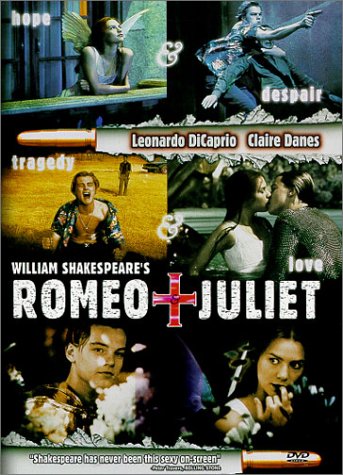
It didn't take me very long, half an hour, probably, to think of what that one thing would be for me. It was seeing Romeo + Juliet, the Baz Luhrmann movie from 1996, in the movie theater.


My eyes hurt when it was over, because I didn't blink enough while watching.

It would be dumb to claim that the film's appeal to fourteen-year-old me had nothing to do with the romance of the story, nor with my attachment to both of the young actors who played the leads, and certainly I was in love with Shakespeare's language even that early. Plus, I'd been Balthazar AND Friar John in a high-school performance of the play (both of whom, incidentally, are main players in fucking up the kids' communication, leading to the suicides - go me). But the film of the film is what really made it the seminal experience it was for me.

I hadn't known movies could impose themselves upon the audience visually the way that one does, could grab me almost solely by the eyeballs and hold on for two hours. Previously I liked movies for their stories, I liked actors for their natural appeal. I didn't see movies as pieces of art, as projects undertaken by droves of professionals, but as entertainments that dropped out of the sky. I would never see cinema that way again, not after Romeo + Juliet. That one movie is why I got a degree in film. It's the catalyst for some of the most profound experiences I've had. It's why I see the world the way I do.

Food for thought. What's your pre-17 thing?

Tuesday, August 20, 2013

Ulysses and Other Adventures

I have lots to say about what I'm reading lately.

First, two books that seem to have been written with me specifically in mind: 1) William Shakespeare's Star Wars, by Ian Doescher, is a retelling of A New Hope in [largely] Elizabethan language, in iambic pentameter, WITH. SONNETS. "Red Six doth stand by." Star Wars and Shakespeare are two of my most favorite things - like, up there with chocolate lava cakes and sleeping - so that someone combined them in an intelligent, delightful way is a gift beyond price.

And 2), Gods Like Us, a history of movie stardom by Boston Globe film critic Ty Burr. I don't exaggerate when I say that this is a book I've been wanting to read since I was a junior in college, even though it was only published last fall. Among the hats it wears, it's a critical examination of celebrity, its history and development from Florence Lawrence up to the present day. The field of star studies, a miniature niche of film criticism to be sure, has fascinated me since before I knew it existed. This book feeds my need. It's lively and informative and I'm going to write him a fan letter when I'm through.

A couple of weeks ago, I plowed through The Things They Carried, Tim O'Brien's novel in stories about Vietnam. I have a weak constitution when it comes to art about Vietnam (my father is a vet), and I kind of wish that I'd been able to get through life without having to consume this particular piece of art. But I couldn't. And I read it. And I'm not sorry I read it, but it was somewhat an unpleasant chore, if a fascinating book.

Plus I read less than 50 pages of a book called The People of Paper and gave up. Not for me.

And I read Innocence, by Jane Mendelsohn, which is a late-YA fever dream of a novel. It was quick, and very beautifully written, and was wrapped around an allegory that is well worth contemplation by a large audience of smart young women. But I wanted more concreteness out of it, and I wanted a good deal less emotional wallowing. It, the tough time I had reading Spinelli's Love, Stargirl, and my utter indifference to a book called Chime by Franny Billingsley that was made much of, have forced me to consider (and worry over) the idea that YA no longer appeals to me as much as it once did. Which would be a real shame, if true.

Along with the stars (movie and Wars), at present I'm listening to an audiobook version of Ulysses, which I've never read. It was suggested to me at Esalen that listening to the audio version of this kahuna allows the listener an easier time with the language of the book than reading it. Although only one-seventh of the way through the book (three discs out of 22), I can wholeheartedly endorse this. I downloaded the Gutenberg text onto my e-reader so I could go over some of the passages I didn't quite understand, and I was amazed at how much more complex and obtuse some of the text seemed on the page, when I got the meaning easily enough in hearing it.

The version I'm listening to has been abridged (but I'm not sure that's such a bad thing) and is read by Jim Norton and Marcella Riordan, who are both totally astonishing. Norton has the larger part, and he sings and chants and meows and takes on brogues gamely. But Riordan arguably has the more difficult task: she reads the part of Molly Bloom, both throughout the regular text and for the long stream of consciousness section that closes the novel.

I may eat these words in the end, but at the moment I'm having the same reaction to Ulysses that I had to some of Dubliners: beautiful language, Joyce is obviously the Orson Welles of 20th century literature, but I have no idea why I should care about these characters or what happens to them. I admire it, but it's failing to move me or even involve me much except in little bits, here and there. How stark a contrast I find between it and The Sound and the Fury - which is stylistically almost a riff on Ulysses, but which held a lot more depth for me.

On a not-really-related note, I watched Julie Taymor's film of The Tempest last week. Some of my reactions to it were completely unexpected, i.e. I thought Russell Brand was amazingly good and Helen Mirren kind of dull and flat. (!!!) The MVP was definitely the costume designer. The Tempest is a weird play, and I've yet to find it as compelling as its ideas in any interpretation I've seen (although perhaps I've just been unlucky), so I can't blame anyone involved in this rendering for falling a bit short. They filmed it on Kauai, which the Bard may as well have had in mind when he wrote the play, and Taymor's idiosyncratic style was not at all misplaced. But it just didn't gel.

Ahead is Jincy Willett's book of short stories Jenny and the Jaws of Life. And some writer-type activities, too, a writer's "faire" at UCLA next weekend and some laborious revision. And classes starting. Yeah, that.

Tuesday, July 16, 2013

What It Is I Know Not

This is a great song for those hours of the morning that just slip away while you catch up with what you missed on the internet the night before. You're welcome.


Funny story. I got some shocking but useful feedback on Highbinder a few weeks ago, and one bit of information I couldn't reconcile was about me mentioning 1930s movie stars in the early chapters of the book. My reader said that he found this confusing and odd. I talked it through with Matt, and at length I realized that I was myopic about what these references meant. To me, movie stars are signposts, references that help me determine when and where I am. To others, that's not so at all. They might appear to be name-checking to no purpose, or deliberately confusing, rather than orienting the reader, which is what I intended.

I laughed about this for a long time, because that is what comes of being too obsessed with cinema for one's own good - feeling like, well, mentioning Garbo is helpful, because her American career was at its height in the 30s. How could that not be helpful? If, unlike me, the average person doesn't think about Garbo in any given week, it's not helpful. It's actually the opposite of helpful. Well, now I know.

This is Garbo. For me, the question is really how you can not think of her in any given week. 
--

Recent reads include Toni Morrison's Jazz, Sharon Olds' Stag's Leap, and Mary Gaitskill's Don't Cry.

Jazz: I don't know. I feel unqualified to talk about Morrison's books. I felt the same way after this as after Beloved: WTF was that? Did I like it? Am I supposed to feel white guilt? Am I supposed to feel rapture? I have no idea. It was Something, but what it was I know not.

Stag's Leap: Whoooooo. If you've ever been in a relationship that has ended (and duh, who hasn't?), these poems will bring up some stuff. What a gutsy, straightforward, marvelous collection. Even a little fun at times.

Don't Cry: Er...reply hazy. I don't think I got some of the stories, or perhaps I didn't like them. Others I liked a lot, even loved. She definitely has a grip on language that is entirely her own. Reminds me of George Saunders in a way - they don't write very much alike, but they do both write quite idiosyncratically. This made me want to read more of her work in the hope of understanding it better, which I guess is a positive reaction.

I also did a bit of reading of early Joan Didion from Slouching Towards Bethlehem. A very small bit, just a couple of essays, and I enjoyed them. I've read two? three? of her books and have not yet liked her work over the long haul, but I've put her collected essays on my Amazon wish list anyway in the hope that I will come to my senses.

Up next is A Visit from the Goon Squad by Jennifer Egan and a book of poetry by a fellow named Erik Campbell, whose poems (these poems, in fact) I read in Prairie Schooner and loved enough to buy his book, and then maybe I'll get back to some genre reading. I like switching back and forth between genre and literary, and it's growing easier to figure out when it's time to do so - I'm getting to know the signs of becoming exasperated with one set of characteristics or the other.

--

Last week was physically challenging for me, so I did a lot of lazing around and feeling impotent. I read (obviously) and I watched MST and I did crosswords, in between resting. Real work was actually impossible for a lot of that time and seemed impossible later on.

I'm putting together a short story in my head, about two women, but I haven't opened up my notebook just yet except to take notes. There's work I could probably be doing on the wikibook but I am not doing it. After a big 4,500-word release on that project, I haven't done anything else but notes and thinking, and I don't know if it's because I'm still in the Let's Fuck Around For A Few Months Before Getting Down To Business stage of the book or if I'm in the No, I've Gotten Started stage and I'm just completely denying that I need to do any work on it at all for the book to spring magically into existence.

In either circumstance, I need to work on it. Don't I end my blog posts with that imperative a lot?

Wednesday, June 12, 2013

Super Spoileriffic Live Blog of The Happening!

So I decided to work my way through all of M. Night Shyamalan's terrible movies in honor of the fact that he was TOTALLY INVISIBLE on the After Earth marketing materials. The last one I hadn't seen was The Happening, and I decided to liveblog it, just for fun. Aaaand away we go!

Wednesday, June 5, 2013

This Is Not for You

I wrote and polished the below as a brief essay for a website like The Mary Sue or Jezebel, but neither responded to my queries. Before it gets too out of date, I want at least a minuscule audience to enjoy it. Et voila.


This Is Not for You


I think I'm done with spectacle movies.

You could also call these types of movies "blockbusters" or "summer movies" or "Baystravaganzas" or "movies where you just turn your brain off and enjoy the explosions." But because this demographic has kind of Voltroned in recent years to include superhero movies, sci-fi epics, resurrected franchises from the 80s, movies made from popular books, and other odds and ends, I'm just going to call them spectacle movies.

The last one I saw was Star Trek Into Darkness, and that's mostly why I think I've had enough. Rob Bricken over at io9 said it all about the incoherent plot, but I do have to add that of all the dudetacular spectacle movies I've seen in the past couple of years, this one was the most stunningly noninclusive. STID’s version of the future contains more white men than my average day in 2013. Even in the background, at meetings, they couldn't toss in a few extras of different races or genders? Really?

I'm tired of turning off my brain for these movies, but more than that, I'm tired of turning off my gender. More and more, I don't see where I belong in popular film. I am obviously supposed to identify with the central male character(s), but I don't, because I’m not male. I can't identify with most of the, uh, central? female characters, because they are nearly always sketches at best and cardboard stereotypes at worst. Recently, Iron Man 3 has been getting points for passing the Bechdel test. That's nice, but it's an outlier, and still not anything close to about the women in it. The big movies of late have told me, loudly and clearly, that they were not made for me.
One of these things is not like the others

I've come to the conclusion that many well-meaning men just don't get this. They don't see how the default setting in spectacle movies is for their eyes and their attitudes. (It took a film degree for me to see this.) They don't see that women are required to get over the hump of our gender in order to enjoy the piece, and men are not. I'm not talking about women not enjoying explosions or Dwayne "The Rock" Johnson as much as men do. A friendly but ill-comprehending man will say, well, of course STID doesn't pass the Bechdel test. It's about a starship crew mostly composed of men. That is precisely the point, I say. All the movies are about groups mostly composed of men.

Where are our spectacle movies? Where can women go to turn their brains off? Jezebel recently put together this revealing chart, showing how romantic comedies have vanished as superhero movies have bloomed. (I place this at the feet of the Farrelly brothers, for dudeifying rom-coms to the point where they're too vulgar and insulting for women to withstand, but that's really beside the point.) I never liked rom-coms much to begin with; they seemed to be about women who somewhat resembled me without really being for us. No mainstream movie about women has really felt right to me until Bridesmaids, and even that had the whiff of Apatow about it in places.

Coming soon are Man of Steel, which has Amy Adams going for it, but otherwise...; World War Z, in which Brad Pitt evidently ditches his wife to go fight zombies; The Lone Ranger, which has a disposable woman or two in it but seems to be largely about Johnny Depp, Armie Hammer, and their respective hats; The Wolverine, which is by my count the fifth major release in fifteen years focused on one of the most hypermasculine characters in all of geekdom; and that took me to the end of July, where I got depressed and gave up.

Remember Hanna? A 2011 action movie starring Saoirse Ronan as a kickass girl fighting against a powerful woman? Yeah, not many people went to see it. It had far fewer plot problems than STID, and much more interesting hand-to-hand action sequences, but it came and went with hardly a whisper at the box office. I wish even half the women who unwillingly went to The Hangover II that year had seen Hanna instead. They might have seen someone they could actually identify with instead of feeling shut out.

Me? I'm done. I'll see Man of Steel because Zack Snyder's attitude toward women interests me (I could talk about Sucker Punch all day), but the next time a Star Trek movie comes around, I think I'll stay home and watch my DVDs of Voyager. Janeway could've taught Kirk a thing or two.

Tuesday, May 14, 2013

Incidences

For nearly all of my stories and for some of my books, I've conceived and executed the whole thing. Characters, story, descriptions, themes, etc etc, up to and including putting words on the page and then (of course) revising them. But other books I've talked over with Matt until we're both hoarse. In some of these cases, he's given me central ideas, ideas without which the project would not exist. I've told him repeatedly that I feel guilty taking these ideas and putting my name only on the book, but he tells me that he can't write the damn thing, and what good are his ideas without the writer who does all the work?

My guilt persists. This weekend we talked for over an hour on the wikibook (as it shall now be known), because I was brainstorming and wanted to know if certain technology ideas I had were feasible. The information and ideas he gave me in the course of this conversation may (or may not) end up being pivots on which the plot turns. Like, they're his ideas, his plot. Doesn't he deserve some credit for that other than a thank-you in acknowledgements that no one reads?

What do you think? Where does authorship start and end?

On Sunday night I watched L.A. Confidential for the 1800th time, and man, it just never is anything but brilliant in every gesture, every moment. The reason I loved it most this time was how character-driven it is. One of the most recent times I watched it, it dawned on me how hard it is to create three main characters who are superficially alike but thoroughly different underneath without turning them into broad sketches. It's a difficult balance and I'm always impressed by it. This time around it was inspiring to see just how much character drove the plot - how intertwined character and motivation were, and how characteristics slotted in to make plot developments fresh (if not surprising per se), moving, and easy to comprehend.

That's how I want to write. It's harder on character Z that X event happens because he has characteristic Y, and the reader knows it in an instant because Z has been developed so well. I attempted that in Highbinder, but I think it was a little rudimentary, and I had a lot fewer moving pieces there than L.A. Confidential does. (A GM assembly line has fewer moving pieces than L.A. Confidential does.)

Incidentally, while watching I found myself thinking of The Black Dahlia and realizing that part of the reason it failed so spectacularly at being a good movie was that it was trying to be the next L.A. Confidential. Which was a dumb thing to do. Also incidentally, I just saw Guy Pearce in Iron Man 3 last weekend, and he looks not a molecule different now than he did 15 years ago. Whatever he's using, I want some.

Today I went to the L.A. County Museum of Art to see the Kubrick exhibit. I also took a quick walk around the modern art gallery and saw all kinds of wonderful stuff. They have a Rothko, which I sat and looked at for a little while. I had a freaky transcendental experience in the Rothko gallery at the Tate Modern about ten years ago, and ever since then I've been a fan.

This is the one I saw, White Center, 1957. 

Incidentally (again!), if you choose to go to LACMA - and you should, it's a wonderful museum - set aside a considerable period of time to get there and back. I've been down into the city a handful of times for various things since we moved here (exhibits, a concert, To the Wonder), and this was by far the worst experience I've had with it. Nevertheless, I had such a wonderful time looking at Hollywood (the district) outside my car windows. There's so much to see on every block. I'd want to live there if it didn't have such a vacant, sad, dangerous feeling in the air.