Showing posts with label video games. Show all posts

Saturday, July 18, 2020

The Smaller the Pond


Matt and I have been playing The Last of Us Part II for a few weeks. There's a lot going on in our experience. The first game was devastating, as any scenario which purports to be about the apocalypse but is actually about the people who survive the apocalypse generally is. This one is almost unbearable. The two main groups of characters struggle against each other bloodily, murdering each other until almost no one is left. 

I haven't been able to get the title out of my head. 

The game recounts stories of the last of us - the remaining members of the human race after a zombie-making virus has wiped out most of us. The title chills me more the longer I meditate on it. Last indicates a dwindling, a winding-down. Us indicates the community of species we all share, no matter our values. The end of humans. The closing chapter of our long, long story. 

Yet in this game, the characters are driven by revenge and tribalism to murder other humans, rather than just the zombies that threaten their lives. It would make sense for the last of us to band together against the common threat, to make more people, to perpetuate our existence rather than closing down more and more lives. But the drive to be correct about the values by which we live is apparently stronger than the drive to survive at any cost. 

That sentence demonstrates the hardest part about playing this game at this moment in the lifespan of the human race. We are murdering each other, softly or the hard way, every damn day, out there in the real world. We're not taking the coronavirus seriously enough to do whatever's necessary to survive, and for months I've thought it was because: the virus takes a long time to curdle and kill; it's not a sure thing (in the game, one bite and you're definitely dead); and there are enough of us that it doesn't seem like a species-wide existential threat, not really. 

But playing The Last of Us II has made me think differently. It has made me believe that tribalism and cursed American individualism are stronger than our survival instincts. In observing the past month or so of national behavior, I have begun to understand just how many people think that rules do not apply to them. Even in my little universe: the rich people at the barn don't wear their masks, they leave them around their chins. Maybe they think the risk is minimal, outdoors and with only a small handful of other people around. Or maybe they just...don't think the rules apply to them. 

In my early 30s, I started to think that greed was the worst human quality, the drive that caused the most suffering. Whatever single word expresses the trait of "surely they don't mean I have to follow the rules" is causing far more chaos in our world right now, although greed surely isn't helping. And the tribalism underlying the (supposed) ideological implications of who wears a mask...ugh, it's so horrible, causing such excessive needless suffering. But that's not what's going on in The Last of Us II. It's something more primal, and a tiny bit less petty (although not much). 

Years ago I wrote a novel about a secret race of people, Viking descendants, living in a massive cavern under Greenland's ice sheet. (I know it sounds awesome, but it was a failed novel; one day I'll rewrite it to be better.) I imagined a struggle for the throne of this kingdom on the level of the old English monarchy: poisonings, conspiracies, betrayal. Matt asked me whether I thought it was realistic that people would struggle so hard for a throne that meant so little, in the scheme of things. The power that anyone can hold in a closed community is naturally limited. 

This was a rare moment in which Matt was wrong. He is never wrong about human nature, or almost never - in this instance, as the years pass, I grow surer that he was. People struggle most bitterly for the smallest fiefdoms, I have found. English departments at colleges and universities are the primary example I'm aware of, but there are many others. The smaller the pond, the more fish get eaten, so the biggest one can grow fat. I don't know why humans are so dogged about what they control, and so much more so when what they control is minor, but they are. 

The Last of Us II is a beautiful, harrowing exhibit of this behavior. In light of the sunset of the entire species, you'd think that matters of revenge would fall by the wayside in favor of survival. Alas, no. The two main characters cut through dozens, hundreds of human beings in order to try and kill each other. (I think it's possible that the player kills fewer zombies than healthy people in this game.) Their strength, their will, could bolster entire communities, help them thrive; instead, they expend their resources on ending each other. 

They are compelling characters. Their choices are organic and agonized, and they make terrible mistakes, which always jump-starts a narrative. But I cannot stop thinking about what it means that they are the last of us. The very qualities that make them so good at surviving the apocalypse have also buried vengeance and bloodlust deep down in their natures. How does one dig those qualities out to cooperate with the others who have lasted, instead of killing them? 

Some version of this behavior exists within each of the two parties in our political system right now, and between them. Here I started writing some examples, but realized midway that you are likely to get mad at me for some of them, because that is how deep tribalism goes: it's impossible to read criticism of one's values without feeling personally insulted. We cannot even unite against the common enemy of the virus, a phenomenon that could swipe away a major chunk of our population, because we can't agree on the deeper meaning of wearing cloth on our faces. What the fuck. 

So the revenge and murder in The Last of Us II is striking deeper than it might at any other moment in American history. Five years ago it might have seemed like pure fantasy - the only way revenge stories feel good to me is if they are fantasies, because revenge is always going to harm more than help - but now it seems extremely realistic, that the last of us are killing each other rather than the common enemy. And God, how that aches. How it stings. How I wish it were not so relevant, so true to life. How I wish we were not in so desperate a fix. 

Thursday, August 23, 2018

Mostly About Stuff I Wrote

Well, this has not been an especially fun week. Which is a shame, because some really good stuff of mine got published.

For BUST (yay!), I wrote about Mara Altman's well-meaning and intellectually diligent but fundamentally problematic essay collection, Gross Anatomy. In fairness: although her collection veered away from feminism in some critical ways, she seemed to veer back toward it in the short interview with her that was tucked into the galley. Part of me wishes I'd given her more credit for what was in that interview, but a) space did not permit and b) what's in the book is in the book, and I'm reviewing the book. It failed to break the link between women's value and their physical attractiveness, and I'm not letting it off the hook for that.

An article I wrote months ago, about the tandem video game practices of my husband and me, finally appeared on Crixeo. Editorially, it was great to work with them, and they paid me well and rapidly, but the accompanying picture and layout of the article were sort of disappointing (as was the lag time - although I've finally figured out that weeks or months of lag time is par for the course, it's still irritating). Nevertheless, I'm grateful for the chance to write publicly about how Matt and I play together. I've heard that other friends of ours with the same configuration (husband works in video games, wife doesn't but is familiar with nerd culture) do the same thing.

Only one book review this week, and it's a good one: of an anthology about 1990s culture, Come as You Are. It's up at Barrelhouse, where I've been submitting my work since the mid-2000s. If I weren't so distracted by my un-fun week, I'd be over the moon.

Finally, I wrote my first piece for Popscure, a listicle + analysis of five 1970s movies. I stole the "hijinks ensue" bit from a blog post I read years ago somewhere on the internet. If I could remember where I found it, I'd either credit the post's author or remove the bit, but I can't remember. If I stole it from you, please contact me and I'll make it right. The actual article observes something I noticed after I watched Rollerball for the first time (having previously seen Logan's Run approximately 267 times and the other films in varying quantities). I'm looking forward to a similar article being written in 30 years or so about Arrival, The Martian, et al. Not that I think 1970s fashion will ever be bested.

It wasn't a good week because I suspect that a pitch of mine got...let's say repurposed, after an editor I've pitched many, many times rejected it months ago, and then published a curiously similar article by a staff writer this week. My own article appeared at a different outlet, back in June, so there's a paper trail. And it could be a coincidence. But I doubt it, which makes the world feel cold and petty.

Plus, my concentration has been really unreliable lately, which has given all my work a slapdash feel to me, even if it doesn't seem that way to others. There's roofing work happening at my place, which is a terrible, scary thing if you work at home and are sensitive to noise. And the gods overseeing weather, the mail, and the very practice of sleep have all deserted me recently.

The good news is that I planned August unusually well. I did okay with deadlines, and I don't have any other books to read or review urgently this month, just edits and check-ups on stuff I've already filed and pitches to push through. I have a practical task which should take me the rest of August to complete, but I'm not very stressed about it. Hence, I have these last two weeks of the month, this and next, to laze around and worry about what comes next.

Oh, well, okay then

What comes next is a bunch of cool stuff in September. Interesting reviews and good essays. But also volunteer work at CSUN, which will get me out of the apartment, which is good for me like flossing is good for me. And a handful of books for October and November that look pretty good, even though many of them are short stories.

I've determined for good and all across this year that I just don't like reading short stories. I just don't! I have tried hard to enjoy them but I do not enjoy them and that's all there is to it. So many books seeking reviewers (instead of books that are already assigned) are story collections, so I wind up reading them a lot, and I'm as fair to them as I can be in terms of craft and characterization and whatnot. But the truth is, I do not enjoy them. I do not, Sam-I-Am. But hey, maybe they're like flossing, too.

Monday, November 3, 2014

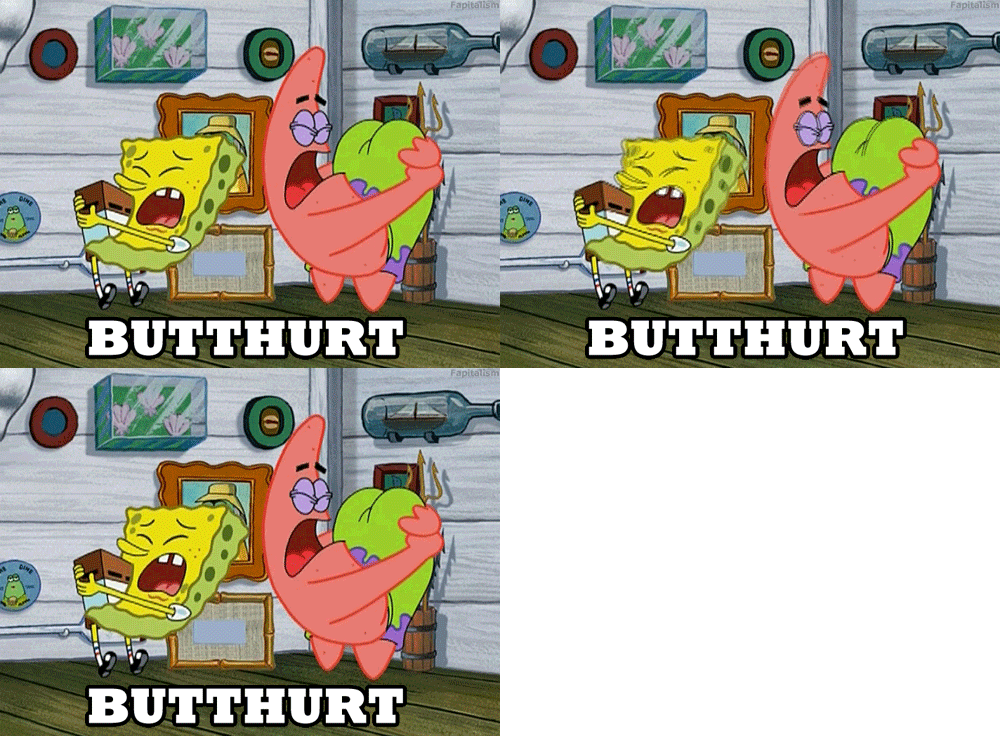
What Not to Do if You're Butthurt and Other Stories

Here are a few mini-blog posts, instead of one coherent one, because that is what I have for you.

(1) I woke up this morning thinking about public figures who are not universally admirable - a consequence of reading this post, which had a sort of eternal-mirror effect on me, as I'm close to removing that blog from my reading list because I find the writer increasingly combative, and so while I don't have the same relationship with the writer of that blog that the writer of that blog has with the subject of that blog post, it's still kind of ironic. Dontcha think?

I considered writing my own post about how I cope with public figures I admire but do not like, but after I looked at the comments on Jenny's post and found that "people we admire usually aren't everything we want them to be" is not in fact the great new lesson that I thought it was - because I learned it on my own, through experience, without being taught it by a parent or a mentor or an article on Medium.com, and hence thought it was worth sharing as if it was new - I decided to save that musing for a time when it's somehow more relevant. Anais Nin, Richard Nixon, and yes, Amanda Palmer: these are people who are not everything I want them to be (or sometimes almost nothing I want them to be), but whom I still admire. Another time I'll tell you why.

Yes, I admire Richard Nixon.

There are so many good Deal With It pics that I pretty much died trying to pick one

(2) This weekend I finished Absalom, Absalom!, and I hope there are few books more momentous, more sublime, to come in my lifetime. I don't think my heart can take many more. It was SO HARD, you guys, it was harder than Remembrance of Things Past (or the first three volumes anyway) and way harder than Moby-Dick, but it was better than almost any book I've ever read.

I don't know why.

I can't distill for you why, for me, it built to such a pitch that I thought my head might pop like a grape before I was finished putting all of its words through my eyes, nor why even for all that I couldn't understand exactly what happened in the last major set piece. (Thank Christ for SparkNotes.) It was like the dead middle of The Sound and the Fury, two or three of my favorite pages in all literature, except bigger and badder, and for a stretch of many more pages. It reminded me of a film, Ordet, which is so difficult as to be almost unwatchable but which I always list as one of my favorite films. It gave me a set of thoughts and sensations that no other film has ever given me. Absalom, too, is so hard that I can't see myself recommending it, but I'll certainly put it up there on the list of the best books I know.

(3) Something happened in the videogame world that reflects very tidily on something I'm dealing with in my workshop class that I've been wanting to blog about. Jim Sterling, a critic for The Escapist, created a walkthrough review of the independent videogame The Slaughtering Grounds, giving it a poor grade. (That is, Sterling recorded his eye-view experience of playing the game and talked over the recording, discussing what he found was or wasn't working about it. Video here.) The developer, whose name does not seem to be a matter of public record, responded to this poor review by making a video with text annotations over Sterling's criticisms, explaining his intentions in making the game and why Sterling is a poopyface. This went about as well as you might expect. (Sterling's response to the response to the review is here. The dev's response to the response to the response to the review [yep] is here.)

Actually, same goes for this one - just Google Images "butthurt"

The central problem here is that you can't argue against someone's response to your art. You can't. You can't. You can talk about how your intentions may be different than the consequent experience of the art, but it's risky; I think the only contexts in which that works are a) if you need to improve the art, to make the experience jibe with your intentions, and you need more explicit feedback to do so, or b) you find it funny or interesting or instructive how the intentions and experiences don't match up and you want to share that. But it is not possible to defend against user experience. And most kinds of defending oneself against criticism sound terrible. They sound defensive and immature, almost universally. From the outside, even subtler ones than this dev's poorly spelled insults sound defensive and immature.

See, I couldn't even narrow it down to just one

It's particularly awkward in workshop, because there's nothing I know of that a writer can say about her intentions to which I won't respond with "Okay, but it needs to be on the page." If you get published, you can't go around to everybody in the world who's reading your story and stand over them and say what you meant by this or that. It has to be on the page. Matt's boss puts it even more succinctly: "You don't come in the box."

[by which he means a little version of the developer is not wrapped up with the game disc. perv.]

(4) My writing exercise this weekend went so much better than I expected that it put me in a good mood, which is such a rare event that I feel the need to record it. I keep waiting for a writing exercise to be good enough that I want to share it, but not so good that I want to keep it under my hat for revision, expansion, and potential submission. If that ever happens, I'll post it here. In the meantime, th-th-th-th-that's all, folks.

Tuesday, September 23, 2014

Narrative...Narrative Everywhere

Last week. Matt is playing Destiny. I'm wading through Faulkner.

"I guess shotguns won't change much in the future," he says.

I read to the end of the sentence and look up. "Hm?"

"It's funny to me that the shotgun is still the same. You load it like this and you pump it like this." His avatar loads some shells and chk-chks the gun like you do.

"But if you changed those functionalities it wouldn't be a shotgun anymore," I say. Matt and I both know that on the rare occasions I play video games myself instead of watching him play, the shotgun is my weapon of choice. It would also be my weapon of choice in the zombie apocalypse. (Of course we've had that conversation.)

"Future shotguns should make shotguns better," he says.

"But if you changed out the weaknesses of present-day shotguns, they wouldn't be shotguns."

"So what makes a shotgun?" he says. He asks the question in this probing genuine way he has that tells me he wants a real answer, that he's not just blueskying or joking. That the answer will offer up some other little grain of sand that makes me me, some more content regarding the wife he chose.

I don't think for long. I just rattle off the things I love about shotguns. "The shrapnel aspect of the shells, the pump action, the fact that you don't have a lot of ammo, and...the sheer power of it when you fire." My brain thinks BOOM, thinks of people jolted at the shoulder and staggering back a step. Oh, pardon me, BOOM, while I turn you into dog chow.

Matt's avatar's gun rises and falls gently with her breath while he looks at me. "That's interesting," he says. "What you think of as shotgun characteristics are like the story of the shotgun."

Huh. "Huh," I say.

"I mean not how it's manufactured or its technical specs, but what you have to do to fire it, and what happens when you do. That's the story of the gun, not what's good about it."

"I never thought of that," I say.

"It's very you," he says.

"I don't really know much about shotguns," I say. "You'd have to ask [friend who owns a bunch of guns]. I just know what I like to fire at dudes in videogames."

"Uh huh," he says. His avatar gets back to running and gunning. He favors arming her with an assault rifle for reasons I will never understand.

Friday, August 9, 2013

Haters Gonna Hate, Bullies Gonna Bull, Trolls Gonna Tro

Note: the links and video in this post are full of expletives and adult content - some of it vile, some of it hilarious. FYI. 

The end of July brought pretty lame news for creatives. An indie game developer, Phil Fish, got tired of taking abuse from various corners and announced that the game he was in the process of creating was going to be cancelled and that he was leaving videogames altogether. The games industry needs developers like Fish (creatively; not perhaps personally), and it's pretty ridiculous that haters drove him out.

He really just needed to look at this chart by Ann Friedman (click to embiggen).
It makes things so CLEAR. 

This article on the Penny Arcade Report is one of the best I ever expect to read about the ways in which superfluous negative criticism - a.k.a. trolling - subtracts from our lives. The toxicity of trolls feels to me like a kind of cosmic blowback from the no-tolerance-for-bullying thing that's swept American schools for the past few years. We'll just take it to the internet, the bullies bellow; you can't stop us there.

I was bullied a little bit in middle school. The thing I learned from this experience (along with "middle school sucks") is that nothing fucking works. Ignoring them doesn't work, because they escalate. Reporting them doesn't work, because they will find you alone, and they'll escalate until they get your attention. Responding in kind doesn't work, because then you're a jerk too. Plus, they escalate, and you'll both get bloody noses. Making them think usually doesn't work, because people don't bully with their brains. Humiliating them from your place on the high road is pretty much the only thing I know that works, and hoo mama is it tricky.

Upsetting as it was at the time, I remember only sketches of the bullying I underwent then. I remember better something that happened in a community college bookstore about five years ago. I had come straight from work, and I was wearing a button-down shirt that I liked a lot. It had wide, vertical black-and-white stripes, and the black was a little distressed and arty.

Two bookstore employees hanging around in the aisle made fun of me for wearing a shirt that looked like a referee's. Actually made fun of me, exactly the way you'd make fun of your little sister for a stupid-looking ponytail if you were ten. I was so amazed that this was possible in adult life that I muttered "thank you" several times (??) and got the fuck out of there. This still bothers me from time to time, not because they hurt my feelings and made me stop wearing that shirt forever after, but because it seemed so colossally dumb and bizarre to ridicule a grown woman, a stranger, for her clothing. What the hell were they thinking? Why??

Matt has tried to explain to me that trolls have a different thought process than you and me. That "why" doesn't really enter into it. That all they want is a reaction, any kind of reaction. Returning their abuse, killing them with kindness, and deletion all offer them satisfaction. Because each shows that you wasted a thought on them. Leaving aside how little I understand this, I find it pretty pathetic. Like Honey Boo Boo. A desperation for attention so all-devouring that it lowers every one of us into the muck.


On my last morning at Esalen, I had breakfast with a couple of ladies I hadn't talked to much before. One of them was around my age and the other was around my mom's age. I don't remember how it came into conversation, but I said that I didn't know how much of my motivation to write well and succeed should come from "I'll show 'em all." The woman my age nodded fervently, clearly grokking it even without what I was about to say, the explanation I was about to give: there are so many people I've encountered whom I want to look defiantly in the eye when I shake hands with an agent, or pick up the Sharpie to sign yet another book, or accept my National Book Award (and while I'm dreaming, I'd like a pony). So many people I think of when I write a really fine sentence and think See, fuck you, I'm worthwhile, and you'll be sorry you crossed me.

But even before I said any of that, the woman my mom's age said "Not even one bit of it. Don't waste your energy on showing anybody. People you have to show aren't worth a moment of effort."

She said it with such conviction. I'd heard this message before, but hadn't heeded it, as it's always seemed a bit like communism. A nice principle, but not one that is applicable in the petty, muddy, bloodily competitive human life I generally lead. Rugby on a rainy day doesn't coax the finest, highest thoughts out of most players. I've been using "I'll show 'em all" to motivate me from time to time, because I figure that at least it's something to motivate me, rather than just muddling about and hoping for the best. But the woman seemed to speak from experience. And the idea of showing 'em all does leave me kind of empty at the end of the day.

Of course, there's stuff like this (NSFW, but a must-watch):


I think "Thank You, Hater!" is a one-off, and taking this amount of time and energy to respond to trolls is really not a good idea on a regular basis. But oh, is it ever satisfying to watch.

Speaking of satisfying, if you ask me, Parker/Stone are kind of the last word on this whole question of what to do about people who tear you down for no apparent reason - bullies, haters, trolls, lesser rappers. This whole episode from season 16, "Butterballs," is worth watching for its insight on bullying, but this bit, at the end, is one of those moments that sticks after the satire fades.

If only Phil Fish could have seen this and taken it to heart before he gave up on his endeavors. Before he let them win.


Tuesday, January 15, 2013

Postscript: Concerning Vaas Cheesecake

Two people said they wanted to hear me expound about something I brought up in the last post after all, so, here it is.

This is Vaas Montenegro.


Friday, November 9, 2012

Katharine on Catherine

At the beginning of this week, a friend of mine posted this picture on Facebook with a comment on his disappointment in game-makers for doing shit like this:


He then linked to this ad for the video game in question:


In case I have to say it, ugh. Ugh ugh ugh.

Someone linked to a Malibu Stacy video, someone else reproduced Picard doing this in ASCII, some other people said some awesome defending-women-as-humans-with-brains stuff. Yay for enlightened men. But then someone linked to the Wikipedia page for the Japanese game Catherine. And I kind of did what Picard did:
Nooooooo Catherine is full of ridiculous sexism. Madonna/whore crap and female devouring. no no no no no.
My friend replied with
I haven't played through it yet, but to be fair, that stuff is in the dreams of the dude. It makes sense that his subconscious would have sexist ideas.
I did the computer equivalent of opening my mouth to reply with a long diatribe, and then snapping it shut again. I was going to argue that it hardly mattered whether the game put (very, very old and very, very harmful) ideas in dreams or subconsciousness or whatever, that putting them in games at all was harmful because it continued to perpetuate and spread the ugliness. Fucked-up is fucked-up and it matters very little whether the main character was dreaming or fantasizing or rehearsing a play. The ideas still burn out of the screen right into my brain as sexist.

But I took my fingers off the keys when it occurred to me exactly how hypocritical this would be. In my short story "Fucked", which was published in two print venues, my main character gets her lower abdomen sliced open (shallowly; she winds up okay) by a man who's angry because she's pregnant. A recent story I wrote from the POV of an abusive gymnastics coach begins with this paragraph of sunshine & rainbows:
She’s doing it wrong again. The little bitch. She’s not trying hard enough. She thinks because she has other talents I’m going to let her slip by without doing it right, exactly right, every time. Sneaky little bitch.
And, in fact, the depraved story I wrote last week invokes the devouring woman in a pretty literal way.

So I sat with this for a little while and wondered how I could continue to believe in the ugly fiction I write while maintaining that Catherine was misogynist and harmful. I think it is, but I couldn't figure out how to defend that position while still defending my own work.

I know very well why I write stories where such terrible things happen to women: because terrible things constantly happen to women in real life, and I believe that by bringing attention to them in literature, people will actually give some thought to these things in real life. I want to explore wounded women and unlucky women, and even villainous and clueless women. I am drawn to the dark rather than the light because that's the way I am, but I'm drawn to darkness in women because I find it more interesting, more provocative, and less explored than in men in literature. I approach darkness with the intent to empower and enrage, maybe in equal parts.

But in thinking about how I'd rebut this Facebook comment, I couldn't say for sure that in writing stories where awful things happen to women, I wasn't doing the same thing Catherine did, showcasing and encouraging bad attitudes against women by exploring them in such loving detail.* Scripting harm against fictional women probably does harm actual women in any form, and the fact that I'm a female writer trying to make a point about the unfairness and commonness of violence against women could have been beside the point. Since I couldn't defend myself while leveling criticism at Catherine, I just said nothing.

And then I asked twinkly and kamper about it when I saw them in San Diego. What am I missing? I asked. I described Catherine in a few sentences, explaining that girlfriend-Katherine wants to get married now please, I don't care if you're husband material or not, buy the cow, shackle yourself to me, NOW but otherwise is sort of personality-free, and that dalliance-Catherine is a perfect mistress, sexy and playful and devoid of distinct personality or motivation that is not first, ideally pleasure the man, and then, bring that sucka down and emasculate the stuffing out of him. I noted that the main character is sort of a well-meaning schlubby type whose life isn't going anywhere.**

twinkly and kamper explained in equal and intelligent parts that what I was missing was the approach. It sounded to them as if Catherine came from a base of unconscious misogyny, rather than a base of trying to overturn and explore misogyny (my own). And they're right. The underlying assumptions of the game are degrading and harmful to women. Such as Katherine and Catherine automatically being Madonna and whore and not having any sort of nuance to these portrayals. And the necessary underpinning that all men have nightmares about being devoured by giant, terrifying succubi with many breasts. That nightmare comes from a place of fear about women being too powerful or dominating, as an entire gender. That is not good.

I do think twice about what I write before I write it. Something I put in a recent story seemed a little bit like an instruction manual in a way that creeped me out. But it came right out of warnings my mother gave me about keeping safe when driving by myself (in brief: always check your backseat before you get in the car), so my hope is that it'll keep safe someone who's good more easily than it'll give inspiration to someone who's bad. My enduring hope is that people reading my work will say "hey...why is the other half of the population treated this way?", even if none of them burn a bra or join NOW.

None of what I write blots out the insidious workings of games like Catherine or, most unfortunately, Top Girl. What's interesting to me that sexism like you find in Catherine is more and more often being replaced with the new sexism of Top Girl or the Bic for Her pens or the awful, very-quickly-cornfielded "Science...It's a Girl Thing!" ad campaign.*** That stuff is harder to pin down, as it's not part of an old and harmful archetype, and it's not very blatant.

But it's still there. It's always there.

--
*Total sidebar: I don't think a male director could have gotten away with American Psycho. It, too, explores violence against women in extreme detail, and I think in failing to explain much about why Bateman chose mostly women as his victims, Harron was saying that of course he chooses women, because what other group would an American psycho choose to victimize? At least, I think that's her point. If a male director had made the movie, it might have made me a lot madder even than it did.

**Not unlike a Judd Apatow character, in fact. Golly, what a coinkydink. 

***Do watch both of those videos, when you have the chance. Five minutes altogether. 

Sunday, September 9, 2012

Is a Man Not Entitled to the Sweat of His Brow?

Over the past week, I played the game Bioshock from start to finish. (On Easy mode.) For all my big talk about geekdom and video games, I don't actually play video games often at all. The last time I played was, oh, 2007? 2008? when the RPG Oblivion was new. I played that for hours and hours, and loved it. But I grew so invested in the nature of play that my emotions got way out of control, and I had to stop. Generally I sit and spectate while Matt plays, often very helpfully adding feedback. ("No, go over there first...what is that thing? Oh, it's just a floor light, never mind.")

I've watched him play a lot of games that were unique or interesting or worth thinking about, but almost none of them have I desired to play myself. I wish I could have played all three Uncharted games from start to finish, but they're quite long and I think the combat would have pissed me off. The Gears of War series is fascinating, but although I could discuss its meticulous bar-raising within the context of gaming for a long while, I don't think it really has cultural import outside of that context, and anyway it's so damn bloody that I don't even like watching it, much less playing. I'd probably like the Fable series, but I never really got into the stories when Matt went through them.

Bioshock, on the other hand, enchanted me from its first moments. Its premise is that an engineer industrialist named Andrew Ryan (whose shared initials with Ayn Rand are not a coincidence) built a city, Rapture, at the bottom of the sea, and attempted to create a society of supermen there using genetic engineering and the sheer force of his will. You, the player, make your way down to Rapture after a plane crash, and hijinks ensue. (There are many more aspects to the story and structure of this game, but I'm selecting the ones that made me fall in love with it.)


The game is almost a whole piece of art in its visual design, imagineered to the very smallest detail, an Art Deco paradise that has been wrecked by seawater and greed. Its beauty utterly mesmerizes me. Beyond that, the mechanics of the game are superb, the gameplay is endlessly diverting, and the story delves into philosophical issues that turn the very act of playing a video game entirely on its head. I won't call it flawless, but it's the finest piece of work that I've ever seen Matt play.

I decided to play it myself for two reasons: 1) the ghost of Rapture just won't leave me alone, its beauty and mystery and madness, and I can hardly command Matt to play it for me again; and 2) the third Bioshock game is being released early next year (supposedly; the release date has already been pushed back) and I want to play it. I was pretty sure I would suck badly at the game, and at first I did, but I got used to using the controller quickly enough and on Easy mode, it's pretty hard to die. For the record, shooting splicers in the face with my grenade launcher never got old.

Even though in real life, Rapture would be terrifying and dangerous (and, of course, impossible), during the hours I spent there this week, I constantly had that same looping feeling that I have when I read Harry Potter: I never want to leave this place. I just want to walk around in the environs of Rapture for days and days, looking at the advertisements and the wreckage and the remnants of the beauty that was. I want to imagine it's possible that such a place could ever have been built, even if petty human urges ruined it. I want to stay here forever.

And that, my darlings, is effective world-building.