I've now put out all the most worrying fires that got started while I took the month of October off from reviewing. There are plenty of emails that need answering, and a whole chain of labor to do related to a relatively minimal chore (must print shipping label and proofs of freelancer pay, must move printer to desk in order to print, must organize desk in order to move printer, must organize rest of office in order to organize desk, must figure out bookshelf situation in rest of apartment in order to organize office), and o, the pile of books to read. But I feel okay about the future for now.
I do have lots of thoughts and ideas flying around in my head, which is usually evidence that I need to write a blog post. So here I am.
Showing posts with label Marilyn Monroe. Show all posts
Showing posts with label Marilyn Monroe. Show all posts
Tuesday, November 5, 2019

Monday, June 24, 2013
How to Read the Same Thing Twice
Three weeks ago I read a 1963 book called The Story of the Misfits by James Goode. (The Misfits in this case being the 1961 film starring Clark Gable, Marilyn Monroe, and Montgomery Clift.

Not the punk band,

nor the rival band

of Jem and the Holograms.) The book was more or less a production diary of the overlong, over-budget shoot that resulted in one of the oddest letdowns of that period in cinema. I don't know what I was hoping for from this book; more dirt and gossip, maybe, or a clearer window into the potent personalities involved in the film (John Huston directed and Arthur Miller wrote the screenplay) and how they bounced off one another. Whatever I wanted, I didn't get it.
Throughout the parts of the book that involved Marilyn, I kept having the feeling that this wasn't like I remembered it. No, I wasn't there - my mom turned two that year - but I was recalling the stories of these events from my main source for Marilyn inspiration and knowledge: Donald Spoto's exhaustive biography of her. It presents a whole woman, flaws and all, and offers carefully sourced versions of events in her life that aren't in many other books about her.* After finishing Goode's book, I reread the sections of the Spoto book involving The Misfits, and I was amazed at how different a picture was painted.
For example, Goode's book mentioned from time to time that John Huston was doing a lot of gambling throughout the picture's lengthy location shoot in Reno. If you asked me what Goode intended to convey by talking about this, it would be that Huston had a man's habits and a fool's luck at the gambling table, but boys will be boys. Something Goode failed to mention but Spoto pointed out was that Huston was gambling with the production money. Tens of thousands of (1960) dollars of it. Which he had to call around to Hollywood friends to try and replace before the shoot ended. I don't think that Goode's book tried to pin all the production problems on Marilyn instead, but it lovingly described her huge entourage of assistants and groomers and repeatedly brought up how her lateness made things more difficult and expensive.**
The Spoto biography also put into perspective that Arthur Miller continued to alter Marilyn's role in The Misfits as their marriage situation got worse and worse, twisting Roslyn into a character with less integrity and more flooziness, more of a soft female foil to Clark Gable's incontrovertible masculinity, as the shoot wore on and on. Goode did record that scenes were being rewritten all the time, but didn't mention any character shifts (not that he had access to such subtleties; if he even saw that Marilyn and Arthur's marriage was failing, he didn't say anything). He also spent a lot of time quoting Miller, who sounded to me like a pompous, conceited sourpuss, but I can see how you would mistake that for intellectual giantism if that's what you expect.
Spoto takes every opportunity to sympathize and empathize with Marilyn, to show the reader the events from her point of view. I appreciated this enormously when I first read the biography, because I felt like I'd sat and talked to Marilyn herself for the length of the book, rather than reading about her at a remove. However, next to Goode's reportage, the style seemed downright simpering, as if Spoto was overly interested in making her sympathetic rather than serving the facts. I always felt that his biography was pretty neutral, not fawning, as he doesn't hesitate to talk about her mistakes and how her character failed her. But I no longer had that sense when reading about the same events from a different point of view.
All this is to say: I am astonished at how wildly disparate the same events - sometimes the same actual quotes coming out of the same person's mouth! - seem in different hands, in different contexts, with different attitudes. This long but fascinating article, which is about this very issue applied to a John Belushi biography authored by Bob Woodward, demonstrates this particularly well.
It's also the very thing I plan to get at in the wikibook. (I think I'm too ambitious about theme in this project, because I also want to get at how life on the internet works on people.) The central purpose is to write about how the real version of events, when the participants aren't talking or can't be trusted or all tell different stories, can never truly be known. How our perception of events determines what we consider the actual nature of those events when we are reading about them; how the unbiased reporter can (unwittingly?) become the biased storyteller. Rashomon, sort of, but with more petty arguments between Wikipedia editors.
I'm trying to write a little on it every day, in no hurry at all. I expect this book will take me in the years rather than in the months. It's a much more meticulous, cerebral project than any of the book-length work I've done before. Last week went okay with it, but all spring I've been much more adept at avoiding it than writing on it.
In case you're interested, I was inspired by the death of Jean Harlow's second husband, Paul Bern. He probably killed himself, but we'll never really know.
---
*She never slept with Robert Kennedy. She probably slept with JFK once. She died due to gross negligence over drug dosages/combinations on the part of her doctor, Ralph Greenson, not because she overdosed on purpose or the Mafia killed her or whatever. Stuff like that. I tend to believe Spoto's versions of these disputed events, because he clearly spent more time on Marilyn than most of her other biographers did.
**For those of you who don't know much about Marilyn Monroe, she was pretty much always late for casting calls in the last years of her career, sometimes by a matter of several hours. I.e. if shooting was supposed to start at 10 AM, she might not show up until 1 PM, with no explanation. Spoto indicates that she was insecure and suffered from atrocious stage fright, and her lateness resulted from not being emotionally ready to perform. She also had serious sleep problems throughout her whole life, which meant that in the morning she sometimes had trouble shaking off the sleeping pills she took.
Not the punk band,
nor the rival band
of Jem and the Holograms.) The book was more or less a production diary of the overlong, over-budget shoot that resulted in one of the oddest letdowns of that period in cinema. I don't know what I was hoping for from this book; more dirt and gossip, maybe, or a clearer window into the potent personalities involved in the film (John Huston directed and Arthur Miller wrote the screenplay) and how they bounced off one another. Whatever I wanted, I didn't get it.
Throughout the parts of the book that involved Marilyn, I kept having the feeling that this wasn't like I remembered it. No, I wasn't there - my mom turned two that year - but I was recalling the stories of these events from my main source for Marilyn inspiration and knowledge: Donald Spoto's exhaustive biography of her. It presents a whole woman, flaws and all, and offers carefully sourced versions of events in her life that aren't in many other books about her.* After finishing Goode's book, I reread the sections of the Spoto book involving The Misfits, and I was amazed at how different a picture was painted.
For example, Goode's book mentioned from time to time that John Huston was doing a lot of gambling throughout the picture's lengthy location shoot in Reno. If you asked me what Goode intended to convey by talking about this, it would be that Huston had a man's habits and a fool's luck at the gambling table, but boys will be boys. Something Goode failed to mention but Spoto pointed out was that Huston was gambling with the production money. Tens of thousands of (1960) dollars of it. Which he had to call around to Hollywood friends to try and replace before the shoot ended. I don't think that Goode's book tried to pin all the production problems on Marilyn instead, but it lovingly described her huge entourage of assistants and groomers and repeatedly brought up how her lateness made things more difficult and expensive.**
The Spoto biography also put into perspective that Arthur Miller continued to alter Marilyn's role in The Misfits as their marriage situation got worse and worse, twisting Roslyn into a character with less integrity and more flooziness, more of a soft female foil to Clark Gable's incontrovertible masculinity, as the shoot wore on and on. Goode did record that scenes were being rewritten all the time, but didn't mention any character shifts (not that he had access to such subtleties; if he even saw that Marilyn and Arthur's marriage was failing, he didn't say anything). He also spent a lot of time quoting Miller, who sounded to me like a pompous, conceited sourpuss, but I can see how you would mistake that for intellectual giantism if that's what you expect.
Spoto takes every opportunity to sympathize and empathize with Marilyn, to show the reader the events from her point of view. I appreciated this enormously when I first read the biography, because I felt like I'd sat and talked to Marilyn herself for the length of the book, rather than reading about her at a remove. However, next to Goode's reportage, the style seemed downright simpering, as if Spoto was overly interested in making her sympathetic rather than serving the facts. I always felt that his biography was pretty neutral, not fawning, as he doesn't hesitate to talk about her mistakes and how her character failed her. But I no longer had that sense when reading about the same events from a different point of view.
All this is to say: I am astonished at how wildly disparate the same events - sometimes the same actual quotes coming out of the same person's mouth! - seem in different hands, in different contexts, with different attitudes. This long but fascinating article, which is about this very issue applied to a John Belushi biography authored by Bob Woodward, demonstrates this particularly well.
It's also the very thing I plan to get at in the wikibook. (I think I'm too ambitious about theme in this project, because I also want to get at how life on the internet works on people.) The central purpose is to write about how the real version of events, when the participants aren't talking or can't be trusted or all tell different stories, can never truly be known. How our perception of events determines what we consider the actual nature of those events when we are reading about them; how the unbiased reporter can (unwittingly?) become the biased storyteller. Rashomon, sort of, but with more petty arguments between Wikipedia editors.
 |
| So not that different at all, really |
I'm trying to write a little on it every day, in no hurry at all. I expect this book will take me in the years rather than in the months. It's a much more meticulous, cerebral project than any of the book-length work I've done before. Last week went okay with it, but all spring I've been much more adept at avoiding it than writing on it.
In case you're interested, I was inspired by the death of Jean Harlow's second husband, Paul Bern. He probably killed himself, but we'll never really know.
---
*She never slept with Robert Kennedy. She probably slept with JFK once. She died due to gross negligence over drug dosages/combinations on the part of her doctor, Ralph Greenson, not because she overdosed on purpose or the Mafia killed her or whatever. Stuff like that. I tend to believe Spoto's versions of these disputed events, because he clearly spent more time on Marilyn than most of her other biographers did.
**For those of you who don't know much about Marilyn Monroe, she was pretty much always late for casting calls in the last years of her career, sometimes by a matter of several hours. I.e. if shooting was supposed to start at 10 AM, she might not show up until 1 PM, with no explanation. Spoto indicates that she was insecure and suffered from atrocious stage fright, and her lateness resulted from not being emotionally ready to perform. She also had serious sleep problems throughout her whole life, which meant that in the morning she sometimes had trouble shaking off the sleeping pills she took.
Thursday, May 3, 2012
Write Me
One of the best pieces of feedback I've gotten for the [non-]horror novel so far is a reader saying that the main characters seemed to be eating an awful lot, constantly sitting down to meals. She said would probably be too upset to eat most of the time. Due to my blood sugar issues, I'm constantly thinking about my next meal, and I know I transferred that to the book in a way it doesn't really belong. The problem upon revision is what activity I can give my characters to gather them all together periodically so they can have conversations. There aren't any TVs where they are, and it's hard to imagine them just kind of sitting together in the same room with no purpose to the gathering.
I gave it some thought, and hey, you know, maybe they'd play cards. It feels like an antique activity to me, but what do you do when you're stuck in the middle of nowhere with a bunch of other people? You do what your grandparents did. I had a brainwave that one of the characters could play clock solitaire, a game I played when I was a little girl (I was an only child), because, you know, the book is about time and it's clock solitaire. But I couldn't remember how to play clock solitaire, and I'd need to know that to put it in the book.
I looked it up on the internet, but the instructions on the internet were completely different from the way my mom taught me to play, and much more complicated. The notion wouldn't leave me be last night, before I went to sleep, that I had to remember how to play. It felt a little desperate that I couldn't recall. So I unearthed a deck of cards in my house and laid out the clock on my bed.
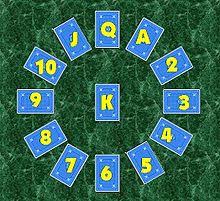
After a few rounds, I remembered how I used to play, but it took the physical act of laying out the cards to jog my brain. The cards I found have never been used, to my memory, and they were slippery, sliding toward me over the sheets. And I couldn't win a hand. I was tired, and ready to sleep, but I was just determined to win a round before I put the cards away and went to sleep. I played for nearly half an hour, the pre-sleep white-noise app on my phone creating a thunderstorm around me, and ultimately never did win. I want very much to go back to it this morning, to play until I manage to organize the cards in the proper way. And I can't cheat. I cheated at Solitaire when I was a lass, but I'm too damn old to do it now and look myself in the mirror.
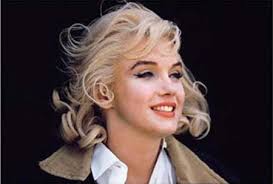
Part of what wouldn't let me alone about this experience was the deck of cards itself. The only cards I knew we had in the house - unless I had given them to charity, which I thought I might have, and I was so relieved when I found them in the little drawer where they've likely been sleeping for about five years - was a deck of Marilyn Monroe playing cards given to me by an ex-boyfriend. He gave me a lot of little Marilyn things like this, because I got interested in her while we were together. The idea of the novel I want to write about her had started to stir and wake even then, all those years ago. Marilyn magnets and bargain Marilyn photography books and a Marilyn purse, he gave me. I still have most of it.
Last night, the pictures of her on these cards were...haunting is the wrong word. She doesn't haunt me; she's too alive, too dynamic to haunt. Mesmerizing isn't quite the right word either, too dark. Impelled me, these cards did, implored me: write my book, Kat. Write me. Set me forth, the way you've been telling yourself you will for six years.
I've got to finish the sci-fi story, about which I'm pretty confident, and I'm thinking of doing a couple of other, smaller projects in between, but the Marilyn book is the Next Big Thing. I'm just ultra-anxious about it, too anxious to begin. I made a start on it years ago, and my pages were rotten. Too fawning, too personal. I have a decent story and thematic construct in my head, which is more than I had then, but I'd like to have a better handle on it all before I get going. A lot of books about her (some claiming to have new information and insight) have come out in the last six or seven years, and I really should read some of them, not depend solely on Spoto. I'd also like to be sure that it's not going to implode once I get in there. But I guess you can never really know that, right?
I gave it some thought, and hey, you know, maybe they'd play cards. It feels like an antique activity to me, but what do you do when you're stuck in the middle of nowhere with a bunch of other people? You do what your grandparents did. I had a brainwave that one of the characters could play clock solitaire, a game I played when I was a little girl (I was an only child), because, you know, the book is about time and it's clock solitaire. But I couldn't remember how to play clock solitaire, and I'd need to know that to put it in the book.
I looked it up on the internet, but the instructions on the internet were completely different from the way my mom taught me to play, and much more complicated. The notion wouldn't leave me be last night, before I went to sleep, that I had to remember how to play. It felt a little desperate that I couldn't recall. So I unearthed a deck of cards in my house and laid out the clock on my bed.
After a few rounds, I remembered how I used to play, but it took the physical act of laying out the cards to jog my brain. The cards I found have never been used, to my memory, and they were slippery, sliding toward me over the sheets. And I couldn't win a hand. I was tired, and ready to sleep, but I was just determined to win a round before I put the cards away and went to sleep. I played for nearly half an hour, the pre-sleep white-noise app on my phone creating a thunderstorm around me, and ultimately never did win. I want very much to go back to it this morning, to play until I manage to organize the cards in the proper way. And I can't cheat. I cheated at Solitaire when I was a lass, but I'm too damn old to do it now and look myself in the mirror.
Part of what wouldn't let me alone about this experience was the deck of cards itself. The only cards I knew we had in the house - unless I had given them to charity, which I thought I might have, and I was so relieved when I found them in the little drawer where they've likely been sleeping for about five years - was a deck of Marilyn Monroe playing cards given to me by an ex-boyfriend. He gave me a lot of little Marilyn things like this, because I got interested in her while we were together. The idea of the novel I want to write about her had started to stir and wake even then, all those years ago. Marilyn magnets and bargain Marilyn photography books and a Marilyn purse, he gave me. I still have most of it.
Last night, the pictures of her on these cards were...haunting is the wrong word. She doesn't haunt me; she's too alive, too dynamic to haunt. Mesmerizing isn't quite the right word either, too dark. Impelled me, these cards did, implored me: write my book, Kat. Write me. Set me forth, the way you've been telling yourself you will for six years.
I've got to finish the sci-fi story, about which I'm pretty confident, and I'm thinking of doing a couple of other, smaller projects in between, but the Marilyn book is the Next Big Thing. I'm just ultra-anxious about it, too anxious to begin. I made a start on it years ago, and my pages were rotten. Too fawning, too personal. I have a decent story and thematic construct in my head, which is more than I had then, but I'd like to have a better handle on it all before I get going. A lot of books about her (some claiming to have new information and insight) have come out in the last six or seven years, and I really should read some of them, not depend solely on Spoto. I'd also like to be sure that it's not going to implode once I get in there. But I guess you can never really know that, right?
Subscribe to:
Posts (Atom)