Showing posts with label Shakespeare. Show all posts

Tuesday, October 27, 2015

The Primordial Blobbery

Since we moved out of the 1970s in terms of the fiction syllabus provided to me this semester, a lot more light at the end of the tunnel has become visible. In three weeks, I read John Haskell's I Am Not Jackson Pollock, Dubravka Ugresic's Lend Me Your Character, and Karen Russell's St. Lucy's Home for Girls Raised by Wolves. I loved all of them, for totally different reasons, and the first two gifted me with a plethora of ideas, and such an open-ended horizon, for what I can/want to write in the future.

That horizon will have to wait, though. School is not finished killing me.

Thing is, all the ideas dislodging from the soil and floating up and moving around, they're all interesting but unformed. I've taken notes, asked myself questions, created little tadpole blobs of associated words. I have a blob about Kathy Ireland, a blob about a specific memory of laughter, and a long essay-blob about my brain. I've done justice to none of these ideas and honestly, I don't even know what one of them means. They're blobs. They're not even really things yet.

There's a more shapely blob I've had in my head for about two years about Roland Barthes. It's not fiction, it's scholarly, and I'm not in any position to be advancing a scholarly idea like it in the format it deserves. But it won't let go, and I am wise enough to beware of the blob. It creeps. It leaps. It glides and slides.


The point of all this is that it's good that school is not finished killing me. I need time for these ideas to gestate, time for them to sink out of the primordial blobbery and solidify. I'm impatient to return to writing rather than schooling, but all things in their own time, I think. That's what I'm being told. Time is being given to me in different ways than I want it, but we don't get to choose how time works on us.

And the other point is that this is what school is good for. The laughter idea is going to be a big deal if it comes together the way I suspect, and it never would've floated up from the muck if not for what Dr. Chatterjee said when I was sitting in class on Monday night. I never would've read John Haskell and thought you mean I could just do this and call it a short story? if not for Dr. Haake's unusual method of creating a syllabus. Education is no small help.

Other news. I meant, but failed, to post on Sunday that it was St. Crispin's Day, and the 600th anniversary of the Battle of Agincourt. I mentioned this in my Your Friday Yes video, which I also did not post timely in this space.


So there's the video, and here's the St. Crispin's Day speech from Henry V. My original idea for last Friday's Yes was to read the whole speech into the webcam, and I think we can all be glad I came up with a different idea.

There's more to say, but I'm out of time. Natch.

Tuesday, August 25, 2015

Missing Scenes

Over the weekend, I wrote a scene between two characters, a revelation scene, that I intended to be the centerpiece of the second-to-last chapter of the secret project. As I'm nearing the end, I feel the need to tell all the secrets I've been keeping for ten chapters, hence these revelations.

I was dissatisfied with what I'd written. In an intense but vague way. It was like indigestion - an unease in the gut, something not sitting right as it works its way through your plumbing.

I compared the scene with an earlier dialogue scene with which I'm far more satisfied. The differences were myriad: ages of the characters, positions of power held by each, what was at stake for each, relation between them, content of the discussion, I could go on and on. The scenes had very little in common. Mostly, though, one was good and one was not. I kept poking at them with sticks until I figured out why.

These are notes Virginia Woolf wrote and drew for her novel To the Lighthouse.

I got this from the fascinating website Woolf Online, which has a huge cache of archival materials about To the Lighthouse - original notebooks that have been both scanned and transcribed, page proofs corrected by Woolf, letters written to and from her about the novel, etc. Check it out.
If you can't read the above, it says "All character - not a view of the world. Two blocks joined by a corridor."

The novel is divided into three sections. The first and third take place over short periods of time, a day or so, but explore in enormous depth what is going on inside and between the characters. Each of these days is of no special consequence to any of the characters - not the day everything changed for them, not the day they learned what it is to be a woman, etc. Just a fairly regular day. The middle section, "Time Passes," takes place over a much longer period of time, 10 or 15 years, I think, but it's only 17 pages long in my edition, and that's because Woolf doesn't go very deep on anything during that time. She instead summarizes with remarkable brevity the major events that occur over that span: births, deaths, marriages, World War I. In between she describes the gradual decay of a summer house et al.

She's up to a lot of different things in "Time Passes," a lot, but I think I figured out one of the reasons she structured the book this way. As readers, we learn a lot more about the characters, and are ironically a great deal less bored, by the little stuff, the days of no consequence that pass in a family life, than we are by the big turning-point moments that matter so much to a character's makeup.

Reading scenes of large, important emotional events is not terribly interesting at this point in literary history. Most people react to a revelation with surprise. They react to loss with grief. They react to danger with fear, and potentially with bravery or cowardice. These reactions do not take imagination to write, nor do the scenes themselves. Twenty-first century audiences have seen and read these scenes everywhere, in old books and movies and in bad TV. Contemporary literature does not need me to write a scene where a woman tells a girl that she has to sacrifice herself to save her best friend; in itself, this situation may not be cliched, but the things that the woman and the girl say to each other during this scene absolutely are. I was bored writing it, which means people will be very bored reading it.

This scene is a key point of drama for certain of the characters in my book, so it has to exist. But the question I began to ask myself as I was thinking about To the Lighthouse, the $64,000 question that may lead to much, much, much better writing: does it have to exist in the book?

Infinite Jest had missing scenes like this, moments the characters kept thinking about or referring to but which were not included in full scene form in the novel. Some of them I kept waiting to read, because I presumed all things of import would be included in an 1,100-page novel, but they never appeared. And I think it's because those scenes were fairly easy for the reader to imagine for herself and would have been uninteresting for Wallace to write.

Woolf, too, decided to dispense with the big stuff in mere phrases and parentheses, and stuck with the little stuff for the main body of the novel. She knew what we already knew about the world, and she knew what she could show us afresh.

What is included and what is not included - but not left out. Discretion that jazz musicians must understand before they can really play. Choices that true craftsmen of short stories comprehend. Judgment that I suspect can be the codex for making a novel that's a work of art, rather than a novel that's merely good to read.

Events in fiction don't have to happen more than once to be what a professor of mine terms "repeated events", which "occur once, but are narrated multiple times throughout the story." Hamlet refers to his father's murder over and over and over and OVER again. Stephen Dedalus's mother's death haunts several chapters of Ulysses (usually with the very same sentences). It's the same little scratch on the roof of your mouth that your tongue keeps returning to, unbidden, but it has a different sensation on day one than it has on day four. The same death, but different reactions, depending on Stephen's surrounding company and the strength of Hamlet's metaphorical sword arm.

So even though this revelatory conversation has to occur, has to keep being considered by the characters, I don't necessarily have to write the conversation into the book. The characters know it exists, and readers of the characters therefore cannot miss its existence. What exact words passed between the characters in that room on that day is not of much importance, because the reader can imagine them and possibly a great deal more than I could put in her head directly.

How useful this is! What I can put in place of these scenes are scenes that have not been read and seen hundreds of times by a postmillennial audience. Matt said this sounded like an interesting challenge, alluding to a crucial moment well enough for the reader to imagine it rather than just writing it, and I agree. But, for once, such a challenge fills me with happy anticipation instead of terror. Even though it will be hard, I'm not stuck writing boring scenes I don't want to write. And it's all hard, anyway. No writer gets a pass on hard.

Friday, October 24, 2014

Such Outward Things Do Dwell in My Desires

Maybe next year St. Crispin's Day will fall on a day when I'd normally blog, but this year it's tomorrow, October 25, 2014, that the anniversary of one of the bloodiest single battles in the history of Western civilization (a more ironic term in this case even than usual) falls. If you didn't know about it, you've got a year to learn until the 600th anniversary. I might throw a party. I threaten to throw a Battle of Agincourt/St. Crispin's Day party every year and never do, but a 600th anniversary of anything is rare enough that I might actually follow through.

Not pictured: St. Crispin Glover

Anyway. Since it's not actually October 25th, and posting the Henry V speech would be a very lazy way to fill this space, I'll address some of the other stuff that was in my Facebook feedback a couple of weeks ago. These are questions that didn't lead to long or good answers, unfortunately, so I'm going with a Q&A format.

Q. Tips about being a good editor of one's work?

A. See, great example. My tips include a) practicing, a lot, for yeeears, and b) buying Self-Editing for Fiction Writers by Dave King and Renni Browne. That's it. Not that interesting an answer.

The more you practice on other people's work, the better you'll be at your own. If you don't have any other people's writing to practice on, find a text copy of Oliver Twist or another Dickens novel on Gutenberg and try editing it, just omitting needless words and making sentences clearer and punchier, in your word processor. That sounds unkind, or presumptuous, but...just try it. I think you'll see what I mean.

Art by Kate Beaton

Q. All About Fonts?

A. I sort of love fonts, although having learned about the existence of true font nerds, I don't fall in that category. I really like Bookman Old Style and Book Antiqua, I am not that excited about Arial, and I dislike Courier. Of course Comic Sans is a scourge, and the font that Slate has been using of late is such a travesty that I've stopped reading the site altogether, when it used to be an everyday thing. Those ys, ugh. TNR is completely transparent to me, with no inflection at all, so that's always my preference. I do think fonts have inflection, and affect the way readers read, but I couldn't begin to interpret how they work.

You thought you were writing a joke comment, didn't you? Ha! HA! I even edited down that paragraph because I went on too long about sans serif.

Q. What are they teaching you in that [workshop] class of yours?

A. Lots of stuff. If I learn anything that seems worth chewing over or passing on, I'll probably write whole posts about it, like this one. Sadly, I haven't garnered any more faith in the process. In my workshop class last semester, we focused on "What is this story doing?", which turned out to be a lot more fruitful than other methods. But I think you need a lot of skill, both in the group and in the workshoppee, to do it from that angle.

I could write a whole post about what I think of workshopping, but it would not be especially positive. So I'll set that aside for now.

Here's a hint. Art by Peter Brueghel. 

Q. Writing rituals?

A. It's kind of silly how superstitious I am. However, the only element that's not negotiable is food. I can't be hungry or I can't write. Funny, because historically many writers have been motivated by hunger, but I can't concentrate for shit if my stomach's not full.

Otherwise, this is how I prefer to do it. I keep a notes book, always smaller than 8.5 x 11, where I write down dreams, character ideas, stuff I saw out in the world that I want to preserve for later, etc., all the way up to many-page plot outlines and poorly drawn maps of fictional cities. Any notes I take elsewhere - on my phone, in a .txt on my desktop, etc. - eventually get transcribed in the notes book. I keep a separate drafting book, a lined A4 or 8.5 x 11 Moleskine, where I write the first draft of everything longhand with specific Sharpie pens, which cost too much and don't last long enough, but I'm addicted to them. When drafting is done, I type from that notebook, and in typing I'm revising. So the first typed draft is like the second or 2.5th draft of the work, because I'm usually correcting the draft even as I'm drafting, because I am annoying.

Not everyone needs writing practices this specific.

This was by far the oddest Google Images search result for "meticulous." 

None of these elements other than the full tummy is 100% required. Sometimes I'll write in ballpoint on notebook paper. (Not often, though.) And sometimes I need a small alcoholic beverage to lose my fear of the blank page, but getting too drunk to go on is a bad idea.

Speaking of which, don't let any rogue Agincourt partiers slip you anything too strong this weekend. It's only the 599th anniversary, after all. No need to really let your hair down.

Thursday, September 12, 2013

One Formative Night at the Movies

Some time ago I read this in the stage of the morning when my eyes are still only partway open. All the stuff in there is fine advice, but the only item that struck me as terribly different from other, similar online lists of advice from people who have grown old enough to know better than all of us was #8, which lodged in my mind.
When meeting someone new, try to find out what formative experience occurred in their lives before they were seventeen.  It is my belief that some important event in everyone’s youth has an influence on everything that occurs afterwards.
As I read other stuff and moved on with my day, I kept turning that over. What an interesting notion, I thought, that everyone in the whole world had some single formative experience that mattered so much to them that it impacted the whole direction of their lives. Of course all the stuff that happens to you before age 17 is formative in some way, as is pretty much everything else in the years that go forward from there - we're clay, after all, not steel - but the idea that there's ONE thing that mattered to every other moment in life, well, that got my imagination going.

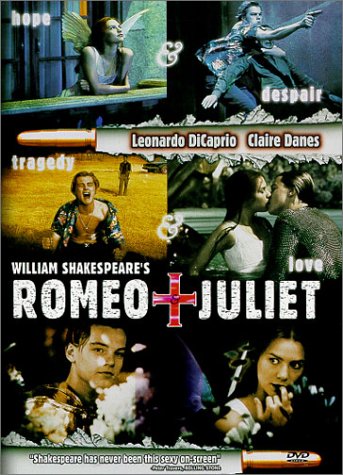
It didn't take me very long, half an hour, probably, to think of what that one thing would be for me. It was seeing Romeo + Juliet, the Baz Luhrmann movie from 1996, in the movie theater.


My eyes hurt when it was over, because I didn't blink enough while watching.

It would be dumb to claim that the film's appeal to fourteen-year-old me had nothing to do with the romance of the story, nor with my attachment to both of the young actors who played the leads, and certainly I was in love with Shakespeare's language even that early. Plus, I'd been Balthazar AND Friar John in a high-school performance of the play (both of whom, incidentally, are main players in fucking up the kids' communication, leading to the suicides - go me). But the film of the film is what really made it the seminal experience it was for me.

I hadn't known movies could impose themselves upon the audience visually the way that one does, could grab me almost solely by the eyeballs and hold on for two hours. Previously I liked movies for their stories, I liked actors for their natural appeal. I didn't see movies as pieces of art, as projects undertaken by droves of professionals, but as entertainments that dropped out of the sky. I would never see cinema that way again, not after Romeo + Juliet. That one movie is why I got a degree in film. It's the catalyst for some of the most profound experiences I've had. It's why I see the world the way I do.

Food for thought. What's your pre-17 thing?

Tuesday, August 20, 2013

Ulysses and Other Adventures

I have lots to say about what I'm reading lately.

First, two books that seem to have been written with me specifically in mind: 1) William Shakespeare's Star Wars, by Ian Doescher, is a retelling of A New Hope in [largely] Elizabethan language, in iambic pentameter, WITH. SONNETS. "Red Six doth stand by." Star Wars and Shakespeare are two of my most favorite things - like, up there with chocolate lava cakes and sleeping - so that someone combined them in an intelligent, delightful way is a gift beyond price.

And 2), Gods Like Us, a history of movie stardom by Boston Globe film critic Ty Burr. I don't exaggerate when I say that this is a book I've been wanting to read since I was a junior in college, even though it was only published last fall. Among the hats it wears, it's a critical examination of celebrity, its history and development from Florence Lawrence up to the present day. The field of star studies, a miniature niche of film criticism to be sure, has fascinated me since before I knew it existed. This book feeds my need. It's lively and informative and I'm going to write him a fan letter when I'm through.

A couple of weeks ago, I plowed through The Things They Carried, Tim O'Brien's novel in stories about Vietnam. I have a weak constitution when it comes to art about Vietnam (my father is a vet), and I kind of wish that I'd been able to get through life without having to consume this particular piece of art. But I couldn't. And I read it. And I'm not sorry I read it, but it was somewhat an unpleasant chore, if a fascinating book.

Plus I read less than 50 pages of a book called The People of Paper and gave up. Not for me.

And I read Innocence, by Jane Mendelsohn, which is a late-YA fever dream of a novel. It was quick, and very beautifully written, and was wrapped around an allegory that is well worth contemplation by a large audience of smart young women. But I wanted more concreteness out of it, and I wanted a good deal less emotional wallowing. It, the tough time I had reading Spinelli's Love, Stargirl, and my utter indifference to a book called Chime by Franny Billingsley that was made much of, have forced me to consider (and worry over) the idea that YA no longer appeals to me as much as it once did. Which would be a real shame, if true.

Along with the stars (movie and Wars), at present I'm listening to an audiobook version of Ulysses, which I've never read. It was suggested to me at Esalen that listening to the audio version of this kahuna allows the listener an easier time with the language of the book than reading it. Although only one-seventh of the way through the book (three discs out of 22), I can wholeheartedly endorse this. I downloaded the Gutenberg text onto my e-reader so I could go over some of the passages I didn't quite understand, and I was amazed at how much more complex and obtuse some of the text seemed on the page, when I got the meaning easily enough in hearing it.

The version I'm listening to has been abridged (but I'm not sure that's such a bad thing) and is read by Jim Norton and Marcella Riordan, who are both totally astonishing. Norton has the larger part, and he sings and chants and meows and takes on brogues gamely. But Riordan arguably has the more difficult task: she reads the part of Molly Bloom, both throughout the regular text and for the long stream of consciousness section that closes the novel.

I may eat these words in the end, but at the moment I'm having the same reaction to Ulysses that I had to some of Dubliners: beautiful language, Joyce is obviously the Orson Welles of 20th century literature, but I have no idea why I should care about these characters or what happens to them. I admire it, but it's failing to move me or even involve me much except in little bits, here and there. How stark a contrast I find between it and The Sound and the Fury - which is stylistically almost a riff on Ulysses, but which held a lot more depth for me.

On a not-really-related note, I watched Julie Taymor's film of The Tempest last week. Some of my reactions to it were completely unexpected, i.e. I thought Russell Brand was amazingly good and Helen Mirren kind of dull and flat. (!!!) The MVP was definitely the costume designer. The Tempest is a weird play, and I've yet to find it as compelling as its ideas in any interpretation I've seen (although perhaps I've just been unlucky), so I can't blame anyone involved in this rendering for falling a bit short. They filmed it on Kauai, which the Bard may as well have had in mind when he wrote the play, and Taymor's idiosyncratic style was not at all misplaced. But it just didn't gel.

Ahead is Jincy Willett's book of short stories Jenny and the Jaws of Life. And some writer-type activities, too, a writer's "faire" at UCLA next weekend and some laborious revision. And classes starting. Yeah, that.