Showing posts with label KUFC. Show all posts

Wednesday, October 2, 2019

One's Gotta Go

September, uh:


Fourteen reviews is a lot for one month. I didn't file all of them at the same time or even within a few weeks of each other, so it's a little disingenuous about the nature of my productivity. A little. But not a lot.

Now that September is over, I'm looking forward to doing fewer things. October has, oh, six or eight books to read, and November has even fewer than that, largely because I've been saying no to things and keeping well away from Nectar Literary's delectable newsletter.

Idly, I've been wondering what to do next. I'm trying to slow down the reviews because they're not leading to steady income (yet), and that's starting to become a priority. Freelancing is exhausting, and while I'm better suited to it than to a regular job, I'm so worried and keyed up all the time that I'd like to have something else in place by mid-2020.

I'm applying for various opportunities and putting my intentions out there. Irons in the fire include a podcast a friend is launching with me as a rotating guest, a one-time editing job that's going to be helpful on my resume, and of course the book I'm 9/10 of the way done with. The film series I co-run at CSUN has suddenly taken off in popularity, based on our newsletter numbers and an invitation we got for a Halloween event. I'm trying to teach off- and online. But underlying all this is a question mark about making the Venn diagram work for me.


I don't know whether to lean into stuff that I'm good at and makes money (legal work, detail management), or to keep limping along at what I like. I've lived both ways now, and I like this way better, but I sleep better the other way.

In April and then from August until yesterday, I watched the five seasons of The Wire, which I knew was some kind of phenomenon, but which I didn't comprehend as the monumental work of art it is until I was a few episodes in. I started tweeting it, and couldn't stop, and now I have this huge thread of tweets across several months that covers my emotional & critical reactions to the show. People who have seen the show have really enjoyed the thread, they tell me. I've decided to collect the tweets into a little paper zine, because making an internet-based text into a physical text always tickles me. Don't know when, but hopefully sometime in the next couple of months.

Now that I have one essay left, I'm balking at writing it. Even though I get great satisfaction from finishing things generally (TV shows, boxes of tea, leftover dinners), I don't like finishing creative stuff. I went over this in therapy last week and I think it's tied up with fear of success, and/or disappointment that the best part of the endeavor (the making part) is over, and the part I like least (the fixing part) has to begin. Luckily, I found a contest that it'll suit, and its deadline is October 15. So that's a good prod to make me do the work.

Along with that, I'm planning to reread Highbinder this week. An agent event happened on Twitter recently, so I pitched three folks, and got a full request from one yesterday. I haven't read it all the way through in...gosh, over a year? More than two years? Don't remember. It's time to give it another read. I was thinking about it the other week because I know I named a character Malcolm, and I have to change that because the only male character in Ceremonials is named Malcolm. They both look like Malcolms in my head, just of different kinds. But one's gotta go.

Thursday, December 7, 2017

Mostly Bullet Points, Some Filler

First, in case you missed it:
Three more reviews have been accepted but not run; a fourth has been accepted but not yet written; a fifth has been written but not yet accepted. I like books.

Also, I put up a six-word story on Medium the other day.

It seems like book reviews and reading therefor are all that's kept me from sleeping through the days I have off. The world is hard to bear right now (fires, literal and figurative) and I am tired and processing the last of jet lag and fighting off viruses from all sides. I'm writing largely on deadline instead of writing ahead, and the time I don't spend on deadline is spent reading and pitching. (The one is lovely and the other is exhausting.)

To keep me honest, here's a list of projects I need to work on for the rest of December and in the year ahead. It's a long list because I'm so behind on everything except reviews. This is about half stuff I should've been working on since summer; some of it is definitely for 2018's spring or even summer, not now; some of it is new to me as of fall 2017 but I should've started on it by now.

  • Essay involving Gayle's book
  • Zine (written)
  • Essay about Five Million Years to Earth (solicited)
  • Essay about a film that never was (solicited)
  • Bits and pieces story for the Cupboard (not solicited) 
  • Celebrity story for Enumerate (not solicited)
  • Casablanca novel
  • Conceptual novel 
  • Essay about blurry love
  • Medium story about YA
  • Medium story about eating disorder
  • Essay about Apocalypse Now
  • Essay about Jeanne Dielman
  • Essay about Last Tango in Paris
  • Collaborative thing with Higgs (part done) 
  • Outline for Plan 9 novella
  • Outlines for two workshops (happening by March)
  • Book reviews: nine (9) for now, more next year, surely
  • Endless, self-renewing pitches and queries and proposals and submittals for essays, stories, book reviews, craft book, Highbinder, secret project, whatever else I finish
  • Put together writing about the following topics:
  1. The tree where I left the blue stone
  2. Visit to Santa Fe and all I saw
  3. The Salton Sea and the St. Andrews Cathedral
  4. Trip to Oregon and the fires there
  5. Meow Wolf
  • Interviews with
  1. Duncan
  2. Samantha
  3. Tomas
  4. People who haven't gotten back to me
  5. Whoever else says yes, later
Damn, that is a long list. No wonder I'm stressed out.

Maybe this is a moment for me to reiterate how I work. Once I get going, I am a fast writer, and according to an external observer I'm a very fast reader (though I don't tend to think so). I can turn around a read and review for a book in about a week. When I'm writing other stuff, I need several months (how many of them depends on the project) to get my thoughts together, but once they are together I can write an essay in just a few sittings. For example, "The Girl on the Bike" came together very quickly, in two drafts a couple weeks apart, but I'd been thinking about the stuff in it for years. I wrote Highbinder (93,000 words) in I think five or six months, where I know many (most?) writers take years to write books.

So even though this list looks really goddamn long, even to me, it'll take me probably a month to write, finish, or execute half of the stuff on it. Which I should really just do, in most cases, instead of sleeping and avoiding it because finishing is scary. The other stuff is longer-term, or I haven't even come up with what to write for it yet, but that's the nature of my profession: some projects cook along in the background, like beans, while others get sauteed and eaten rapidly.

Did I say finishing is scary?

I do this thing where I get hung up immediately before the finish line on a task and then dawdle and stall before doing the rest of it. This is true in all areas of life: cooking & cleaning, my day job, writing projects, reading books, correspondence, research, shopping, thank-you notes, et cetera. Like, I'll get through 47 pages of entering my attorneys' billing slips and then my brain tells me to take a break and eat something and maybe nap before doing the last three. Three pages! After I've been working two and a half hours on the first 47! Whyyyyyy do you do that, brain?

Maybe "scary" is why. If I finish, I won't know what to do with myself. I'll have to start a new task that might not go as smoothly as the almost-done one is going (since it's almost done, after all) and then I'll have to work harder (or be more anxious) and if I sit in this almost-done moment for as long as possible, I won't feel anxious or guilty or frustrated.

Yikes.

This may be an explanation, but there's no excuse for letting my to-do list get as far out of hand as the above is. Get to work, Coldiron. Butt in seat. No solitaire. No YouTube. Get that zine printed up. Update your website. Write a list. Write a pitch. Just do what you gotta.

(secret confession: I get a bit turned on when dudes do that hand-mouth gesture.)

Wednesday, June 25, 2014

Dramatic, Climactic Water Revisions

Yesterday afternoon I'd finally had enough of fiddling with Highbinder and I called it good. This is something like my sixth revision since finishing the draft last January, and I'm pretty sure I'm not done, but I'm as done as I can get right now and keep from being able to recite all 325 pages of it from memory. I sent out a few queries and now I've only to write other things while I wait.

Matt asked me if I was happy with the changes I made. The harder I tried to answer that, the less able I was. I made the changes in order to reflect the climax back on the prologue, and the feedback that led me to these changes was directly on point, but it also led me into a kind of tautology that I doubt a reader will notice but that bothers the hell out of me.

Let me just be clear instead of mincing around it, even if this gives some things away. My main character, Berra, has a big problem with water. She can't be immersed in it for very long without harm. In the prologue, which is self-contained, like a short story (or so I hope/intend), she confronts immersion in water, and while she's not permanently harmed, it's a traumatic experience. The big climax of the book, as written and revised last year, involves Berra causing some property damage with dynamite, after which she's arrested. My miracle reader said, yo, why didn't your climax have any water in it? That's her THING, and you missed the opportunity to inject that type of danger into the scene. Berra didn't confront water in a dangerous way at all for the whole book after you set it up so nicely in the prologue. Wow, man, said I, that was stupid of me. And thence followed an entire year of procrastination while I tried to figure out how I could put water in the climax.

Well, I figured out a way, but only after a number of desperate conversations with Matt where I was just tearing my hair out trying, and really he deserves the credit for setting it straight in my mind, but even so, the whole thing seems kind of precarious. I don't really have a concrete plot-driven justification for the water being there, except that it is, for reasons Berra can't discover either. I hope I'll be able to retcon my way into a good reason in one of the sequels - I have a sorta-reason in mind, but it's flimsy - but as of right now I don't feel that good about it.

Nevertheless, I'm pretty sure that putting water into the climax was the right thing to do. The way it reflects on what happened in the prologue is interesting and worthwhile. Do I feel good about those edits? No. But I don't think I would have felt good about any edits after a year of avoiding them and worrying about them. I'm satisfied with them, for the time being, and if I wake up in the middle of the night with a better idea in two months you bet I'm going to plunge right into a seventh revision.


In other news, I've been on an unlucky streak with books recently. Right now I'm near the end of a novel that is more than a little repulsive, but still promises greater satisfaction than I've had out of the previous three. Maybe I'll switch to poetry for a while, or reread something I know I love. The fall semester is still two months away, but I'm already looking forward to it; I got some good news yesterday that I can't share until it's all certain. I really intended to start on a new short story this week, but it might not work out. We're covering structuralism and poststructuralism in a single day in my summer class, tomorrow, so there's a lot to keep my brain cells occupied. There's other stuff happening, too, but I guess I've forgotten it all, what with learning 2,500 years of literary theory in the past month.

Tuesday, June 10, 2014

A Year of Procrastination, Two Days of Work

On Friday and Saturday of last week, I sat down at last, at long-ass last, to revise Highbinder. I have had this endeavor on my to-do list since June of 2013, since I got some catalytic comments from a reader-friend. I can't believe it took me a fucking year. And I'm done with the first pass, because, as predicted in my New Year's resolution, it was really not that much work. It was burdensome psychological work to get myself to sit down, was all.

I did line edits (cut about 200 words that way, from just under 96,000), but more importantly I changed around the climax, some stuff throughout that informs the climax, and some of the (fictional) engineering of the world. I also removed most of the F-words in it (I resisted him, but my reader was right about that), which made me sad. I like F-words. I'm pretty sure I didn't fuck it up, but I'm going to let it sit for two weeks and then go through the whole thing again.

This revising entailed a full read of the book for the first time in many months. (For those of you following along at home, I finished the draft in January of 2013.) I shouldn't be surprised about this, but it felt...well, it's very much a book I wrote over a year ago, before I took the Esalen workshop, the UCLA class, or any of the CSUN classes. The prose often seemed clumsy, even though in reading I could remember firsthand the effort I'd put into the placement of every word. It's also very much a genre novel; everything was way overexplained, the dialogue sometimes told the story, and the narration is so far inside the protagonist's head that I should've been able to hear her heartbeat.

Ultimately, all of this is okay with me. I think the book works well enough as it is, for what it is, that I don't feel the need to start over from the top and rewrite it. (If it gets roundly rejected, maybe I will, but so far the only rejection has been because "I just didn't fall in love with the characters".) I worry a little bit about writing the sequel, because either the style will be quite different or I'll have to rewire my brain in order to put it together. The latter sounds exhausting.

It was an uneasy couple of days, but it was also such fun to dive back into that world. I enjoyed building it, and I can't wait to share it.

I don't know if it was the revising or something else, but a couple story ideas have dropped onto the pile, my first in several months. I think that means I need to get to my notebook this week. One of them came from work and the other from one of the weirdest damn dreams I've ever had, which linked sex with trains. Don't ask me. I mean...trains?

north by northwest
And not all delightful and sanitary like this 

Sunday, March 10, 2013

Query on Query

The past week has had more than its share of disappointments. Let's just pass over them, because generally life ain't bad and RiffTrax may just get the chance to riff Twilight live. 

After reading a LOT of QueryShark archives, and most of the articles linked from this extremely helpful page, I pumped out a query and a synopsis for Highbinder on Thursday. The best bit of advice I found on synopses is to read and take example from Wikipedia's plot summaries for movies or books. After I read that, I relaxed. That matter-of-fact here's-how-it-went style is honestly one that I adore reading, and although emulating it isn't as easy as it looks, I was able to write the synopsis without flop sweat after considering it a Wikipedia summary. I don't know that I did it well, but I did it. Just have to let it sit for a while.

Wanna read my query (as it stands)? It's short. Critiques welcome.
Berra Thorntree wants to go straight. After she was left for dead by her boyfriend and her boss a year ago, Berra retired from her career as a highbinder - a specialized assassin - and opened a flower shop. As a half-gaiad, she’s as good at growing things as she is at running fearlessly from rooftop to rooftop. But then she learns of Greenheart, the city government’s plan to harness a new energy source. Such a project will lead to the genocide of Berra’s people, and she just has to step in.
Unfortunately, the only person Berra can turn to for help is her former boss, Leori, the head of the most dangerous gang in the city. Naturally, Leori has plans of her own. Berra must weigh the needs of her people against her own urge to walk away from her murderous past – and there’s always the possibility that if the city’s operatives don’t kill her, Leori just might.
HIGHBINDER is urban fantasy, with touches of steampunk and alternate history, and is approximately 96,000 words. Thank you for your time and consideration. 
Now that I've drafted this, the only things left to do are a) wait for book feedback, b) revise the synopsis obsessively, and c) find another freakin' project already. My anxiety hasn't let me do c), even though it's the thing I most need to do. Maybe today's the day.

Wednesday, February 13, 2013

Random Capitalization is KING

I made this on Pulp-O-Mizer.


I love it. I'd've preferred to have the title splash diagonally across the page above the airship, and to remove Amazing Wonder Stories, but neither of those were possible with Pulp-O-Mizer's presets. As it is it's mostly what I had in mind.

I'm most of the way through Fifty Writers on Fifty Shades, and get this: the two most thoughtful, well-written, and filler-free essays I've read within were by writers named Sassafras Lowrey and Sinnamon Love. Clearly, being judgmental about people's chosen names makes an ass out of u and me.

I don't have any writing news, except that I got a rejection for a literary story - shrug - and found another market to which to submit it. And summarily did. And I'm hearing a few things here and there from friends about KUFC as they read it. All are gratifying, some are thought-provoking. Love love love feedback.

It's not yet 8:30 here, and if anyone else reading this is on the West Coast, and you have the capacity, try this to get you through humpday morning.

Tuesday, February 5, 2013

Try, Try Again

Life goes on. Over the weekend, and during a long spell yesterday, I made initial revisions to the KUFC draft. I know I need to give it one more thorough read to make sure I revised it correctly before I start sending it to friends, and I will. Just not...this second.

I realized recently that my job as a copy editor has helped me enormously with my fiction writing. It was a surprise, because the two jobs shouldn't theoretically have much to do with each other. I copy-edit largely meaningless factual articles, all of which have to be written only to a certain point of excellence and not beyond. The New York Times it ain't. Since November of 2011, I've rearranged countless sentences, deleted infinity+1 unnecessary prepositional phrases, and written a great deal of copy even though I didn't want to and wasn't inspired to. All that rearranging and deleting and rewriting has shown me that no sentence has an imperative form, that English is crazy mutable (something I knew vocabularily, but didn't get on a structural level), and that all you need to do in order to write is put one word after another.

The imperative form thing has been the most useful lesson. In the past I tended to think of narrative writing as much more concrete than I now believe it is. Each sentence, I thought, should be structured in one way and one way only, and generally the best way to build the sentence is the way you came up with first, because that's how it feels right.

[your laughter here]

Let's bring in an example. Here's a sentence from the prologue of KUFC (which now has an actual title, Highbinder):
I don't often do jobs across the bay, in part because it's too easy for ferry stewards and M-line attendants to remember seeing me, instead of being able to pass through Ortassi unnoticed like I usually do. 
I know this is sort of a rambling, unsound sentence, but I'm leaving it the way it is. If I wanted to edit it, I would look at it and consider the information I'm communicating in it: 1) Berra (that's "I") doesn't often do jobs across the bay; 2) when a passenger crosses the bay, it's easy for transportation employees to remember seeing him or her; 3) usually Berra goes through Ortassi (that's a city) without being seen. Conclusions we can draw from this sentence are 1) she does most of her "jobs" in the city, and 2) these jobs are of a nature that it's better when she's not being seen.

So, how can I edit the sentence while leaving the information and conclusions intact?
I don't often do jobs across the bay. One reason for this is that ferry stewards and M-line attendants might remember seeing me. I'm pretty hard to spot when I work in the middle of Ortassi. 
This is the simplest edit. It breaks the sentence into thirds and sets its information out to the audience straight, no mixers. With rare exceptions, I just don't write this way. It grates on me and I don't think it communicates nuance the way that something with more style does. Her ego about her abilities shines out in the first edit in an indefinable way that I don't think it does in this edit. You'll notice where I struck through six words that I wrote initially, but didn't need.

Take three:
Most of my jobs take place in the city, so I'm used to passing through Ortassi unnoticed. Going across the bay means encountering ferry stewards, who don't see many people come and go at night. M-line attendants, too, tend to remember seeing you get off at the last stop. 
This is better, stylistically more like me. The similar sounds in "passing/Ortassi" and "attendants/tend" would mean more revision for me, along with the use of the second person in the last part of the last sentence, but other writers would prefer this sort of rhymeish syntax and the genial feeling the reader gets from "you". There's also "see" in two successive sentences. I wouldn't leave it this way, but this is an example.

Take four:
Crossing the bay for my work is unusual. The ferry doesn't see a lot of night passengers, so I might stick in a steward's memory more easily, a problem for someone in my profession. Most frequently I take jobs in the city, and don't encounter too many people who'd remember me for more than a few moments as I flit by in the dark. 
This one is passable, but too wordy and not emotionally nuanced at all. It sets its information forth in an obvious way, which is an advantage for some writers, but not always for me. There are also several simplistic modifiers, like "too" and "more" and "many", which sometimes means I need to break out the thesaurus to say what I really mean, or (as in this case) I'm writing lazily, rather than taking trouble to find the right flow. This version I would strike completely and rewrite rather than trying to cut and paste the pieces together a different way.

Cutting and pasting and rearranging is what I do in my copy-edit job all day long, and the constant question of "How do I put this a different way?" has helped me to read every single sentence in my fiction with the same question in mind. In the past I might have left a not-quite-right sentence as it was just because I didn't think it could be written in a better way. (That sounds egotistical, but what I mean is that I thought there was no better syntactical arrangement of words in English that would say what I wanted to say, not that no one could ever possibly write a better sentence than me.) My assumption was that if I could write it a better way, I would have written it a better way the first time I wrote it. This is bunk and hogwash, but I can only see it as such after having rearranged so many sentences in the past year that I can't even begin to calculate them.

This is what the sentence originally looked like:

I know the formatting's all fucked up if you're reading this in the blog.
Blogger doesn't have a manual picture sizer, because of reasons, I guess. 

So it hasn't changed much. I forgot while I was drafting that I meant this scene to be in the present tense, and later I changed "someone" to "me" to bring the focus back to the main character. Some might argue that I should revise the sentence so that "do" doesn't appear twice, to remove "being able", and so it's clearer sooner that passing through Ortassi refers to I, not to stewards and attendants. But after considering it, along with the other thousands of sentences in Highbinder, I like it the way it is.

The point of this whole exercise is to explain how copy-editing the work of others has helped me with my own, and the biggest change is that I'm able to discern the point of each sentence upon reading it. If I were a more literary writer, the point would be art; if I were a more straightforward writer, the point would be information. For me the point is to communicate information in a specific way, with a specific mood and feel. Doing so often requires breaking the sentence down to its component information and discovering how to retool its syntax to say exactly what I want, exactly how I want. Interestingly, the flexibility of English grammar means that you can often say the exact same thing, with all the same nuance, in half a dozen different configurations. So sometimes revision entails a lot of this, writing and erasing and trying again in a sense that's little more than carpentry.

So, if anyone asks you whether or not writing is an awful lot of work, having read this post, you'll say...?

Tuesday, January 22, 2013

Meet You All the Way (??)

Yesterday morning, I revised the first 15,000 words or so of KUFC. Since I'm not finished with the full draft yet, this might have been premature of me. But in the course of writing the book, some things about the world have changed, so I wanted to get a jump on the more mechanical revisions. Plus, I finally found a website with an architectural glossary, so I could use words like "lintel" instead of saying "the horizontal beam over the top of the door."

It took me until nearly lunch to edit, and then after lunch I sat in the red chair and wrote. I had an hour or so's worth of false starts, and I took several long breaks, but I didn't quit for good until about 11:30, at which point I had finished both the action-y part of the climax and the confrontation-y part of the climax. So all I have left to do now is denoue. Wrap up all my loose ends. Possibly threaten my character's life one more time. And then the [first draft of the] book will be done.

It was hard as fuck to write yesterday's work. Not just because what was happening was impactful and upsetting for these characters, but because it was thrilling. My heart was pounding and I had adrenalin in my stomach. My mood tends to echo what I write when I'm writing it: if a character gets snide or angry, that's what goes on my face and in my mind. If I'm writing a sex scene...well. And this was an action scene, so I got excited, with my heart in my throat. (Silly, perhaps, but I hope it means the writing's more effective.) Because of this it was hard to sit down and concentrate instead of pacing out all that energy. But I did. And then, when I was finished, I slept like the dead.

Today I have pages and pages to type. I'm certain I'll be over 80,000 words when I finish typing yesterday's work, which means to you and me that the book will be book-length in its final draft. Which is always a relief.

That's all for now. I have carpal tunnel syndrome to contract. This cover of "Rosanna" is greater than the sum of its parts. Enjoy.


Tuesday, January 15, 2013

And to Think, All This from Jesus vs. Santa

And now I'm over 60,000 words. This is downright surreal.

There's so much I want to tell you about this book. So many details I want to share giddily with Matt while I'm writing. So many aspects which I feel are full of win, from character development to cool vocabulary I've invented. But I know it's not at all the thing to do, both because I'll give it away (on an individual level) and because I'll be opening myself up to thievery (on the wider blog-on-internet level). So I'm having to spin in my own little circle of happiness about what I'm writing instead of spreading the love.

This would all be a lot easier if I wasn't on such a flaming roll, writing thousands of words every day. All I want to think about is the world I've built, and all I want to do is create more inside of it.

Partly for this reason, I'm kind of dry for what to write about here. I thought of writing about this picture, which appeared on Kotaku the other day and spun up all kinds of interesting commentary in my head about gender and pinup art and what women are attracted to. But I didn't think anyone would be interested, so I chucked that idea. I thought of discussing my various writing plans in the near future, but they're all twisted up with my personal life and that was too far in the other direction, away from commentary and toward navel-gazing.

Oh! I know. Over the past few months, I watched the entire berth of South Park available on Netflix. I'd seen most of season one, some of season two, all of season nine (for some reason), and scattered episodes from all the others (the essentials, like the Scientology episode and the Scott Tenorman episode). In all, there were 221 23-minute shows available on instant watch and I'd probably seen a third of them. I loved the series, cheerleaded for it, but still hadn't seen the majority of it. I finished last week, with the last episode of season 15, and even I am genuinely astonished at exactly how good South Park can be. It's subversive to a level that little else in our culture is, it's intelligent to a degree that funny shows virtually never are, and the only adjective I can think of that sums it all up is necessary. America badly needs every effort possible to bring us down a few pegs, whether out of our own self-obsession or out of our strict prudishness about vulgarity and absurdity, and that's possibly South Park's greatest purpose.

One of the complaints I read over and over as I looked up context for the individual shows was that the series picked low-hanging fruit to skewer. This is not an unfair criticism, but the show also bothers to make it well worth your while to watch it skewer the topic in its own especial way. More than just "ha ha, Mormons are so funny," the approach is "let's make a musical about the real story of Mormonism, and the laughs will take care of themselves."

That's the other thing that frankly amazed me. When it wasn't being blatantly absurd (the U.S. military is probably not trying to open a Stargate into Imaginationland), South Park was always factually accurate. The retelling of Great Expectations, the basis of Scientology, various laws of the United States, certain history lessons: the creators unfailingly did their research, and everything was bang-on correct. That makes me respect them even more. A lot of creative types wouldn't bother, and I don't think anyone holds South Park to a particularly high standard of responsibility aside from its own creators.

Just as I was finishing up season 15, I read this article on Slate. If you're too lazy to read it, it lays out reasons why marathoning a TV show is a bad idea. I can't remember when I agreed less with every one of the basic foundations of an article (unless it was just nonsense, like this bullshit). Episodes have their own integrity? It's better to consider TV characters as pals who hang around in our living rooms once a week than actors whose performances we can watch at our leisure? And recaps and commentary are worth reading?? Dude must have been smoking some of the good stuff.

Matt thinks I should write a full-on magazine essay about why marathoning TV is so awesome and worthwhile, so I'm not going to blow my wad about it here. But after absorbing roughly 60 hours of South Park in the last couple of months, I'm here to tell you: in great ravenous gulps is totally the way to watch a series.

Now go watch South Park for yourself. I have writing to do.

Sunday, January 6, 2013

Mental Sweat

I can't believe I'm over 40,000 words.

I can't fucking believe that.

I look at the word count - 41,345, 1,934 of which are definitely getting chucked and rewritten, but still - and I look at the page count - 71 pages, single-spaced (I don't double-space until it's time to edit, I don't know why, but it's how I roll) - and I just...I just don't believe it. Surely it's an error. Surely I haven't cracked 30K yet. But it isn't.

I told Matt it was because the work hadn't been difficult, and then immediately took it back: of course it's been difficult. It's been labor, hard work, I've put many hours into it and sweated and struggled and plotted and rewritten and tried again. But it hasn't been arduous. That's not quite correct, either, because it has been a great deal of effort, but it's the closest synonym I can think of. I guess what I mean is: I breezed past 40K without a thought, instead of feeling like I accomplished something when I looked at the left corner of my Word document and saw that number there.

Because there's been so much confidence. So much for me to believe in about this project, so much surety that every word I put down is another word on a book that's going to kick as much ass as my main character does. It's like when you sit down to do homework (or...you know, some adult kind of work), and you are definitely putting mental sweat into every minute, and then you look up and whoa, it's two hours later. You certainly worked hard, but the work and the time passed much quicker than you thought.

So now I'm at 41,345 words. And on Saturday I wrote another, oh, 4,000? longhand in my notebook. Funny story about that notebook. I'll get to it in a moment. That 4,000 was the second emotional peak in the book, when my MC learns that she's been rather a fool, and she has to draw on her reserves of strength and move forward with unfortunately less dignity. I was so inside the story that I had adrenalin butterflies in my stomach about what I was going to write, because I knew exactly what was going to happen and she didn't. This isn't the weirdest emotional reaction I've had when writing, but it's definitely one of the strongest. I had to drink an overly potent tequila screwdriver to calm down enough to write the damn thing.

I looked up once, and it was 8:00; I looked up again, and it was 10:15.

--

So, remember how I said I bought a Moleskine? By the end of last week, it was half full. The damn thing cost me $30 and I was definitely going to use it up long before I finished writing this book. Matt offered me several helpful suggestions for writing in such a way that I didn't Moleskine us out of house and home, and I couldn't accept any of them because I am a picky jerk. Instead I lolled about on the couch bemoaning how rapidly I'd used up half the Moleskine. He asked me what it was that bothered me so much about that, and I said it was just one of those moments that showed me how lifehacking my brain just doesn't work on me. "It's one of these times where I look at myself," I said, "and think, oh Kat, you tried to be smarter than yourself, and instead you showed that you were stupider than yourself."

On Saturday, after going to an extremely long opera (yes, yes, one thing at a time), I drove to the Barnes & Noble in Calabasas, because the Barnes & Noble twenty minutes away was just too convenient and now it's been closed and I have to go to the one that's thirty-five minutes away. I hate you, corporate America. I returned a couple of books and bought a two-pack of the flexible notebooks that Moleskine makes, full-sized but with soft covers instead of hard moleskiney ones and with many fewer pages. They're not as posh as the other but they were much cheaper, and they'll satisfy my need for paper and pen without making me feel guilty when I inevitably use them up (in a couple of weeks? That's what it's looking like, which means I'll have to go all the way the fuck back to Calabasas again).

--

So, the long opera. It was Les Troyens, it was five and a half hours long, it was unbelievable, and I am basically in mourning that I'll probably never see another staging of it. Most of the operas I've seen this season have become my new favorite opera, and with Troyens I'm tempted to protest "but I really mean it this time!" It was bigger than I thought it could be, more moving and beautiful than you'd believe if I told you, with more unique and fascinating music than I imagined. It rang through my every cell. But I would be a fool to recommend a five-and-a-half-hour opera to anyone, so I won't. Still. It was such an experience. The kind where know you'll never have quite another like it.

The very coolest thing about the opera was the tenor lead, Bryan Hymel, who had a simply colossal voice. Tenors don't usually do much for me, but he speared me to my seat. One of the other cool things about it, though, was this little Asian guy who had a supporting role. I don't know how tall he actually is, but he was shorter than most of the women on stage. He came in as a servant to the queen, and when he opened up his mouth to sing I got the shock of the week. I don't know what I expected from his voice, but not this:


That's him in Lucia di Lammermoor, but you get the idea. Gorgeous rich baritone, itty-bitty living space. I mean no disrespect, it was just kind of fun and surprising to have my expectations turned upside down like that.

And now that you've had your opera PSA for the week, I'm off. Heed me: don't get used to writing in fancy pretty notebooks. Stick with notebook paper (or the computer you already paid for) and you'll be a happy writer.

Thursday, January 3, 2013

We Both Have Truths - Are Mine the Same as Yours?

Finally, FINALLY, I finished 2666 this week. Although I enjoyed the fifth and final section far more than the fourth and longest section, what had come before had wearied me so much that I was really pushing to get through it, force-feeding my eyes with the content of each page, rather than enjoying the journey, which is a shame. Also, I had hoped the storylines of the book would all tie up, because the writer so obviously knew what he was doing. They did not. Very little, close to nothing, was clearer at the close than it had been when I started the damn thing. I admire this book, but can't recommend it. Pieces of it took my breath away, and I enthusiastically enjoyed its unpredictability in the first few hundred pages, but I wouldn't wish on anyone such frustration as I ultimately felt.

I do agree pretty much 100% with this review. Spoilers there, and a real shock: the crimes, the murders of hundreds of women described in sickening, wearying detail, are real.

On New Year's Eve I read The Lifespan of a Fact, which engaged and interested me more than pretty much anything I've read in print (i.e. anything not longform journalism on the internet) since The Chronology of Water. I previously wrote about its central problem, and about it, here. I know I have friends reading this who are as interested as I am in nonfiction vs. fact and the awkward place of "the truth" in both essays and reality. Buy. This. Book. Don't miss it. Don't let the formatting or the overpricedness deter you. Get it and read it, and maybe read it again.

My other suggestion (presuming that you take the first one) is that you read a little tidbit about John D'Agata and his purpose as a writer before you read the book, or you may end up thinking he's just a complete dickface right up to the point where the book's 75% over. For instance, that he has an MFA in poetry lent some meaning to his claims about the rhythm of this or that phrase.

If you hate the fact-checker instead for his obscene attention to detail, well, let's dialogue about that. Soul of nitpicking that I am, I adored him.

Right now I'm reading The Bloody Chamber by Angela Carter. I'm having a bit of a where-have-you-been-all-my-life reaction to her. Such fascinating, subtle, unique writing. Like Poe with sharper knives.

A break for music. I'm having an intense romance with electropop and I can't stop listening to this one:


I also recently read two longform articles I wanted to draw some attention to. First is this one, a Wired article (which I read in the actual physical magazine!) about John McAfee, the guy who invented the eponymous software and is now being sought for murder in Belize. In the reading it reminded me of one of the most interesting longform articles I've ever read, this one, about a guy who crashed a $1.3 million Ferrari after many bizarre only-in-America (and-possibly-Dubai-at-this-point) adventures. If you like long interesting profiles, the one about McAfee is as much a no-miss as the one about Eriksson.

I also read this article, which I found unfocused and snooty and indulgent and confusing. What am I missing about it? Maybe just that it's Harper's? I thought it had some kind of essential, thundering, Rome-too-shall-fall point to make but completely missed the mark in making it. But perhaps I'm not smart enough or old enough to see it.

On to the writing: I revised the opera story yesterday thanks to some strong feedback and sent it out to a market. I also typed the chapter of KUFC that I'd written in my notebook back in the halcyon days of 2012 and fretted briefly about chapter divisions not working out especially well in the last 5,000 words or so. Then I wrote another few pages before bed, a scene that I'm not sure I'm actually going to use, and laid in bed for a few minutes wanting very much to go back into the living room and turn on the light and write for another three hours. And then I fell asleep. There are lots of reasons why I don't stay up late and write (something I am always wanting to do but never do), all of them good, but I wish I had the stones to push them all aside and do it.

Yesterday I learned that Victrolas don't have horns; those are gramophones. Victrolas are big cabinets. I think I'm going to have to learn some things about Zeppelins in order to keep writing. I love learning things, but annoyingly, my projects seem to set me in search of obscure shit instead of easy-to-find shit. It was a pleasure to have to learn a bit about the Civil War last year, because it was so much easier than learning about the history of goddamn Greenland.

On Saturday I go to the opera for Les Troyens. Which is five hours and forty-five minutes long. I'm bringing a sandwich.

Finally, a PSA. On this blog I tried to keep to every-other-day posts in 2012, and I've determined that that's too often. Not for me, but for you. When I space out the posts, I get more comments, which indicates to me that people are reading with more interest. So maybe it'll be every three days, or twice a week, or something. Not as often as before. Just so you know.

Friday, December 21, 2012

The Point Where You Stop Talking About It

Earlier in the week I edited the opera story and sent it to a reader. Matt liked it. I liked it too, although I had the same feeling in rereading it that I had when I finished drafting it. Not my favorite story of mine, but solid and worthwhile. I guess it's not necessary to spray my guts on the page with every single story in order to do good work. (Contrary to popular wisdom.)

I'm chugging along on KUFC. I think it's going okay. I'm continuing the practices that have worked so far: 1) not writing every day, 2) taking notes about the next couple of chapters when I'm finished with the current one, 3) writing longhand for the first draft instead of typing.

I don't have that much to say about the process of writing this one. Part of the reason is simply that I'm playing it close to the vest. Matt doesn't even know that much about the story, when usually, idea-wise, he could easily claim credit as my co-writer. This means that when I get stuck I have to get out of it on my own, which is hard, kind of exhilarating, and leads me (ironically) to greater certainty about the ideas I'm integrating. Perhaps it's blind arrogance, not certainty, but I guess we'll see when I'm finished.

Another part of the reason I think I don't have much to say was voiced eloquently by your hero and mine, Caitlin Moran, in an interview with The Hairpin:
You know when you've met the right person because there's nothing really to say. I've noticed that time and time again, every time one of my girlfriends goes "I've met this guy," and it just goes on forever in the G+ circles I'm in, and there will be pages and pages filled with like five or six of us debating what he said and what he did, and you're going "Well he did this, and he did that, what does it mean?" And then suddenly that person will disappear, and they've met someone else and they'll just resurface five weeks later and you go "What's going on?" and they're like "I just found a man." And they just stop talking about it. That is generally the key, the point where you stop talking about it, because there is nothing to say when you're happy. So yes, that's basically one of the big rules that I've found out in life. If you're talking about him, it's probably not your future husband.
It's not that I think KUFC is The Book of Destiny, but I do think that better relationships and better writing result when you can get your insecurities to shut the fuck up and let you conduct your business. If I have lots and lots to say and parse and think and dig into and moooooooan about, then I'm not sure the writing's really going that well. I optimistically interpreted this behavior as caring about my art, as talk-therapy to make it better, but it walks and quacks like insecurity and obsession, not meticulousness.

So. Word by word, it's going on the page. Don't know what else to tell you without giving it away.

Over the last couple of weeks Matt and I have been having a sort of ongoing conversation about Jim Butcher's wisdom on storycraft and other assorted writing skills. Matt's part of the conversation is actually a lot more interesting than mine, but he brought it to my attention that Butcher is not a fan of literary writing and has taken the trouble to point out why it sucks compared to genre fiction.

It depresses me that a writer I like as much as Butcher has a closed-minded view on literary writing, which he set forth in brief in the comments on his website. Those posts are years old so I don't know if he's come around to literary fiction since then, but sheesh, that is so not the way forward for genre writers, to get bitchy about the differences between the forms. Since reading as a hobby has been trending downward basically since the end of the Victorian era, I equate this genre/literary argument to passengers arguing about seating arrangements on the Titanic lifeboats. We're all after the same thing, let's just get along, mmkay?

If you want to see a really lengthy example of the literary argument against Jim Butcher, a screed which, when you clear away all the fancy words and the ability to construct a debate-team-style argument out of popsicle sticks and Superglue, is the work of a troll with a dictionary, go here. If you want to see a reasonably good set of arguments against Butcher's opinion, go here, but the comments get a little bit snippy.

Christmas, she's a-comin'. I woke up with a sore throat, so it's possible my already-potent holiday cheer will be intensified by a virus. Whee. I'm not sure whether I'll be posting much over the next seven days; I'll be out of town, and I'll have my laptop but it's really a whirlwind tour that's been planned. So, in case I don't see ya, good afternoon, good evening, and good night.

Monday, December 17, 2012

See, Because She's Sneaky

For no reason: 

theswinginsixties:

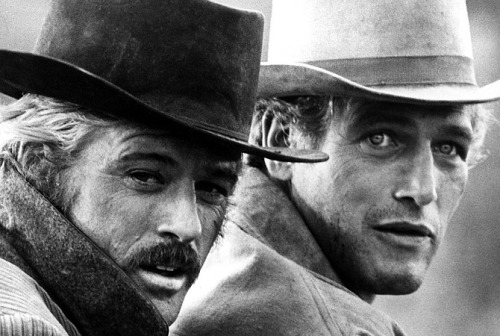
Robert Redford and Paul Newman in ‘Butch Cassidy and the Sundance Kid’, 1969.

“Who are those guys?”

Not a movie I have much affection for (I know, I'm crazy, but I saw The Sting first and liked it better), but ooh, those boys. Matt compared this picture to a double-barreled shotgun. I added "of sexy."

After last week's longhand stuff was typed, KUFC stood at 29,860. I told this to Matt on Friday and he said "Oh, come on! Write an exceptionally long SENTENCE!" But I didn't do any drafting this weekend; other things happened instead. 

One of those was plotting for this week's writing. Years ago I read about a potential reboot of Superman (this was before Brandon Routh) and the ideas the screenwriters were tossing around. One of the producers insisted that he wanted a big battle to take place at the Fortress of Solitude. A screenwriter argued that you couldn't do that; it's the Fortress of Solitude, which indicates by its very name that there's no one there. Can't really argue with that. Apparently the producer just wanted to use a cool set for a big battle. 

I found myself in a similar predicament. In my book there's a prison that's located in a Zeppelin floating above the city, and I very much wanted my main character (the nominal KUFC) to be in a big action scene there. I mean, what production designer could resist an awesome Parkour fight around and across a Zeppelin prison? The problem was that plotwise, I couldn't come up with a way for this to work. Logic noted that the fight would be purposeless, and would have plot-hole repercussions that I just couldn't write around. So, I told Matt, I guess she'll just sign in and interview the prisoner like a normal person, and I'll write a big fight scene next chapter at a less interesting location. 

Wait, sign in? he said. Your cool ninja assassin chick is going to sign in? Well, yeah, I said. She needs to interview a prisoner. She's a ninja assassin, he said. Have her break in to the prison! It shows just how much of a badass she is that she's breaking into a prison, and not just any prison but a Zeppelin prison. 

Oh. Right. 

This is what comes of being a head-to-toe lawful good person in real life and writing a character who's chaotic good/neutral. You forget from time to time that she doesn't feel the need to follow the rules. 

I'm over page 500 in 2666, and I can't recommend it so highly anymore. The longest section of the novel, where I am right now, is about a series of more than 200 murders of women that take place over the course of a few years, and the book details the finding of each and every corpse: what had been done to the woman and in what state she was found, and then whether the crime was solved or not (mostly not). Nearly all the women have been raped and all of their bodies are abandoned, found in parking lots and ravines and garbage dumps. Reading about this over and over and over and OVER is not at all a pleasant experience. There are other characters in this section, of course, and some of them have interesting stories, but centrally it's 300 pages about these women and their terrible deaths. It reminds me of a book on the Green River Killer that I read. Murder fatigue. Yet this book's different sections and characters hook together so subtly that I can't just skip it, in case I miss something that is important to the final section and/or to untangling the book on the whole. Which I very much want to do. 

This week I'll be editing the opera story. I've let it sit for two weeks, so I look forward to rediscovering what I put in it. Like a fruitcake you set aside for a year. Jeez, did I really use those radioactive green things? 

Thursday, December 13, 2012

The Thing That Wants to Live

I spent Tuesday in a state of paralysis. I had no idea how to begin chapter seven, whether with one scenario (dialogue over lunch) or another (inner reflection/backstory) or still another (just skip to the action happening the following night). I wasn't willing to try one of these and have it not work, so I didn't do anything, just watched the cursor blink. This was idiotic.

So on Wednesday I used the ol' notebook trick and wrote an entire chapter, which consisted of all three of the above scenarios, longhand. That way, work got done and I won't have to do the extra labor of typing what I wrote if I don't like it.

Longhand is really working out for me lately. That's no promise that it's going to continue working out, and it's certainly taking its toll on Ol' Righty, but I'm kind of astonished at how hugely it's helping me for now.

I also submitted a story to a writing competition in the name of a writer I have much affection for. This is actually the third time in recent months I've sent this story out in the hopes of it winning me something. I worry that this is somehow cheating, to try and win multiple things with the same story.

--

I feel like I'm in a continuous learning process with the internet - how to behave when within it, how much is too much or not enough, how to use it to my advantage, and frequent refresher lessons on how it can make me wish I was dead. At this time in its development I'll defend to my last breath that it's a greater good than it is an evil, but who knows what the next twenty years will bring?

I've sort of lost my taste for blogging for the time being, so that's all for today. The video below has far more beauty and insight than I ever will, anyhow. Join me next week, when I guarantee there will be at least one gripe about the holidays.

Tuesday, December 11, 2012

Jackie Wilson, Where Art Thou?

The holiday thing is happening. The thing where I just endure my day-to-day from sometime in December until early January. The stress in the air from all the humans in a ten-mile radius is painfully palpable, for me at least. I had to shop at the mall yesterday morning and I'm still recovering from all the negative energy. It was like that scene in Ghostbusters II where Ray and Winston start yelling at each other for no reason.

Pink slime = "holiday spirit" 
Partly for that reason, that I'm still grumpy and headachy (and I STILL didn't find the right goddamned dress), I haven't got much to share with you today. Maybe next week I'll have a glut of Topics to write about.

The opera on Saturday was Un Ballo in Maschera, by Verdi, and I think it may have been the best opera I've yet seen. Many of the reviews of the production said the opposite things about it that I thought - they said the staging was unoriginal and forced, when I thought it was innovative and revealing; they said the tenor lead was known for being a poor actor when I thought his acting was one of the best parts of the show; they said Kathleen Kim was physically awkward and mediocre when I thought she was perfect and adorable. I suppose I will never be an opera critic, but I think that means I'll enjoy it a lot more, so it's okay. The encore is on January 9th, and I'm pretty sure I'm going to go again. I suggest you all go too. It's an opera that shows how weird and interesting and stunningly emotional opera can be. If you can sit through it and you cry and boggle the way I did, you'll love opera for life.

I'm pushing through KUFC word by word. Yesterday I wrote a somewhat fragmented chapter and finished it off with a sex scene, which was fun. I love writing sex scenes. Also, I did some revisions on the urn story last night that I hope will improve it. I wish I had a better sense of how subtle is too subtle, but it's the thing I have learned I am most terrible at judging in my own writing.

That's shaping up to be a long list, actually, things I am terrible at judging in my own writing. Ah well.

Friday, December 7, 2012

Let Not the Swamp Consume You

I managed another 1,000 words on KUFC (for those of you just joining us, it stands for Kickass Urban Fantasy Chick) yesterday, in between work. I also wrote several pages of notes. I set down all the different plots in the book and explained their shape from beginning to end; although they all overlap each other and I consider them all part of the same thing, it helped to have them all drawn out. I'm now up over 20,000 words in the main text, which means I am officially past the beginning and into the middle.
The Great Swampy Middle (or GSM) knows no fear, no mercy, no regret. It doesn't come after you. It darned well knows that you're going to come to it. It knows that you're going to be charging along, sending up the spinning plates, ripping out the strong character introductions, planting cool bits into your story for the future, and generally feeling high on life. And just then, as you get all that fun opening-story stuff done, it pounces. And suddenly, you're staring at a blank word processor screen trying to figure out how to get your story through the next paragraph.

And it laughs at you. It laughs and dances on the ashes of your enthusiasm. It knows full well that you are going to be its bitch from now until you somehow finish the book or else give up in despair and slit your wrists with the edge of one of those index cards you're using to try to figure out the rest of the plot. It rejoices and dances around a primal bonfire, howling its glee at the uncaring stars.
Yes, Jim Butcher, thank you for the extremely accurate depiction of what lies ahead.

Back in 2006, Butcher offered terrific advice on his LiveJournal about how to avoid the GSM. I read it yesterday (thanks to Matt) and decided to take it to heart. I got the sense that the mini-arc was something he used in Storm Front, and I remember feeling like the structure of that book was a little wonky. (Also, after you read it: I always thought that the LoTR plot actually divided, with no set of character goals more important than the other. Hence, Frodo/Sam Ring Quest is equal in weight to Aragorn & Co. proceeding eventually to the Battle of the Hornburg. Although the retrieval of Merry and Pippin is supposedly a mini-arc, none of the rest of their quest would have happened if they hadn't gone that way and had to end up in Rohan, so I have a hard time seeing it as a mini-arc.) So I decided not to go with that. Instead I'm planning a Big Middle, which will be an emotional peak for my MC and possibly a hell of a scrap as well. Later on we'll have the big dramatic choice of the climax.

The GSM is what happened to me to a very great extent on the Greenland book and to a lesser extent on the time book.* In both of those, I knew what I wanted to happen in the end, but only very vaguely, and I didn't exactly know how to fill up the 50,000 words or so of the middle in order to get to the end and write through what would happen. Stephen King had reassured me that writing with an outline wasn't necessary for all writers, so I thought my instincts would lead me through to the end. SADLY, NO! I still think that outlining to the last detail isn't necessarily a hot idea for everybody, but having more than a vague idea of what will happen is, I suspect, better.

So that's what I'm doing. I know what's ahead, more than vaguely, even if I'm not sure how each chapter will be worked up. I hope this is a sufficient happy medium and not just me lazily coming to the realization that outlines are necessary for me.

Last night I saw Pulp Fiction in the theater, thanks to Fathom Events, and it was pretty cool. There were trailers shown before the movie "hand-picked by Tarantino from his private collection" - one for a 70's movie with John Cassevetes, Britt Ekland, and a very worked-up Peter Falk called Machine Gun McCain; one for Scarface; and one for a Hong Kong movie with a much younger Chow-Yun Fat (Chow-Young Fat?) called The Killer that I kind of want to see. Trailers were also shown for all of Tarantino's other movies, and my favorite of his (and one of my favorites of all movies) is Kill Bill, the first part of which I failed to see in the theater. So that was cool.

Pulp Fiction itself was a fun thing. That movie is new to me every time I see it, despite knowing chunks of it really well, and Matt and I talked afterward about how nothing else has really been made that resembles it, even 18 years later. (Except Tarantino's own movies.) Unfortunately we were sitting on the same aisle as a group of guys who enjoyed reciting lines along with (and sometimes prior to) the characters. Oh well. It was still worth going. There were a couple of younger folks sitting upwards of us who'd cosplayed as Vincent and Mia for the occasion. I could say an awful lot more about Tarantino here, but again, not the point of this blog.

Opera again tomorrow. December's punishing opera schedule will lead to a lighter January and ever more culture in my brain, so I'm soldiering on. Sallying forth. Pushing forward. Happy Friday.

*The time book = the [non-]horror book. I am tired of writing that punctuation over and over, so henceforth it is the time book.

Wednesday, December 5, 2012

"What's on your mind?"

Yesterday I wrote about 3,200 words on KUFC. Although I whinge and wheedle, I'm now sure it's the right thing to do to go on and write this book. After reading through what I'd done most recently (months ago, before this whole literary adventure), I felt a rekindling of interest in the idea and the main character, to my great relief. It's good stuff, and I'm pretty sure it's going to be a terrific book. I'm especially interested in the project because I came up with a terrible, wonderful choice for my MC at the final turning point of the book, tens of thousands of words away. The kind of choice where neither option is particularly good, i.e. a realistic choice. Great tension in that.

I feel like until now I'd been writing half-asleep, without really considering how things fit together in the world of a novel. I'm still not at the point where I can outline things very specifically more than about two chapters in advance - which may indeed be evidence that I'll have to rewrite this one, too - but I'm determined to let character propel the story, rather than just my ideas of what must come next.

I'm now about 300 pages into 2666, and I still have my opinion of BOY. Jeez oh Pete. This is a weird book and I have no idea how all this shit goes together and I can't wait to read the next hundred pages.

I'm also enjoying some new-to-me music lately. Although I'm only now listening to more than a song or two of hers, Regina Spektor feels like an artist I've been listening to for years, like a friend I've known since we were teenagers. She hardly feels new, just natural.


I found this fantastic band, the Leftover Cuties, who I think would resist "hipster" or "retro" and insist that what they're up to is 100% normal:


And I'm completely obsessed with this song (please ignore the source...):


Even better with headphones. And there's also Callas. Lots of Callas.

Finally, I'm trying to dislodge the hold Facebook has on me. I read a bunch of addiction narratives in a row, rather by chance, a couple of weeks ago. In thinking about what they had in common, and the general pattern to which addiction adheres, I discovered that the way I feel and behave about Facebook is, erm, pretty unhealthy. Of course Facebook isn't nearly as destructive as, for instance, heroin - that's a stupid idea - but it's still remade the pattern of my days in a way that is bringing me less peace. So the concentration and attention I give it is declining.

I thought I'd write a lot more about this, but it seems so lame, and I can't find the right words without skipping into other topics. And it doesn't matter much. I'm slowly backing away from Facebook, which is both challenging and pathetic, and the details aren't too interesting to anyone except myself.

Monday, November 5, 2012

Maybe There's an App for "Write It Anyway"

I'm starting to feel like I'm getting my groove on. The secret project is going okay, I came up with a good and sad idea in my dream last night to supplement a story I'd started tentative plotting on, and I'm on task for assembling a submission and pitch for the Monstrous project.

Also, last night I revised the ugly story. I'd been putting this off, because the revisions I knew I needed to do seemed like they would add several hundred words, and I wanted the thing to stay excessively lean and mean. I had to balance out the narrator to make him slightly less of a monster, and I had to do some explaining, which I hate doing in stories. No matter what, I always feel like I'm doing it wrong, whether at too much length or too much subtlety, or putting it in the wrong place, or using the wrong types of words, or whatever.

Amazingly, when I was done with my revisions, I'd only added 150 words. This morning I added another 100, which are also okay with me, and the thing is still plenty lean and really, really mean. I don't know if I'm actually finished with the story, but the revisions improved it a lot, which is nice.

I got three rejections in the last week. One of them indicates to me that a story needs to be retired; it's just been rejected too many times and I'm tired of screwing with it. (Yo writers: when do you decide to retire a story from trying to get it published? Is there some point, some rejection, some thing that tells you it's time?) Another one just needs me to research another market at which to try it, because I know it's worth publishing. Ugh. Don't wanna.

Speaking of don't wanna, the thing I have not done is reopened KUFC to write on it. I had hoped to do this during November - every day during November, actually - and there are a lot of piddly little reasons why I haven't. None of them are really any good, but my brain seems to have put its foot down on the matter. Hopefully there will be more on this as it develops. I really don't want a stalemate between me and this book.

I'm still pushing away at my poetry experiment (namely Kat Reads Poetry Without Giving Up In Frustration). I finished Louise Erdrich's Baptism of Desire yesterday, which sounds as if it's a cheesetastic kind of racy and naughty, but isn't, is instead majorly potent stuff. I loved it, for the most part. Then I read about half of Anne Carson's Autobiography of Red and, I'm awfully sorry, I don't like it much at all. There are incredible sentences here and there but in general it's not for me.

In other news, I've started listening to an Andrew Johnson iPhone app before I go to bed each night. He's a Scottish hypnotherapist who has a dozen or so different mini-programs in the iTunes store to download, each focusing on some issue - quitting smoking, gaining confidence, public speaking, etc. At first I was very uncomfortable with a hypnosis tape, because all I could think about was that passage in Brave New World - "Oh no, I don't want to play with Delta children" - but I listened to the program when wide awake prior to listening to it before going to sleep to make sure there aren't any "fly, my pretties"-type suggestions hidden in it. So far so good. The one I'm listening to every night right now is for procrastination, which has been a problem in ways both big and small for me over the last several months. It actually seems to be making a difference.

Speaking of which, I've got to get on with today. This blog isn't a tool for procrastination, but revising my posts into the ground is.

Wednesday, October 17, 2012

Whatever, I'm Not Reading Fathers and Sons Again

The other day the UPS man came to our door, and when I opened it he sighed in relief and said "Thank God you have a clean apartment." I said thank you, because I guessed that was a compliment, and he went on to say that some of these people's apartments...and he shook his head. I said with a nervous laugh that I didn't want to know, which was sort of true and sort of not; exactly how messy does an apartment have to be before you say "Thank God" about a clean one? That I'd like to know.

One of the things he was delivering was a string of solar lights. Our little balcony doesn't have any plugs, so it's solar or Jesus if I want illumination out there. I really paid too much for these lights, as the string only has six globes and they're not super-duper-bright, but they're pretty and they make me happy. I also bought a short string of regular AC lights shaped like metal dragonflies, for decoration if not illumination. The internet says that with a visit to Radio Shack I can probably convert them to solar or battery. Still thinking over whether I want to do that and risk fucking them up.

Not the best-framed picture ever, but you can see both strings of lights.

Based on the wise recommendation of a friend I'm reading One Flew Over the Cuckoo's Nest. I started it over the weekend and fully intended not to enjoy it, since I read it when I was a teenager and didn't like it at all. I thought it was opaque and weird and pointless. In the years since, I've learned a lot more about mental illness and have read a wider variety of books, and now I honestly can't put it down. I had no idea Kesey was such a prose stylist. I thought he was just famous for his topic. I feel humbled and stupid.

I hope this doesn't mean I have to give another chance to all the classics I tried and didn't like in those years. I suffered through Madame Bovary during that time and I really don't want to read it again.

On the same trip to the library for Cuckoo's Nest I picked up Dubliners. One of those books I tried as a younger person (I think in college) was A Portrait of the Artist as a Young Man, which I know a lot of writers swear by, but I couldn't get beyond the tenth page. I've been getting this feeling in my belly that I need to read Ulysses, the same kind of feeling I had before I read Infinite Jest, so I thought I'd try Dubliners first to see if the feeling dissipates on contact with actual Joyce. When I got home from the library I held up the book with a fake Colbert-ish openmouthed grin of enthusiasm on my face to Matt. He replied "Are you sure about that? You can always just take it back." Like it was an ugly blouse. Tee hee.

I really want to keep working on the KUFC book. I think it's going well and I'm going to miss my self-imposed deadline for a first draft if I don't get back to a regular schedule with it. But after reading some of that Writing Fiction book and after a couple of other buckets of cold water reminding me that I don't actually know squat about my chosen profession, I'm afraid to sit down to it again. I'm afraid I'll wind up writing another book that just needs to be rewritten from word one.

There are other excuses, too - work and home have needed a lot of attention lately, I'm in the middle of a major South Park overdose, an interesting trip is coming up in November, opera season is beginning. But mostly I'm just afraid. I don't want to turn out an inferior product, I don't know primarily what kind of writer I want to be, and for fuck's sake I don't want to have to rewrite one two THREE books after writing them the first time.

At least I have a clean apartment.

Sunday, September 23, 2012

The Dim Star

Before I get going - yesterday I blazed through Alison Bechdel's Are You My Mother? in about four hours. I know there are people who read this blog who have challenging mothers, and if you're one of them, get yourself to the library and put your paws on this book. I admit bias, because her Fun Home is in my top ten favorite books ever. But really. Read it. Epiphanies await you inside. (And don't listen to this sexist asshat.)

All right, so, today's subject. Remember how I said I went to the beach in part to see if I could make some biggish writing decisions? The one that was troubling me the most was which book to buckle down on: the [non-]horror novel or the KUFC book. For one or the other, I need to set a deadline and commit to it and get to work.

I could reproduce for you the dithering I was doing over these two projects, but I do not think it would make good reading. In short: the most significant attraction for the [non-]horror novel was an agent telling me it's an extremely saleable idea and she wants to see a rewrite if I do one, and the most significant attraction for the KUFC book was a heady and totally new blend of confidence and organization. The most sig. negative for the [non-]horror novel was having to write from scratch a book I'd already written and am a bit sick of, and the most sig. neg. for the KUFC book was fear (creeping terror, in truth) that I'd get to the end and be similarly fucked.

Trust me that there were many more things to consider and I've rifled them all.

Mid-last week I was so tired of worrying about it and wanted so much just to write that I opened up KUFC and started writing. I'd only gotten to about 9,000 words on it, which is really very little, before setting it aside. Last week I added 4,000. After my third day of work on it, I guessed that my decision was made.